StarCast ยท Astrophotography Gear Guide
LightCast

Best Lens for Astrophotography

Wide aperture matters more than focal length for Milky Way photography. Here's how to choose a lens โ€” and why the conditions you shoot in will determine image quality more than the glass.

Try LightCast Free โ€” iOS App Check tonight's sky free on web โ†’

iOS app: $2.99/mo ยท 7-day free trial ยท Cancel anytime

Photography forecast

What Makes a Lens Good for Astrophotography

The single most important lens spec for Milky Way photography is maximum aperture. f/1.8 or faster collects significantly more light than f/2.8 in the same exposure time, which means lower ISO, less noise, or shorter shutter speeds to avoid trailing. Everything else is secondary.

๐Ÿ”ญ
Aperture: f/2.8 Is the Practical Minimum
f/2.8 is workable. f/2 is noticeably better. f/1.8 or f/1.4 is excellent. Going from f/2.8 to f/1.8 is equivalent to gaining one full stop โ€” you can cut ISO by half or shutter speed by half while collecting the same light. For astrophotography, aperture is the most impactful lens spec.
๐Ÿ“
Focal Length: Wide Is Better
Wide lenses (14โ€“35mm on full frame) show more sky and allow longer shutter speeds before stars trail. 24mm is the sweet spot for most Milky Way photographers โ€” wide enough for context, tight enough for some detail. Ultra-wide (14โ€“20mm) for expansive sky, longer for more detail on specific regions.
โšก
Coma and Sharpness at Wide Aperture
Many fast lenses show coma โ€” a comet-like streak on stars near the corners when shot wide open. Stopping down one stop (e.g., f/2 instead of f/1.4) typically eliminates most coma while retaining most of the light advantage. Read optical reviews specifically for coma performance.
๐Ÿ’ฐ
Best Value Options
The Rokinon/Samyang 14mm f/2.8 and 24mm f/1.4 are the most popular budget-friendly astrophotography lenses. Manual focus only โ€” which is fine for astrophotography since you're always focusing manually anyway. The Sigma 14mm f/1.8 Art is the premium wide option.
LightCast
๐Ÿ””
StarCast Push Alerts
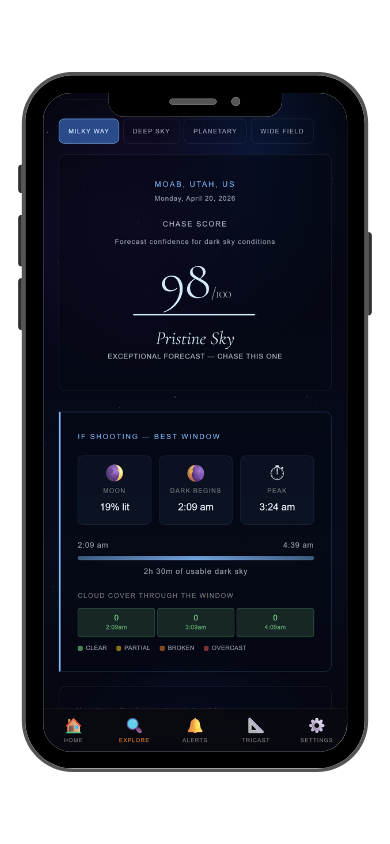
The best lens in the world won't save a shoot on a full moon night in poor transparency. StarCast monitors conditions and alerts you when a high-scoring night is forecast โ€” so your gear investment pays off when you go out. Exclusive to the iOS app.
Common Questions
What is the best lens for astrophotography?
Fast and wide: f/2.8 minimum, f/1.8 or faster preferred, 14โ€“35mm focal length. Popular choices: Rokinon 24mm f/1.4, Sigma 14mm f/1.8 Art, Nikon/Canon/Sony 20mm f/1.8. Check StarCast before the shoot โ€” conditions matter more than glass. Free on web.
Do I need an expensive lens for Milky Way photography?
No. The Rokinon/Samyang 24mm f/1.4 costs under $400 and produces excellent results. Location and moon phase matter more than lens price. A budget fast lens in Bortle 2 sky beats an expensive lens in Bortle 5.
What focal length is best for Milky Way photography?
14โ€“24mm on full frame for wide shots showing the full arc. 35โ€“50mm for tighter compositions isolating the galactic core region. Most photographers start at 24mm โ€” a good all-round focal length for Milky Way.
Does aperture really matter that much for astrophotography?
Yes โ€” more than any other lens spec. f/1.8 vs f/2.8 is a full stop โ€” half the ISO or half the shutter speed for the same exposure. At high ISOs where astrophotography operates, that stop is the difference between clean images and noisy ones.
What is LightCast StarCast?
StarCast scores night sky conditions using moon phase, Bortle class, transparency, and cloud cover. Push alerts notify you when a high-scoring night is forecast. Free on web at lightcastsuite.com/starcast, push notifications in the LightCast iOS app. $2.99/month after a 7-day free trial.
LightCast
Great lens. Check conditions before you use it.

Moon phase ยท Bortle class ยท Transparency ยท Cloud cover
Push alerts ยท Saved locations ยท 3-day outlook

Download LightCast for iOS
or
Check tonight's sky free on web โ†’

$2.99/mo after 7-day free trial ยท Cancel anytime in App Store