DroneCast ยท Location Guide
LightCast

Best Locations for Drone Photography

The best drone photography locations combine visual impact with legal airspace. Here's what terrain types produce the strongest aerial images โ€” and what to check before you fly anywhere new.

Check Conditions for Any Location โ€” iOS App Check today's conditions free on web โ†’

iOS app: $2.99/mo ยท 7-day free trial ยท Cancel anytime

Terrain types and why they work from the air

What Makes a Great Drone Photography Location

The strongest aerial images come from terrain that reveals patterns, scale, and structure invisible from the ground. The perspective shift of altitude changes what's interesting โ€” not every great ground-level location is a great drone location, and vice versa.

๐Ÿœ๏ธ
Desert and Canyon Country
The American Southwest is the strongest drone photography region in the US. Red rock formations, slot canyon shadows, salt flats, and layered geology produce extraordinary aerial compositions. Moab, Sedona, Monument Valley, the Palouse, and the Bonneville Salt Flats are established destinations. Check airspace: many canyon areas have temporary flight restrictions and national park boundaries where drones are prohibited.
๐ŸŒŠ
Coastline and Beaches
The transition between land and water is one of the most compelling aerial subjects โ€” wave patterns, sand texture, tide lines, and coastal geometry read dramatically from altitude. Wind is typically higher at the coast than inland, so check DroneCast specifically for coastal locations rather than relying on a regional forecast. Many beach areas have airspace restrictions near airports.
๐ŸŒพ
Agricultural Patterns
Crop circles, irrigation patterns, field geometry, and harvest textures are among the most visually striking aerial subjects โ€” and they're often overlooked because they're unremarkable from the ground. The Palouse in Washington state is the most famous US example but agricultural patterns exist everywhere. Autumn harvest and spring planting offer the most varied color and texture.
๐Ÿ”๏ธ
Mountain and Alpine Terrain
Altitude gain from a drone above already-high terrain produces dramatic perspective โ€” ridgelines, glaciers, and valley systems that are impossible to show from any ground position. Wind increases significantly at altitude in mountain areas and can be unpredictable near ridges. Always check DroneCast for mountain locations specifically; general regional forecasts understate the wind at altitude.
Always check before you fly anywhere new

Airspace, Permits, and Local Rules

Visual impact and legal airspace are both required. National parks, military zones, airport approach paths, and tribal lands all have restrictions that can make an otherwise perfect location a no-fly. Use the FAA B4UFLY app or AirMap to check airspace before every new location, regardless of how remote it appears. DroneCast handles weather; airspace is a separate check.

LightCast DroneCast
๐Ÿ“
App Exclusive
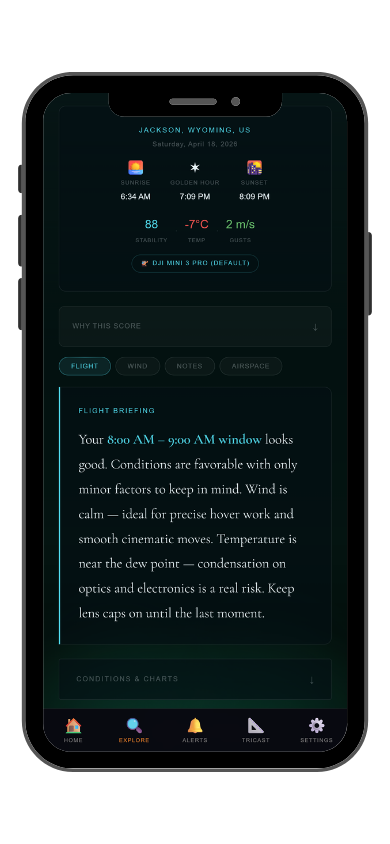
Save any location in DroneCast and check flight conditions before you travel. GoldCast push alerts notify you when golden hour looks strong at your saved locations โ€” so you can plan the travel around both flight conditions and light quality.
Common Questions
What are the best locations for drone photography in the US?
Southwest desert and canyon country (Moab, Sedona, Monument Valley), coastlines, agricultural pattern regions (the Palouse), and alpine terrain. Always verify airspace before flying anywhere new โ€” national parks and many iconic locations prohibit drones. Check DroneCast for flight conditions at any location โ€” free on web or in the iOS app.
Can you fly drones in national parks?
Generally no. The National Park Service prohibits drone use in most national parks without a special use permit. Some national monuments and BLM land adjacent to parks allow drones. Always check specific park rules โ€” they vary.
What terrain looks best from drone altitude?
Terrain that reveals pattern and scale invisible from the ground: canyon systems, agricultural geometry, coastline transitions, river meanders, and snow-covered mountain ridges. Flat featureless terrain rarely produces strong aerial images โ€” look for visual contrast and geometric pattern.
Is wind worse at mountain drone photography locations?
Yes. Wind increases with altitude and mountain terrain creates unpredictable turbulence near ridges. DroneCast for your specific location is more reliable than a regional forecast for mountain flying โ€” regional forecasts often understate elevation-driven wind.
What is LightCast DroneCast?
DroneCast scores flight conditions using wind, gusts, precipitation, visibility, and temperature for any saved location. Free on web at lightcastsuite.com/dronecast, with saved locations in the LightCast iOS app. $2.99/month after a 7-day free trial.
LightCast
Check conditions for your next location before you travel.

Flight score ยท Wind & gusts ยท Saved locations ยท GoldCast golden hour
All tools in one app

Download LightCast for iOS
or
Check conditions for any location free on web โ†’

$2.99/mo after 7-day free trial ยท Cancel anytime in App Store