StarCast Β· West Virginia Dark Sky Guide
LightCast

Best Milky Way Locations in West Virginia

West Virginia is the most forested state east of the Mississippi β€” which means dark sky in the valleys between ridges, and one of the most accessible concentrations of Bortle 2–3 sky in the eastern US.

Check Night Sky Conditions β€” iOS App Check any location free on web β†’

iOS app: $2.99/mo Β· 7-day free trial Β· Cancel anytime

Ranked by Bortle class and foreground quality

Best Milky Way Locations in West Virginia

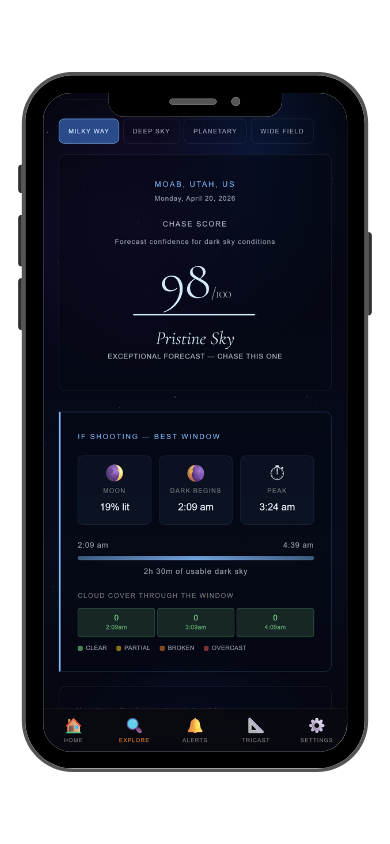
Each location below links to a live StarCast forecast β€” moon phase, cloud cover, atmospheric transparency, and Bortle class scored together for tonight. Click any location to check current conditions before you make the drive.

⭐
Watoga State Park Β· Bortle 2
West Virginia's largest state park and one of the darkest accessible locations in the eastern US. The Greenbrier River corridor and surrounding ridges are well away from any significant urban light source. Cherry Lane area is a favourite for astrophotographers making the dedicated trip. Check tonight's sky β†’
🌿
Seneca Rocks Β· Bortle 2–3
The dramatic quartzite fins rising from the North Fork Valley are one of West Virginia's most distinctive geological features and an extraordinary Milky Way foreground. The valley floor stays dark and the rock formations are backlit by stars rather than town light. Check tonight's sky β†’
πŸ”οΈ
Spruce Knob Β· Bortle 2
The highest point in West Virginia at 4,863 feet offers panoramic views above the tree line with dark sky in every direction. The summit spruce forest and open meadows provide foreground. Part of Spruce Knob–Seneca Rocks National Recreation Area β€” often combined in one trip. Check tonight's sky β†’
🌊
Blackwater Falls State Park Β· Bortle 2–3
The tannin-stained amber waterfall and canyon gorge are striking foreground subjects. The Canaan Valley area nearby is a designated National Wildlife Refuge β€” one of the few high-altitude plateaus in the Appalachians with open terrain and dark sky. Check tonight's sky β†’
πŸ¦…
New River Gorge National Park Β· Bortle 3
America's newest national park sits in one of the deepest river gorges east of the Mississippi. The bridge β€” one of the largest in the world β€” and canyon rim provide dramatic foreground. The gorge itself is dark; surrounding ridges have minimal development. Check tonight's sky β†’
πŸ•οΈ
Dolly Sods Wilderness Β· Bortle 2–3
The high plateau south of Canaan Valley is a rare Appalachian landscape of open heath balds, bogs, and wind-stunted spruce trees. The open terrain above the tree line provides unobstructed horizon β€” unusual for the heavily forested east. Check tonight's sky β†’
Before you go

Planning Tips for West Virginia

West Virginia's Milky Way season is April through October. High humidity and valley fog are the primary variables β€” post-frontal nights in late summer and fall bring the best transparency. The ridge-and-valley terrain channels fog into the hollows at night, so shooting from ridge positions gives better sky clarity than valley floors.

LightCast StarCast
πŸ””
StarCast Push Alerts
Save any location and set a score threshold once. StarCast monitors moon phase, cloud cover, and transparency nightly and sends a push alert when a high-scoring night is forecast. Exclusive to the iOS app.
Common Questions
What are the best Milky Way locations in West Virginia?
The top locations are listed above, ranked by Bortle class and foreground quality. Click any location to check tonight's StarCast score β€” moon phase, cloud cover, and transparency scored together. Free on web, push alerts in the iOS app.
What Bortle class do I need for Milky Way photography?
Bortle 3 or better for serious photography. Bortle 1–2 for the most dramatic results with full galactic structure and airglow visible. Most locations listed above are Bortle 2 or better.
When is Milky Way season in West Virginia?
West Virginia's Milky Way season is April through October. Target new moon windows β€” within 5 days of new moon for a full dark window. StarCast shows moon phase alongside cloud cover for any date.
How do I check conditions before driving to a dark sky location?
Search any location in StarCast to get a 0–100 night sky score combining moon phase, Bortle class, transparency, and cloud cover. Check 3–5 days out for planning, confirm 24–48 hours before when transparency and cloud timing are most accurate.
What is LightCast StarCast?
StarCast scores night sky conditions using moon phase, Bortle class, atmospheric transparency, and cloud cover for any location. Push alerts notify you when a high-scoring night is forecast. Free on web at lightcastsuite.com/starcast, push notifications in the LightCast iOS app. $2.99/month after a 7-day free trial.
LightCast
Check tonight's conditions before you make the drive.

Moon phase Β· Bortle class Β· Transparency Β· Cloud cover
Push alerts Β· Saved locations Β· 3-day outlook

Download LightCast for iOS
or
Check any location free on web β†’

$2.99/mo after 7-day free trial Β· Cancel anytime in App Store