StarCast · Milky Way Season Guide

LightCast

Best Time of Year to See the Milky Way

The Milky Way is visible year-round from dark sky locations — but the galactic core is only up at night from March through October. Here's exactly when and where to look depending on your location.

Try LightCast Free — iOS App Check tonight's conditions free on web →

iOS app: $2.99/mo · 7-day free trial · Cancel anytime
Photography forecast

Milky Way Season vs Year-Round Visibility

There's an important distinction: the Milky Way galaxy is always overhead, but the bright galactic core — the dense, vivid band most people think of — is only above the horizon at night during certain months. In the Northern Hemisphere, galactic core season runs roughly March through October, peaking in June and July.

🌑
March–April: Core Rising
The galactic core becomes visible above the southern horizon in the pre-dawn hours in March. By April it rises before midnight. These are the first months of Milky Way season — good for early risers willing to shoot before 3am.
May–June: Peak Season Begins
May brings the core above the horizon at reasonable hours after astronomical twilight ends. June is the first month with a full dark window for galactic core photography. New moon nights in June are the most sought dates of the year for Milky Way photographers.
🌌
July–August: Prime Window
The galactic core is highest in the southern sky and above the horizon the longest during full dark. The best combination of core altitude, dark hours, and accessible weather for most of the US. Target new moon windows — the core is bright enough to lose in a half moon.
🍂
September–October: Late Season
The core begins setting earlier each night. September still delivers excellent conditions. October is the last reliable month for most northern latitudes. Fall skies often have better transparency than summer — post-frontal air after autumn cold fronts produces exceptional clarity.
LightCast
🔔
StarCast Push Alerts
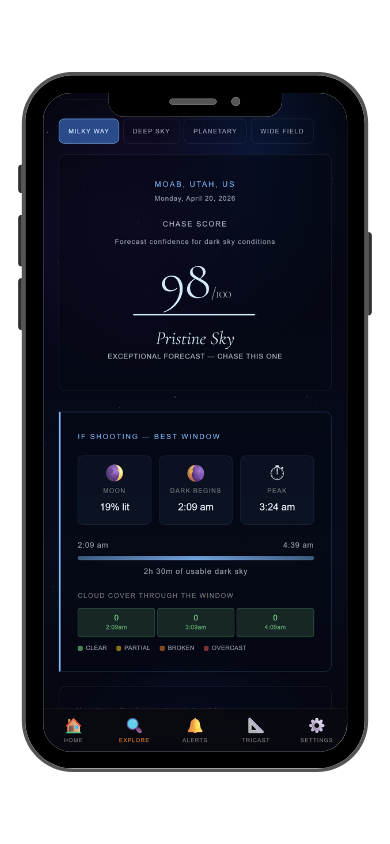
Set your location and score threshold once. StarCast monitors moon phase, cloud cover, and transparency nightly — sending a push alert when a high-scoring Milky Way window is forecast. Stop checking manually every night. Exclusive to the iOS app.
Common Questions
What is the best time of year to see the Milky Way?
May through October in the Northern Hemisphere, with June and July offering the galactic core highest and longest above the horizon. Target new moon windows within this range. StarCast scores conditions for any date — free on web, alerts in the iOS app.
What months is the Milky Way not visible?
November through February in most of the Northern Hemisphere — the galactic core is below the horizon during nighttime hours. The Milky Way band is still visible in winter but the bright, photogenic core is not above the horizon at night.
What time of night is the Milky Way visible?
Depends on the month. In June the core rises after astronomical twilight ends — around 10–11pm at mid-latitudes. In July it's up earlier. StarCast shows the dark window timing for your specific location each night.
Does the Milky Way look different in different seasons?
Yes. The bright galactic core is only visible May–October. In winter you see a different, less dense arm of the galaxy — still a band of stars but far less dramatic. Most Milky Way photography targets the core during its May–October window.
What is LightCast StarCast?
StarCast scores night sky conditions using moon phase, Bortle class, atmospheric transparency, and cloud cover. Push alerts notify you when a high-scoring night is forecast. Free on web at lightcastsuite.com/starcast, push notifications in the LightCast iOS app. $2.99/month after a 7-day free trial.
LightCast
Know when your next good Milky Way night is coming.

Moon phase · Bortle class · Transparency · Dark window
Push alerts · Saved locations · 3-day outlook

Download LightCast for iOS
or
Check tonight's conditions free on web →

$2.99/mo after 7-day free trial · Cancel anytime in App Store