StarCast · Milky Way Planning

LightCast

Best Time to Photograph the Milky Way

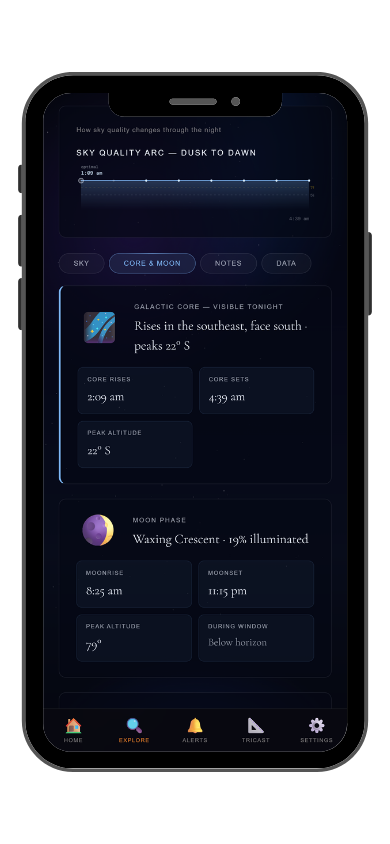
Three variables determine your window: time of year, time of night, and moon phase. LightCast StarCast calculates where they overlap for your location, tonight.

Check Tonight's Window — iOS App Learn More →

iOS app: $2.99/mo · 7-day free trial · Cancel anytime
Time of year

Milky Way Season in the Northern Hemisphere

The galactic core is only visible during part of the year. Outside the season window, it's below the horizon during usable hours regardless of how dark or clear the sky is. Getting the season right is the first filter.

🌱
March — May: Early Season
The core rises in the southeast after midnight. Good for late-night shoots if you're willing to stay out until 1–3am. Lower core altitude than summer but longer dark windows due to shorter nights not yet being compressed by high-latitude summer.
☀️
June — August: Peak Season
The core is highest in the southern sky, transiting around local midnight. Best overall elevation and detail in the galactic center region. Nights are shorter at mid-latitudes, so the window between astronomical twilight ending and moonrise on new moon nights is tighter — but the core quality is highest.
🍂
September — October: Late Season
The core is still visible in the southwest in the evening sky, setting earlier each night. Good for earlier shooting windows — the core is above the horizon during the first few hours after astronomical twilight rather than requiring a late night. Nights get longer, giving more total dark time.
Time of night

The Dark Window: Twilight End to Moonrise

Your usable shooting window each night is the overlap between three conditions: astronomical twilight has ended, the moon is below the horizon, and the galactic core is above the horizon at a useful altitude. All three have to be true simultaneously. Some nights that window is four hours. Some nights it's forty minutes. StarCast shows the exact window for your location.

New Moon
Full night window from twilight end to dawn. Best possible scenario — plan primary shoots around this.
Waxing Crescent
Moon sets 2–4 hours after sunset. Shoot after moonset for a partial dark window.
Waning Crescent
Moon rises 2–4 hours before dawn. Full dark window from twilight end until moonrise.
Quarter Moon
Marginal. Short window when moon is below horizon. Check exact moonrise/set for your date.
LightCast StarCast
🔔
StarCast Push Alerts
Get notified when a good window is coming up. StarCast scores tonight's conditions — core visibility, moon phase, cloud cover, and transparency — and alerts you when a high-scoring night is forecast at your saved location. Set it once and let the app track it.
Common Questions
What is the best time of year for Milky Way photography?
May through August, when the galactic core is highest in the southern sky. New moon nights within this window are the primary target. LightCast StarCast scores conditions for any location — free on the web or in the iOS app.
What time of night is best for Milky Way photography?
After astronomical twilight ends (roughly 90 minutes after sunset) and before moonrise on new moon nights. The core transits — reaches its highest point — around local midnight during peak season, which is often the best single hour to shoot.
Is spring or summer better for Milky Way photography?
Summer for core elevation and detail. Spring for earlier core visibility if late nights are a constraint. Both work; summer is the primary season for most photographers targeting the galactic center.
How do I find the best window for tonight specifically?
You need astronomical twilight end time, moon phase and rise/set times, and galactic core altitude — all for your exact location. StarCast calculates and combines all of these into a single dark window display, updated nightly.
What is LightCast StarCast?
StarCast scores night sky conditions and shows the dark window — astronomical twilight end, moon phase, moon position, and galactic core visibility — for any location. Push alerts notify you when a good window is forecast. Free on web at lightcastsuite.com/starcast, with push notifications in the LightCast iOS app. $2.99/month after a 7-day free trial.
LightCast
Find the window before you plan the drive.

Dark window timing · Moon phase & position · Core visibility
Push notifications · Saved locations · 3-day outlook

Download LightCast for iOS
or
Check tonight's conditions free on web →

$2.99/mo after 7-day free trial · Cancel anytime in App Store