StarCast · Dark Sky Finder
LightCast

Dark Sky Locations Near Me

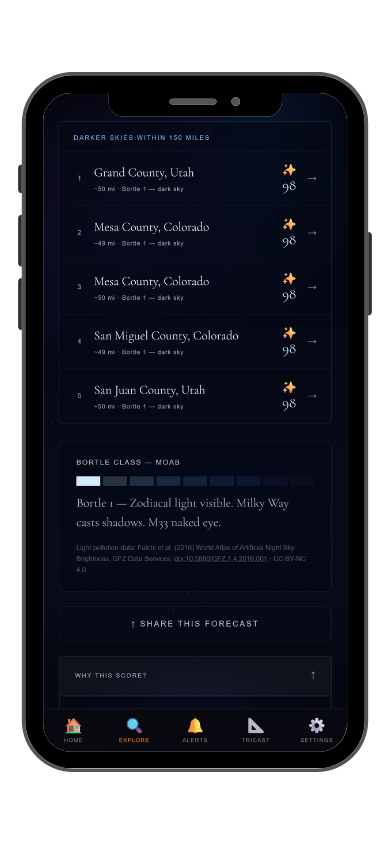
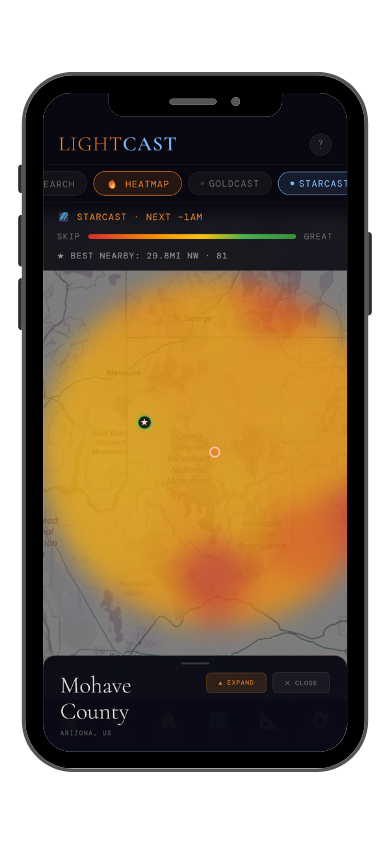
StarCast shows the Bortle class and live night sky score for any location you search. Find the nearest dark sky within driving distance — and know whether tonight is actually worth the trip before you leave.

Find Dark Sky Near Me Try on web →

iOS app: $2.99/mo · 7-day free trial

Finding dark sky by region

How Far Is a Dark Sky From Where You Are?

The answer depends heavily on where you live. The western US has exceptional dark sky within a short drive of most cities. The eastern US requires more effort — but reachable dark sky exists almost everywhere if you know where to look. StarCast lets you search any location and instantly see its Bortle class so you can scout progressively further from home until you find what you need.

🏔️
Western US — Dark Sky Within Reach of Most Cities
Denver, Salt Lake City, Albuquerque, Tucson, and Boise all have Bortle 2–3 sky within 1.5–2.5 hours. The high desert and national forest terrain of the West means dark sky is accessible on a weekend without extraordinary planning. Utah, Nevada, New Mexico, and eastern Oregon have some of the darkest accessible sky on Earth. See the top US dark sky parks →
🌲
Pacific Northwest — Cross the Cascades
Seattle and Portland are cloudy on the west side, but crossing the Cascades via US-2 or I-84 puts you in significantly drier, darker sky within 2–3 hours. Eastern Washington and eastern Oregon have strong Bortle 3–4 sky with occasional Bortle 2 in remote areas. The Palouse and Oregon Outback are standout destinations. Seattle dark sky guide →
🌾
Midwest — State and National Forest Land
The Great Plains have genuinely dark sky but require significant driving from Chicago and Minneapolis. The Ozarks, Upper Peninsula of Michigan, and the Boundary Waters area of Minnesota reach Bortle 3–4. Headlands Dark Sky Park on Lake Michigan is the only Bortle 2 designation in the Midwest. Most Midwest astrophotographers target new moon windows at state forest campgrounds 2–3 hours out.
🌑
Eastern US — Harder, But Not Impossible
The densely developed eastern seaboard makes dark sky harder to reach, but it exists. Cherry Springs State Park in Pennsylvania is a Bortle 2 designation — the darkest easily accessible sky east of the Mississippi. The Adirondacks, Green Mountains, and Shenandoah backcountry offer Bortle 3–4 sky. From NYC or Boston, plan on a 3–4 hour drive for serious dark sky. Best dark sky parks by region →
Location is only half the decision

The Right Location on the Wrong Night Is Still a Wasted Drive

Bortle class tells you what the sky is rated. It doesn't tell you whether tonight is good. Moon phase, cloud cover, and atmospheric transparency change every night — and they matter as much as the Bortle class itself. A new moon at Bortle 4 often beats a full moon at Bortle 2. StarCast combines all of these into a single 0–100 score. Check the score for your target location 3–5 days out for planning, and confirm 24–48 hours before when cloud timing is most accurate.

LightCast StarCast LightCast StarCast
🔔
StarCast Push Alerts
Save your nearest dark sky location and set a score threshold once. StarCast monitors conditions nightly and sends a push alert when moon phase, cloud cover, and transparency combine for a high-scoring night at your saved spot — so you go when conditions are right, not just when you happen to check. Exclusive to the iOS app.
Common Questions
How do I find dark sky locations near me?
Search any location in StarCast to see its Bortle class instantly. Start with national forests and state parks 1–3 hours from your home — they're often Bortle 3–4 and accessible without special permits. For the best-certified sites, see the top US dark sky parks guide.
Where can I see the Milky Way near me?
You need Bortle 4 or better for quality Milky Way photography, and Bortle 3 or better for the most dramatic results. The nearest Bortle 3–4 from most US cities is 1–3 hours of driving to rural or wilderness land. Bortle class plus tonight's moon phase is the combination that determines whether a location is worth the drive on any given night.
When is the best time to go stargazing near me?
New moon window (within 5 days of new moon) during Milky Way season — March through October in the northern hemisphere, with May–August being peak for the galactic core. Check StarCast for the specific night before you go — moon phase and transparency on that night matter more than the general season.
Are national parks good for stargazing?
Many are exceptional — most major western national parks are Bortle 1–3. But they prohibit drone flight (relevant if you're combining aerial and astrophotography). Adjacent BLM and national forest land often has equally dark sky with fewer restrictions. StarCast works for any coordinate — inside or outside park boundaries.
What is LightCast StarCast?
StarCast scores night sky conditions from 0 to 100 using Bortle class, moon phase, moon position, cloud cover, and atmospheric transparency for any location. Push alerts notify you when a high-scoring night is forecast at saved dark sky locations. Free on web at lightcastsuite.com/starcast, with push notifications in the LightCast iOS app. $2.99/month after a 7-day free trial.
LightCast
Find your nearest dark sky and check tonight's score.

Bortle class · Moon phase · Cloud cover · Transparency
Push alerts · Saved locations · 0–100 night sky score

Download LightCast for iOS
or
Learn More →

$2.99/mo after 7-day free trial