StarCast Β· Night Sky Planning
LightCast

How Does Light Pollution Affect Astrophotography?

Light pollution is the one obstacle no forecast can fix. LightCast StarCast factors Bortle class directly into your night sky score so location quality is never hidden from the rating.

Check Your Location's Bortle Class β€” iOS App Check Free on Web β†’

iOS app: $2.99/mo Β· 7-day free trial Β· Cancel anytime

What it actually does to your images

Light Pollution Raises Your Sky Background

In a long exposure, every photon hitting your sensor accumulates: signal from stars, signal from the Milky Way, and signal from scattered artificial light bouncing off the atmosphere. Near a city, the artificial sky glow accumulates faster than the faint galactic signal, washing out contrast before you've gathered enough exposure to reveal the detail you came for. The Milky Way doesn't disappear β€” it gets buried under a glowing orange or grey background.

πŸ“‰
Reduced Contrast on Faint Detail
The outer arms of the Milky Way, nebulae, and dark dust lanes all depend on contrast against a dark background. At Bortle 5 and above, these features are the first to disappear β€” they're simply too faint relative to the elevated sky background. Only the bright core remains visible, and even that loses color and dynamic range.
🟠
Sky Color Contamination
Sodium vapor and LED streetlights scatter orange, yellow, and white light into the atmosphere. In long exposures this tints the entire sky background. Even significant post-processing can't fully remove this tint without affecting star color and Milky Way color simultaneously.
⏱️
Shorter Usable Exposure Times
At Bortle 3, you might stack 60-second exposures for an hour before sky glow becomes limiting. At Bortle 6, the sky may clip to near-maximum brightness in 15 to 20 seconds, limiting total signal collection and requiring more aggressive noise reduction that further degrades faint detail.
πŸ—ΊοΈ
It's Permanent β€” Weather Can't Fix It
Cloud cover changes nightly. Moon phase cycles monthly. Bortle class is a permanent characteristic of a location set by the surrounding infrastructure. A perfectly clear new moon night at Bortle 7 still produces worse Milky Way results than an average night at Bortle 3.
LightCast StarCast
Why Bortle is in the score

StarCast Factors Location Quality Into Every Rating

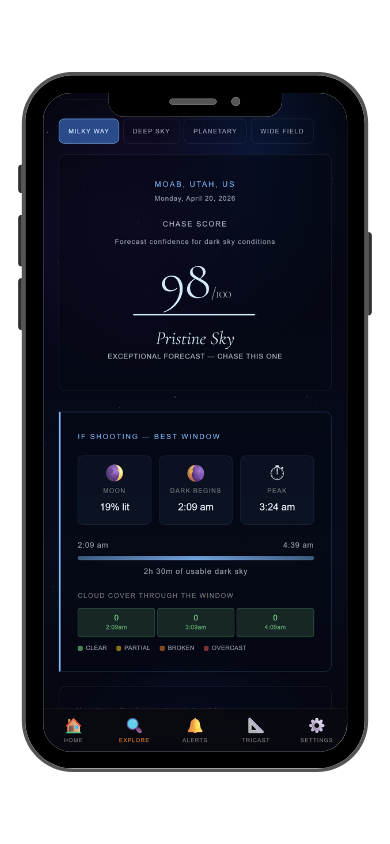
Some night sky apps score only the weather conditions and ignore the Bortle class of the location. A cloudless new moon night at Bortle 8 is not a good night for Milky Way photography, regardless of how good the weather is. StarCast combines Bortle class with cloud cover, moon illumination, atmospheric transparency, and seeing into a single score, so a location's permanent light pollution characteristics are always reflected in the rating you see.

πŸ””
StarCast Push Alerts
Save your dark sky locations and StarCast alerts you when a high-scoring night is forecast there β€” combining good weather with the location's Bortle class in a single score. Never miss a good night at a dark sky site again.
Common Questions
How does light pollution affect astrophotography?
It raises the background sky brightness in your exposures, reducing contrast on faint objects and limiting usable exposure time. At Bortle 5 and above, faint galactic structure is largely lost regardless of how good the weather is. StarCast shows Bortle class for any location β€” available in the LightCast iOS app and at lightcastsuite.com/starcast.
What Bortle class do I need for Milky Way photography?
Bortle 4 or lower for usable results. Bortle 3 and below for full galactic structure, dust lanes, and color detail. Most national parks and wilderness areas in the western US fall in the Bortle 1 to 3 range.
Can post-processing fix light pollution?
Partially. Background gradient removal and color calibration can reduce sky glow tinting. But detail that wasn't captured because sky glow limited exposure time can't be recovered. Shooting from a darker location is always more effective than trying to compensate in post.
How far do I need to drive to escape light pollution?
From a major metro, typically 60 to 100 miles for Bortle 4. Bortle 3 and below usually requires 100 to 200 miles in the eastern US. The western US has much larger dark sky zones accessible within shorter drives from smaller cities. StarCast shows Bortle class at any destination before you commit to the drive.
What is LightCast StarCast?
StarCast scores night sky conditions from 0 to 100 using Bortle class, cloud cover, moon illumination, atmospheric transparency, and seeing for any location. Push alerts notify you when conditions are worth the drive. Free at lightcastsuite.com/starcast, with push notifications in the LightCast iOS app. $2.99/month after a 7-day free trial.
LightCast
Know your Bortle class before you make the drive.

Bortle class Β· Cloud cover Β· Moon illumination Β· Transparency
Saved dark sky locations Β· Push notifications Β· 0–100 score

Download LightCast for iOS
or
Check your location's Bortle class free on web β†’

$2.99/mo after 7-day free trial Β· Cancel anytime in App Store