StarCast · Planning Guide

LightCast

How Far Ahead Can You Predict Astrophotography Conditions?

Moon phase: years. Cloud cover: 3–5 days. Transparency: 24–48 hours. Here's how to layer each into a planning workflow that actually works.

Check Tonight's Conditions — iOS App Check tonight's conditions free on web →

iOS app: $2.99/mo · 7-day free trial · Cancel anytime
Three planning horizons

What You Can Know and When

Astrophotography planning works in layers. Some variables are fixed months in advance. Others only resolve in the final 24 hours. Treating them all as equally uncertain is the most common planning mistake.

📅
Months Out: Moon Phase and Core Timing
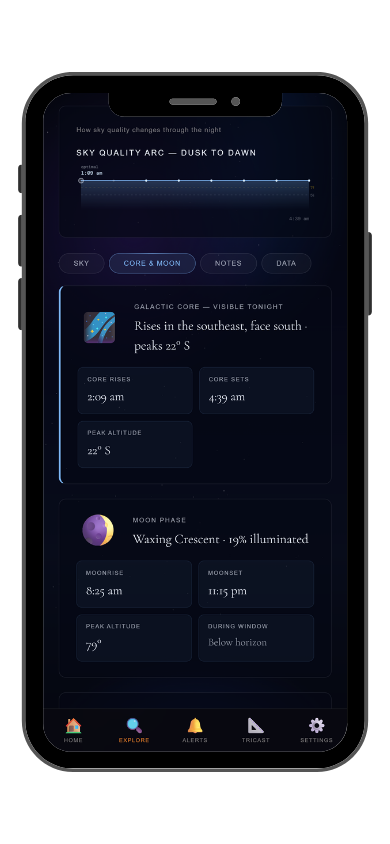
Moon phase is a fixed astronomical calculation — new moon dates are known years in advance. Galactic core rise and set times are equally predictable. Use these to lock in your target dates months ahead before checking anything weather-related. Pick new moon windows in May–August that align with your schedule and travel availability.
🗓️
3–5 Days Out: Cloud Cover Trends
Numerical weather models become reasonably reliable at the 3 to 5 day horizon. You can identify whether a high pressure system is building (good) or a frontal system is approaching (bad). This is the window to make travel decisions for nearby locations and to start monitoring the specific forecast in StarCast.
24–48 Hours: Transparency and Final Go/No-Go
Atmospheric transparency, humidity, and the fine detail of cloud timing resolve in the final 24 to 48 hours. This is when to make your go/no-go decision for a local shoot. StarCast's score becomes most accurate in this window — check the night before and again in the afternoon on the day of.
The practical workflow

How to Actually Plan a Milky Way Shoot

The most reliable approach combines fixed astronomical data with progressive weather confirmation. Don't wait until the week of to start planning — by then your best new moon dates may conflict with unavoidable commitments.

2–3 months out
Identify new moon dates in Milky Way season. Check galactic core rise times for your location. Book travel and accommodation.
1–2 weeks out
Watch broad weather patterns. Look for high pressure systems building over your window. Don't make go/no-go decisions yet.
3–5 days out
StarCast forecast becomes actionable. Check cloud cover trend. Decide on nearby backup locations if primary looks questionable.
24–48 hours out
Final go/no-go on transparency and cloud detail. Check StarCast score morning of. Arrive early enough to scout in daylight.
LightCast StarCast
🔔
StarCast Push Alerts
Set your target location and score threshold once. StarCast monitors conditions daily and sends a push alert when a high-scoring window is forecast — so your phone handles the nightly monitoring while you plan the rest of the trip.
Common Questions
How far in advance can you predict astrophotography conditions?
Moon phase: years. Cloud cover: reliably 3–5 days. Transparency: 24–48 hours. Plan in layers — use moon phase months out, confirm cloud cover 3–5 days ahead, make the final call on transparency 24–48 hours before using StarCast.
Are 7-day weather forecasts reliable for astrophotography planning?
For broad patterns, yes — you can identify whether a high or low pressure system is expected. For precise cloud timing and transparency, reliability drops significantly beyond 4–5 days. Treat 7-day forecasts as directional, not actionable.
When should I check conditions before a Milky Way shoot?
Check 3–5 days out for the trend, then again the day before and afternoon of. StarCast's score becomes most accurate in the 24–48 hour window when transparency and cloud fine detail resolve in the weather models.
Can I predict transparency in advance?
Roughly. High pressure systems tend to bring better transparency. Frontal passages improve it sharply. Wildfire smoke is the hardest to predict — it can appear at altitude within hours from distant fires. Check transparency in StarCast the day of for the most accurate read.
What is LightCast StarCast?
StarCast scores night sky conditions using moon phase, Bortle class, cloud cover, and transparency for any location. Push alerts notify you when conditions meet your threshold. Free on web at lightcastsuite.com/starcast, with push notifications in the LightCast iOS app. $2.99/month after a 7-day free trial.
LightCast
Plan smart. Confirm late. Shoot well.

3-day forecast · Moon phase · Transparency · Dark window
Push notifications · Saved locations · 0–100 night sky score

Download LightCast for iOS
or
Check tonight's conditions free on web →

$2.99/mo after 7-day free trial · Cancel anytime in App Store