StarCast ยท Milky Way Moon Phase Guide
LightCast

How Much Moonlight Is Too Much for Milky Way Photography?

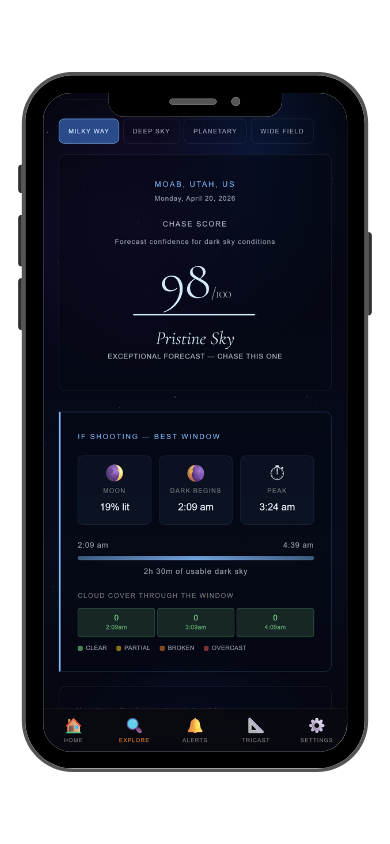
At 30โ€“40% moon illumination, the Milky Way core starts to fade. Above 50%, wide-field deep-sky work is effectively over for the night. LightCast StarCast shows exact moon illumination, rise time, and set time for every location you save.

Download LightCast โ€” iOS Check moon phase free โ†’

iOS app: $2.99/mo ยท 7-day free trial ยท Cancel anytime

Moon illumination thresholds for Milky Way photography

The Moon Illumination Thresholds That Actually Matter

Moonlight is the single most predictable enemy of Milky Way photography โ€” and the most commonly overlooked by beginners. Unlike clouds or atmospheric haze, moon phase is completely foreseeable days in advance. Knowing where you stand in the lunar cycle, combined with the moon's exact rise and set time, tells you whether you have a usable dark window tonight. LightCast StarCast shows all of this for any location you save.

๐ŸŒ‘
0โ€“20% Illumination: The Sweet Spot
New moon and the days immediately surrounding it are the prime window for Milky Way photography. The sky reaches its darkest natural state, faint dust lanes within the core become visible, and dynamic range in your exposures is maximized. Within 5 days of new moon at Bortle 4 or darker, a clear night with good transparency is about as good as it gets. StarCast shows you exactly which nights in the month fall into this window.
๐ŸŒ’
20โ€“40% Illumination: Workable if the Moon Sets Early
A crescent moon at 20โ€“40% illumination doesn't ruin the night outright โ€” but it depends entirely on timing. If the moon sets before astronomical twilight ends, or sets in the first hour or two after dark, you may still get a usable dark window later in the night. StarCast shows moon set time alongside illumination so you can calculate your real window, not just react to the phase percentage.
๐ŸŒ“
40โ€“60% Illumination: Marginal and Location-Dependent
At this range, the sky background in your images brightens noticeably. From a dark-sky site at Bortle 3 or below, a 40% moon may still produce a shootable core โ€” but contrast and dynamic range both suffer. At Bortle 5 or above, a 40โ€“60% moon on top of existing light pollution effectively eliminates wide-field Milky Way work. Your Bortle class determines whether you have any margin at all.
๐ŸŒ•
Above 60%: The Core Is Gone
A gibbous or full moon raises sky background brightness to the point where the Milky Way core is washed out in all but the darkest and most transparent skies. Even in Bortle 2 conditions, a moon above 70% illumination produces images with little visible core structure. These nights are best used for moon photography, lunar landscape work, or planning the next new moon window. StarCast's 3-day outlook helps you spot that upcoming window in advance.
LightCast StarCast
๐Ÿ””
LightCast Alerts You When Moon Phase and Clear Skies Align
When moon illumination drops into your target range and cloud cover clears at your saved locations, LightCast StarCast pushes an alert before dark. You set the threshold. Your phone handles the monitoring. Never miss a new moon window again. Exclusive to the iOS app.
Common Questions
How much moon is too much for Milky Way photography?
Above 40โ€“50% illumination, the Milky Way core begins to wash out significantly. At 60%+, wide-field deep-sky imaging is largely compromised. The practical target is under 30% illumination, or any phase where the moon sets within 2 hours of dark. LightCast StarCast shows illumination and set time together. Free on web, push alerts on iOS.
Can I photograph the Milky Way with a half moon?
Rarely. A 50% moon is bright enough to raise the sky background significantly and bury faint Milky Way structure in noise. From a very dark site (Bortle 2โ€“3) with excellent transparency, the core may still be faintly visible โ€” but contrast and detail will be noticeably reduced. If the moon sets before midnight, shoot after moonset. StarCast shows exact set times so you can find the window.
Does moonrise vs. moonset matter for planning?
Significantly. A moon that rises at 2 AM gives you hours of dark sky before it arrives. A moon that rises at 9 PM eliminates most of your usable night. Moon set time matters equally โ€” a high-illumination moon that sets by 10 PM still leaves you a full dark window. StarCast shows both rise and set times for every location and night.
What is the best moon phase for Milky Way photography?
New moon, or within 4โ€“5 days on either side. This minimizes sky background brightness and maximizes the visibility of faint core structure and dust lanes. Combine new moon with post-frontal clear air and a dark-sky location and you have ideal conditions. StarCast's 3-day outlook helps you spot these windows before they arrive.
What is LightCast StarCast?
StarCast scores night sky conditions using moon phase, Bortle class, atmospheric transparency, and cloud cover into a single 0โ€“100 score. Free on web at lightcastsuite.com/starcast, push notifications in the LightCast iOS app. $2.99/month after a 7-day free trial.
LightCast
LightCast shows moon illumination, rise, and set โ€” so you know your dark window before you pack the car.

Moon phase ยท Bortle class ยท Transparency ยท Cloud cover
Push alerts ยท Saved locations ยท 3-day outlook

Download LightCast for iOS
or
Check moon phase free on web โ†’

$2.99/mo after 7-day free trial ยท Cancel anytime in App Store