StarCast ยท Astrophotography Technique
LightCast

How to Focus at Night for Astrophotography

Night focus is one of the most common failure points in astrophotography โ€” autofocus doesn't work on stars, and infinity on most lenses isn't where you think it is. Here's the reliable method.

Try LightCast Free โ€” iOS App Check tonight's conditions free on web โ†’

iOS app: $2.99/mo ยท 7-day free trial ยท Cancel anytime

Photography forecast

Why Night Focus Fails and How to Fix It

The two most common night focus mistakes: using autofocus (which hunts on dark sky and locks on nothing) and turning the focus ring to the infinity marking (which overshoots on most modern lenses). The reliable method uses live view magnification on a bright star.

๐Ÿ”ญ
Live View 10x on a Bright Star
Switch to live view, zoom to 10x magnification on the brightest star visible. Slowly turn the focus ring until the star is the smallest possible point โ€” not the brightest, the smallest. These are different and the smallest point is the sharpest focus. This works regardless of lens, camera, or conditions.
๐ŸŒŸ
Use Bright Stars or Planets
Planets (Venus, Jupiter, Mars) and bright stars (Sirius, Vega, Arcturus) are easier to focus on than faint stars. Focus on the brightest target available then move your composition without touching the focus ring. Planets are ideal because they're extremely bright.
๐Ÿ“
Infinity Is Not the End of the Ring
Most modern lenses focus past infinity โ€” a design choice that allows autofocus to hunt. Turning the ring to the infinity symbol or the hard stop often overshoots. Use the live view method rather than relying on the infinity marking, then mark the correct position with a small piece of tape.
๐Ÿ”’
Lock It With Tape
Once focus is confirmed, put a small piece of gaffer tape over the focus ring to prevent accidental movement. Bumping the focus ring is a common way to lose a sharp focus mid-session โ€” tape is cheap insurance. Check focus again if you bump the camera or move to a different composition.
LightCast
๐Ÿ””
StarCast Push Alerts
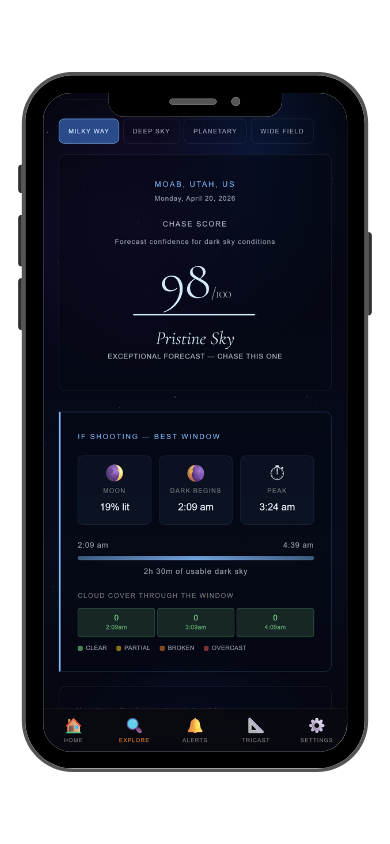
Perfect focus technique won't help on a poor conditions night. StarCast monitors transparency, moon phase, and cloud cover โ€” the variables that determine whether your sharp stars will actually be bright and contrasty. Push alert when a high-scoring night is forecast. Exclusive to the iOS app.
Common Questions
How do you focus at night for astrophotography?
Switch to live view, zoom to 10x magnification on the brightest star, and adjust focus until the star is the smallest possible point. Lock with gaffer tape. Check conditions first with StarCast โ€” free on web, alerts in the iOS app.
Why is autofocus not working at night?
Autofocus needs contrast to lock โ€” dark sky provides almost none. The camera hunts and either fails to lock or locks on noise rather than actual stars. Always use manual focus for astrophotography.
Where is infinity focus on a camera lens?
Not necessarily at the infinity marking or the hard stop. Most modern lenses focus past infinity. Use live view 10x magnification on a bright star to find the actual sharpest point, then mark it.
How do I know if my astrophotography is in focus?
Check a test shot at 100% zoom on the camera screen or in editing software. Stars should be tight points with no halo or elongation. Soft halos indicate focus is slightly off. Streaks indicate trailing from too-long shutter speed.
What is LightCast StarCast?
StarCast scores night sky conditions using moon phase, Bortle class, transparency, and cloud cover. Push alerts notify you when a high-scoring night is forecast. Free on web at lightcastsuite.com/starcast, push notifications in the LightCast iOS app. $2.99/month after a 7-day free trial.
LightCast
Nail the conditions. Nail the focus. Get the shot.

Moon phase ยท Bortle class ยท Transparency ยท Cloud cover
Push alerts ยท Saved locations ยท 3-day outlook

Download LightCast for iOS
or
Check tonight's conditions free on web โ†’

$2.99/mo after 7-day free trial ยท Cancel anytime in App Store