StarCast ยท Star Photography Guide
LightCast

How to Photograph Stars

Star photography ranges from simple wide-field shots to deep-sky imaging. Here's the framework for getting clean, sharp stars โ€” and the conditions that make or break the result.

Try LightCast Free โ€” iOS App Check tonight's sky free on web โ†’

iOS app: $2.99/mo ยท 7-day free trial ยท Cancel anytime

Photography forecast

The Variables That Determine Star Photo Quality

Star photography looks technically demanding but the fundamentals are straightforward. The bigger challenge is conditions โ€” moon phase, transparency, and light pollution determine your ceiling regardless of how well you execute the camera technique.

๐ŸŽฏ
Focus: The Most Common Failure Point
Autofocus doesn't work on stars. Manual focus to infinity โ€” but 'infinity' on most lenses is not the end of the focus ring. Use live view at 10x magnification on a bright star and adjust until the star is the smallest possible point. Lock focus with tape before shooting.
โฑ๏ธ
Shutter Speed: Avoid Star Trails
Stars move across the frame during long exposures โ€” above a certain shutter speed they leave trails rather than points. Use the 500 Rule as a starting point: 500 รท focal length = max seconds. At 24mm that's about 20 seconds. The NPF Rule gives more precise results for high-resolution sensors.
๐Ÿ’ก
ISO and Noise Trade-Off
Higher ISO reveals more stars but introduces noise. ISO 1600โ€“6400 is the typical range for star photography. Modern cameras handle ISO 3200 cleanly enough for strong results. Shoot RAW โ€” noise reduction in post is significantly more effective than in-camera JPEG processing.
โœจ
Transparency: The Invisible Variable
A clear sky with poor transparency โ€” from humidity, smoke, or aerosols โ€” produces soft, dim stars even with perfect technique. Post-frontal clear air after a cold front consistently delivers the best transparency. StarCast factors transparency into every night sky score.
LightCast
๐Ÿ””
StarCast Push Alerts
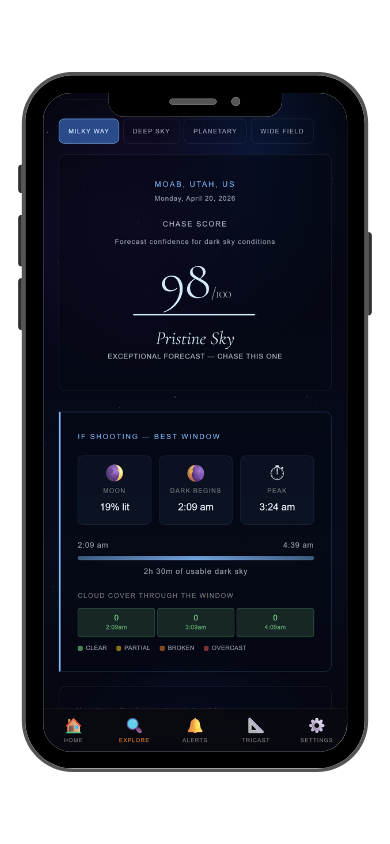
StarCast monitors transparency, moon phase, and cloud cover nightly โ€” the three conditions variables that most affect star photo quality. Push alert when a high-scoring night is forecast at your location. Exclusive to the iOS app.
Common Questions
How do you photograph stars?
Manual focus to infinity using live view magnification, f/1.8โ€“f/2.8, ISO 1600โ€“3200, shutter speed from the 500 Rule. Check StarCast for moon phase and transparency first โ€” conditions matter more than settings. Free on web, alerts in the iOS app.
Why are my stars blurry?
Usually focus or shutter speed. Focus manually using live view 10x on a bright star. If stars show trailing rather than blur, shutter speed is too long โ€” apply the 500 Rule. Atmospheric turbulence (poor 'seeing') also causes blur that no technique fixes.
What is the 500 Rule for stars?
Divide 500 by your lens focal length in mm to get the maximum shutter speed before stars show trailing. 500 รท 24mm = ~20 seconds. Use the NPF Rule for more precision on high-megapixel sensors where trailing becomes visible at shorter exposures.
What ISO should I use for star photography?
ISO 1600โ€“3200 as a starting point. Modern full-frame cameras handle ISO 6400 cleanly. Shoot RAW and evaluate on a calibrated screen โ€” camera preview screens look brighter in dark conditions than the actual file.
What is LightCast StarCast?
StarCast scores night sky conditions using moon phase, Bortle class, transparency, and cloud cover. Push alerts notify you when a high-scoring night is forecast. Free on web at lightcastsuite.com/starcast, push notifications in the LightCast iOS app. $2.99/month after a 7-day free trial.
LightCast
Check conditions before the shoot.

Moon phase ยท Bortle class ยท Transparency ยท Cloud cover
Push alerts ยท Saved locations ยท 3-day outlook

Download LightCast for iOS
or
Check tonight's sky free on web โ†’

$2.99/mo after 7-day free trial ยท Cancel anytime in App Store