StarCast · Trip Planning Guide

LightCast

How to Plan a Milky Way Photography Trip

Moon phase first. Location second. Weather last. Most photographers get the order wrong — and end up at the right place on the wrong night. Here's the framework that works.

Check Conditions for Any Location — iOS App Check night sky conditions free on web →

iOS app: $2.99/mo · 7-day free trial · Cancel anytime
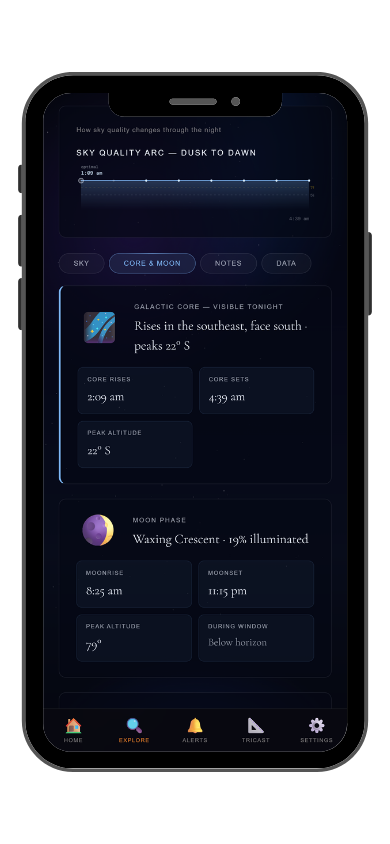
Step one: moon phase

Start With What You Can't Change

Moon phase is fixed. You can choose where to go and when to travel, but you can't move the new moon. Building a trip around the wrong moon phase is the single most common Milky Way planning mistake. Identify your target dates first — everything else is negotiable.

🌑
New Moon: The Primary Window
Shoot within 5 days of new moon for a full night of dark sky. Plan 2–3 nights minimum — one night gives no weather buffer. New moon dates in May through August are the primary planning target for Northern Hemisphere Milky Way photography.
🌒
Crescent Moon: Secondary Window
Waxing crescent sets a few hours after sunset; waning crescent rises a few hours before dawn. Both leave a partial dark window. Useful as a backup if new moon dates are unavailable, but the window is shorter and requires timing around moonrise/set.
🌕
Full Moon: Not for Milky Way
Full moon illuminates the sky enough to make the galactic core essentially invisible. Don't plan a Milky Way trip around full moon dates. Full moon is excellent for moonlit landscape photography — a different genre with different goals.
Step two: location

Dark Skies and Strong Foreground

A great Milky Way location needs two things: dark enough skies to show the galaxy, and foreground compelling enough to justify the composition. Bortle 3 or better for serious photography. For location ideas with live sky scores, see the best US Milky Way locations guide.

Bortle 1–2
Best possible. Full galactic structure, airglow, zodiacal light. Remote national parks and monuments.
Bortle 3
Excellent. Most serious astrophotography is done here. Rural locations 1–2 hours from mid-size cities.
Bortle 4
Good. Core is visible and photographable. Light domes visible on horizon but manageable.
Bortle 5+
Marginal to poor. Core is faint. Only viable on exceptional transparency nights close to new moon.
Step three: weather confirmation

Confirm Conditions as the Date Approaches

Weather forecasts become reliable for astrophotography planning at the 3–5 day horizon. Earlier than that, treat forecasts as directional — useful for watching patterns, not for making go/no-go decisions. StarCast gives you a single score combining cloud cover, transparency, and moon conditions for your specific location, updated daily.

LightCast StarCast
🔔
StarCast Push Alerts
Save your target location and set a score threshold. StarCast monitors conditions daily and sends a push alert when a high-scoring night is forecast — so you're not checking manually every evening in the lead-up to your trip.
Common Questions
How do you plan a Milky Way photography trip?
Moon phase first: find new moon dates in May–August. Location second: Bortle 3 or better with strong foreground. Weather last: confirm cloud cover 3–5 days out, transparency 24–48 hours out with LightCast StarCast — free on the web or in the iOS app.
How many nights should I plan for?
Minimum two to three nights around new moon. One night gives no weather buffer. Four to five nights is ideal for dedicated trips — you'll almost certainly get at least two good shooting windows in that span.
What Bortle class do I need?
Bortle 3 or better for serious photography. Bortle 1–2 for the most dramatic results with full galactic structure and airglow. Most designated Dark Sky Parks in the US are Bortle 2.
When is the best time of year for a Milky Way trip?
May through August in the Northern Hemisphere, with the galactic core highest in June and July. Southwest US locations should avoid late July and August if possible due to monsoon thunderstorms, though they often clear overnight.
What is LightCast StarCast?
StarCast scores night sky conditions using moon phase, Bortle class, cloud cover, and transparency for any location. Push alerts notify you when conditions meet your threshold. Free on web at lightcastsuite.com/starcast, with push notifications in the LightCast iOS app. $2.99/month after a 7-day free trial.
LightCast
The weather layer for your Milky Way trip.

Night sky score · Moon phase · Bortle class · Transparency
Push notifications · Saved locations · 3-day outlook

Download LightCast for iOS
or
Check conditions for your location free on web →

$2.99/mo after 7-day free trial · Cancel anytime in App Store