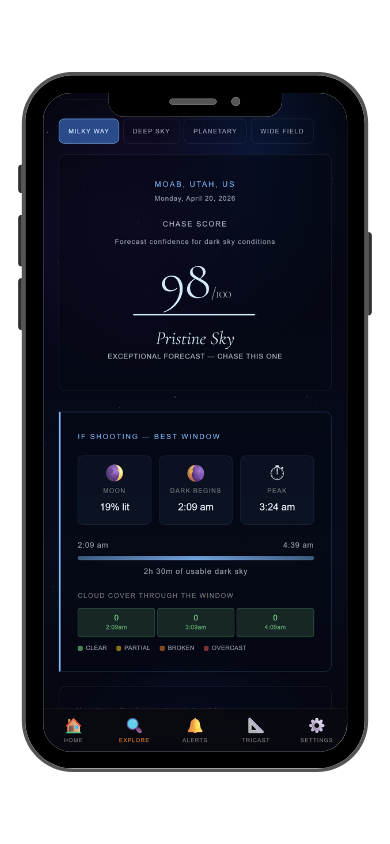
StarCast ยท Milky Way Visibility
LightCast

Is the Milky Way Visible Tonight?

LightCast StarCast scores tonight's Milky Way visibility using moon phase, cloud cover, Bortle class, and atmospheric transparency โ€” for any location.

Get Clear Night Alerts โ€” iOS App Check tonight's visibility free on web โ†’

iOS app: $2.99/mo ยท 7-day free trial ยท Cancel anytime

The short answer

Four Things Determine Whether You'll See the Milky Way Tonight

Checking the weather for "clear skies" isn't enough. Even a perfectly clear night can be a dead end for Milky Way photography if the moon is up, your location has too much light pollution, or there's thin high cloud that doesn't show on a basic forecast. Moon phase, Bortle class, cloud cover at all layers, and atmospheric transparency all have to align.

LightCast StarCast checks all four and returns a single score. On the free web tool, enter any location and get tonight's visibility rating. On iOS, save your locations and get a push notification when a high-scoring night is coming โ€” so you're not checking every evening manually.

LightCast app
75+
Go shoot
Dark, clear, moonless. Set the alarm.
45โ€“74
Partial
Some limiting factor present. Check details.
Skip
Moon, cloud, or light pollution blocking.
What StarCast measures

Why "Clear Skies" Isn't Enough

๐ŸŒ™
Moon Phase and Rise/Set
A full moon washes out the Milky Way entirely. A half moon reduces it significantly. New moon is the target window โ€” roughly 5 nights either side. StarCast shows moon illumination percentage, rise time, and set time so you can identify the dark window each night.
๐ŸŒƒ
Bortle Class (Light Pollution)
The Milky Way requires at minimum Bortle 4 skies. From most cities and suburbs, it simply isn't visible regardless of weather. StarCast shows your location's Bortle class so you know immediately whether the issue is weather or light pollution โ€” and how far you'd need to drive for darker skies.
โ˜๏ธ
Cloud Cover at All Layers
Even thin high cirrus that doesn't register as "cloudy" degrades Milky Way contrast significantly. StarCast checks low, mid, and high cloud separately โ€” a standard weather app's total cloud percentage misses the thin high cloud that ruins astrophotography.
๐Ÿ”ญ
Atmospheric Transparency
Humidity, smoke, and aerosols create a veil that dims stars even under clear skies. Post-rain air produces the cleanest transparency of any given week. StarCast factors in atmospheric transparency so a "clear" but hazy night scores lower than a genuinely clean night.
๐Ÿ””
Get notified when conditions align
The LightCast iOS app monitors your saved locations and sends a push notification when a high-scoring Milky Way night is coming. Set your threshold once. No more checking every evening hoping the moon and clouds cooperate at the same time.

The Milky Way galactic core is only visible during core season: roughly February through October in the Northern Hemisphere, with peak visibility May through August when the core rises highest. Outside that window, StarCast still scores general night sky quality for deep sky objects and star photography.

Common Questions
Is the Milky Way visible tonight from my location?
LightCast StarCast gives you a visibility score for any location based on moon phase, cloud cover, Bortle class, and atmospheric transparency. Check lightcastsuite.com/starcast for free, or download the iOS app for push notifications when a good night is approaching.
What time does the Milky Way rise tonight?
The Milky Way galactic core rises in the southeast for Northern Hemisphere observers and is typically best positioned between 10pm and 4am local time during core season. The exact window shifts by location and month. StarCast shows the rise and set window for your location and date.
Can I see the Milky Way from my city?
Almost certainly not from a city centre. The Milky Way requires Bortle Class 4 or darker โ€” a rural or remote location with minimal artificial light. From most suburbs, the core is faintly visible at best. StarCast shows your location's Bortle class and the minimum drive distance to darker skies.
Does the moon affect Milky Way visibility?
Significantly. A full moon produces enough sky glow to make the Milky Way invisible even from dark locations. Plan shoots for the new moon window โ€” roughly 5 nights before and after new moon gives you adequate darkness. StarCast shows moon illumination and rise/set times so you can identify the dark window each night.
When is Milky Way season?
The galactic core is visible from February through October in the Northern Hemisphere, with peak visibility May through August. In the Southern Hemisphere, the season runs October through April. Outside core season, the galactic centre is below the horizon during nighttime hours.
What is LightCast StarCast?
StarCast is LightCast's night sky scoring tool. It scores conditions from 0 to 100 using moon phase, cloud cover at all atmospheric layers, Bortle class, and atmospheric transparency. Free on web at lightcastsuite.com/starcast, with push notifications and saved locations in the LightCast iOS app.
LightCast
Know before you drive to dark skies.

Milky Way visibility score ยท Moon phase & rise times ยท Bortle class
Push notifications ยท Saved locations ยท Multi-day comparison

Download LightCast for iOS
or
Check tonight free on web โ†’

$2.99/mo after 7-day free trial ยท Cancel anytime in App Store