StarCast · Astrophotography Conditions
LightCast

Is Tonight Good for Astrophotography?

LightCast StarCast scores astrophotography conditions using moon phase, cloud cover at all layers, Bortle class, and atmospheric transparency — for any location.

Get Clear Night Alerts — iOS App Check tonight's conditions free on web →

iOS app: $2.99/mo · 7-day free trial · Cancel anytime
The short answer

Five Conditions Have to Align for a Great Astrophotography Night

Astrophotography has no tolerance for partial conditions. A night that's 80% right usually produces 20% of the results you'd get from a fully optimal night. Moon phase, cloud cover at all layers, Bortle class, atmospheric transparency, and seeing all have to cooperate. StarCast checks all five and returns a single conditions score so you can decide instantly whether tonight is worth driving out for.

LightCast app
🌙
Moon Phase: the Hardest Constraint
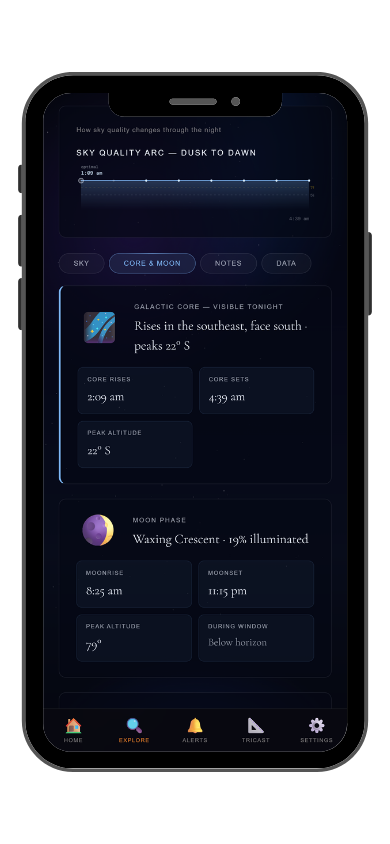
A full moon makes serious Milky Way and deep sky photography nearly impossible. Even a quarter moon significantly reduces contrast. New moon ± 5 days is the core shooting window each month. StarCast shows moon illumination and both rise and set times so you can identify the dark hours even on nights with some moon.
☁️
Cloud Cover: All Layers Matter
Thin high cirrus — invisible from the ground — still degrades astrophotography contrast measurably. StarCast checks low, mid, and high cloud separately. A standard weather app's "clear" rating often misses high cirrus that ruins an astrophotography night.
🔭
Atmospheric Transparency and Seeing
Transparency is how clean the air column is — humidity, smoke, and aerosols all reduce it. Seeing is atmospheric stability — turbulence blurs stars into soft discs rather than sharp points. Both matter separately. Post-cold-front nights typically have the best of both: clean, stable air after the front passes.
🌃
Bortle Class: the Location Constraint
No amount of good weather overcomes a Bortle 8 urban sky for deep sky work. Milky Way photography needs Bortle 4 or lower. Serious deep sky imaging wants Bortle 3 or lower. StarCast shows your location's Bortle class alongside conditions so you know whether the issue is weather or light pollution.
🔔
Get notified when everything aligns
The LightCast iOS app monitors your saved locations and sends a push notification when a high-scoring astrophotography night is approaching. Dark moon, clear skies, good transparency — all five conditions, tracked automatically.
Common Questions
Is tonight good for astrophotography?
LightCast StarCast gives you a single conditions score for any location, checking moon phase, cloud cover at all layers, Bortle class, and atmospheric transparency. Check lightcastsuite.com/starcast free, or get push notifications on the iOS app.
What conditions are needed for astrophotography?
New moon or moon below the horizon, all cloud layers clear (including high cirrus), Bortle Class 4 or darker, good atmospheric transparency, and stable seeing. All five need to align. StarCast scores them together rather than making you check each one separately.
When is the best time of year for astrophotography?
For Milky Way core photography in the Northern Hemisphere: February through October, peak May through August. For general deep sky and star trail work, any clear moonless night year-round. Winter nights are long and often have exceptional transparency after cold front passages.
Does humidity affect astrophotography?
Yes. High humidity creates a moisture layer that scatters light and reduces transparency — producing a milky quality even on cloud-free nights. Post-rain air after a cold front is typically the cleanest and produces the best transparency of any given week.
LightCast
Know before you drive to dark skies.

Astrophotography conditions score · Moon phase & timing · Bortle class
Atmospheric transparency · Push notifications · Saved locations

Download LightCast for iOS
or
Check tonight free on web →

$2.99/mo after 7-day free trial · Cancel anytime in App Store