LightCast · Acadia National Park, ME

Acadia National Park Photography Guide

Best viewpoints for sunset, night sky, and drone — with live conditions updated daily.

Reading today's conditions…

Photography viewpoints · Acadia

Where to Shoot

Acadia sits on the Maine coast where granite mountains meet the Atlantic. The light here is defined by ocean atmosphere — expect dramatic clouds, frequent fog, and some of the most saturated sunrise color on the East Coast. Cadillac Mountain is the first place in the US to see sunrise from October through early March, which draws crowds; the rest of the park rewards photographers who arrive early and explore beyond the summit road.
🌅
Cadillac Mountain Summit Bar Harbor · Sunrise
The highest point on the Eastern Seaboard north of Rio de Janeiro and the first place in the US to catch sunrise from mid-October through early March. The summit road is paved and requires a timed entry reservation in peak season. Arrive 30 minutes before sunrise; the light on the offshore islands and Frenchman Bay turns the water copper before the sun clears the horizon.
🌊
Thunder Hole and Otter Cliffs Park Loop Road · Coastal
The pink granite shoreline along the Park Loop Road is Acadia's most iconic landscape. Thunder Hole is best at mid-tide with a swell running; Otter Cliffs gives 60-foot vertical granite walls dropping straight into the Atlantic. Golden hour from the cliffs facing south and east is exceptional in fall when the angle is low and the foliage adds warm color behind the rocky headlands.
🌌
Eagle Lake and Jordan Pond Bortle 3-4 · Night Sky
The interior lakes are the best night sky locations in the park — sheltered from coastal fog and with reflective foreground for Milky Way compositions. Jordan Pond's still surface on a calm night doubles the star field. The Bortle class is 3-4 due to light from Bar Harbor and Ellsworth, but the galactic core is clearly visible on new moon nights from late April through September.
🏔️
Beehive and Gorham Mountain Trails Elevated · Fall Color
The iron rung ladder trails on the Beehive and Gorham Mountain give elevated positions above the tree line with views over Sand Beach and the open Atlantic. In mid-October the blueberry and birch understory turns crimson and gold against the granite. These are hiking photography positions, not drive-up overlooks; plan for 45-90 minutes round trip depending on your pace.

Inside LightCast Suite
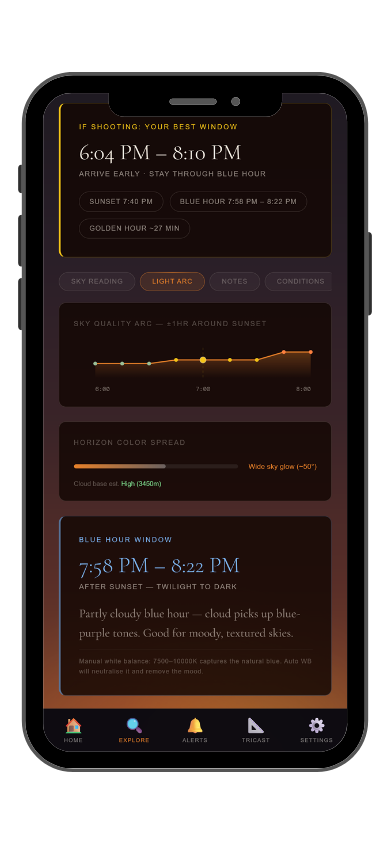
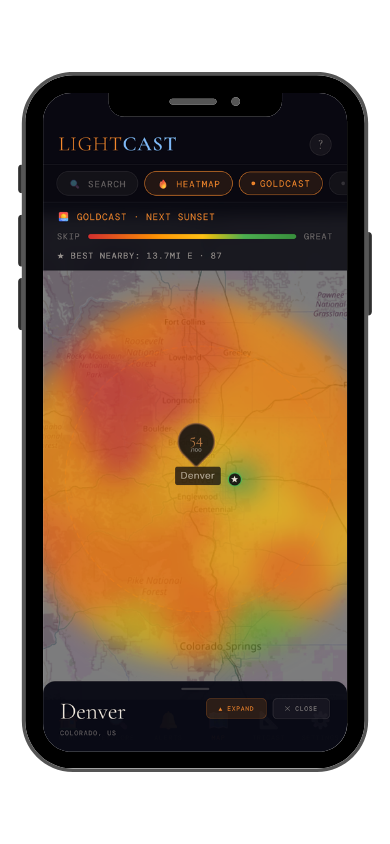
GoldCast golden hour forecast GoldCast conditions heatmap

GoldCast: golden hour score (left) · conditions heatmap (right)
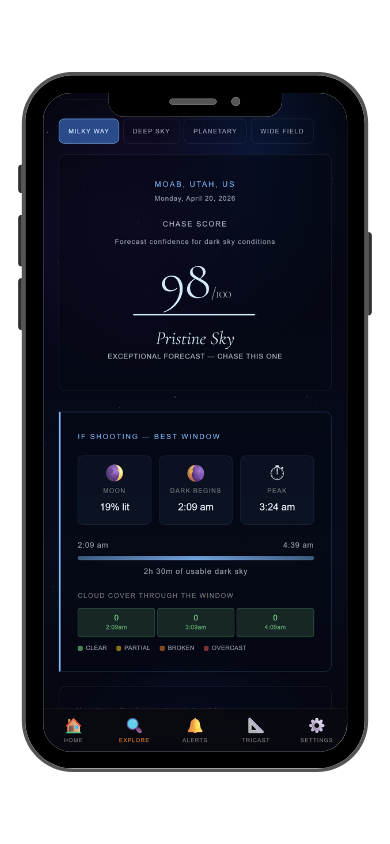
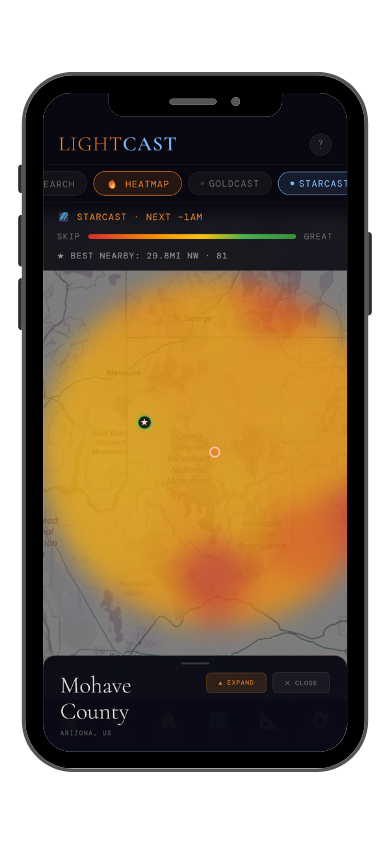
StarCast night sky forecast StarCast heatmap

StarCast: night sky score (left) · conditions heatmap (right)
LightCast Get custom forecasts on iPhone


Frequently asked
What is the best time to photograph Acadia National Park?
Fall (mid-September through October) is the strongest season — foliage peaks around mid-October, skies are clearer than summer, and the lower sun angle gives longer golden hour windows. Sunrise on Cadillac Mountain is the signature Acadia shot; check GoldCast for cloud cover the night before.
Can you see the Milky Way at Acadia?
Yes, on new moon nights with clear skies. The park sits at Bortle 3-4 due to nearby towns, but the galactic core is visible from the interior lakes from late April through September. Jordan Pond and Eagle Lake are the best positions. Check StarCast for moon phase and cloud cover before making the drive to the park after dark.
Are drones allowed at Acadia?
Drone use requires a Special Use Permit from the park and is rarely granted recreationally. The airspace over the park and coastal areas is restricted. Check current NPS rules and FAA TFRs before any flight near the park boundary.
How do I forecast fog at Acadia for photography?
Coastal fog is the biggest wildcard at Acadia, especially in summer. Marine fog can clear within an hour of sunrise or persist all day. GoldCast includes cloud and fog forecasts alongside golden hour timing — check it the night before and again in the morning before heading to the summit. Fall and winter have the most reliable clear mornings.
What is LightCast?
LightCast is a suite of photography weather tools. GoldCast handles golden hour timing with cloud and fog forecasts. StarCast scores night sky conditions. Dronecast covers wind and visibility for drone pilots. All three are free on web; full features including 7-day forecasts and push alerts are in the LightCast iOS app — $2.99/month after a 7-day free trial.
LightCast
Check conditions before you make the drive.

Golden hour · Night sky · Wind & flight · Cloud & fog

Get LightCast on iPhone
or
Learn More →

$2.99/mo after 7-day free trial
