LightCast · Grand Canyon, AZ

Grand Canyon Photography Guide

Best viewpoints for sunset, night sky, and drone — with live conditions updated daily.

Reading today's conditions…

Photography viewpoints · Grand Canyon

Where to Shoot

The Grand Canyon's two rims offer fundamentally different shooting experiences. The South Rim is accessible year-round with paved overlooks; the North Rim is 1,000 feet higher, substantially less crowded, and open roughly mid-May through mid-October. Both reward pre-dawn positioning — the light changes fast and the popular overlooks fill quickly at sunrise.
🌅
Mather Point & Yavapai Observation Station South Rim · Sunset
The most accessible South Rim viewpoints and the strongest for sunset — the canyon walls glow deep red-orange as the sun drops toward the western horizon. Yavapai's glass-walled observation station gives shelter in wind or cold. Arrive at least 45 minutes before golden hour; both fill completely in summer.
🌌
Desert View Watchtower Bortle 3 · East Rim
Located 26 miles east of the main Village, Desert View has the least internal light pollution on the South Rim and an unobstructed southern horizon — essential for Milky Way compositions. The Watchtower itself provides foreground; the campground at Desert View lets you stay on-site for pre-dawn shoots. Bortle class here is meaningfully darker than the Village area.
🏔️
Point Imperial, North Rim North Rim · Sunrise
At 8,803 feet, Point Imperial is the highest named overlook on either rim — and catches first light on the canyon's eastern walls while most photographers are still asleep at the South Rim. The drive from the North Rim entrance takes about an hour; plan accordingly for pre-dawn arrival. Open mid-May through mid-October only.
🌌
Cape Royal, North Rim Bortle 2–3 · Night Sky
The North Rim's darkest and most dramatic overlook — Cape Royal gives a 180° view of the canyon with Angels Window as a natural arch foreground. The Milky Way core rises over the eastern canyon walls in summer and can be framed directly through the arch from around midnight. The 23-mile drive from the lodge is paved to the trailhead.

Inside LightCast Suite
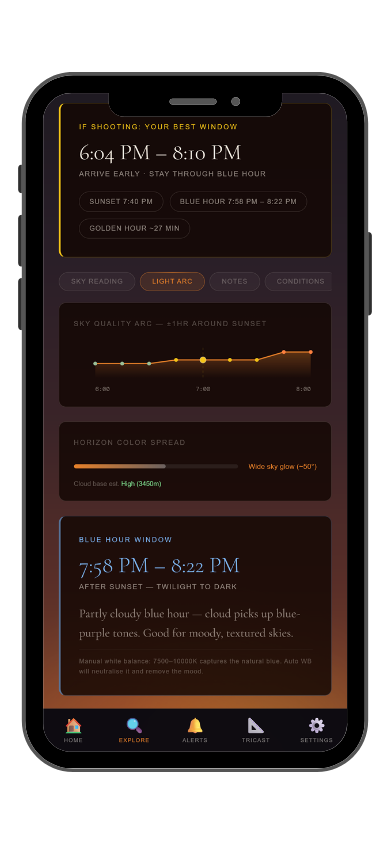
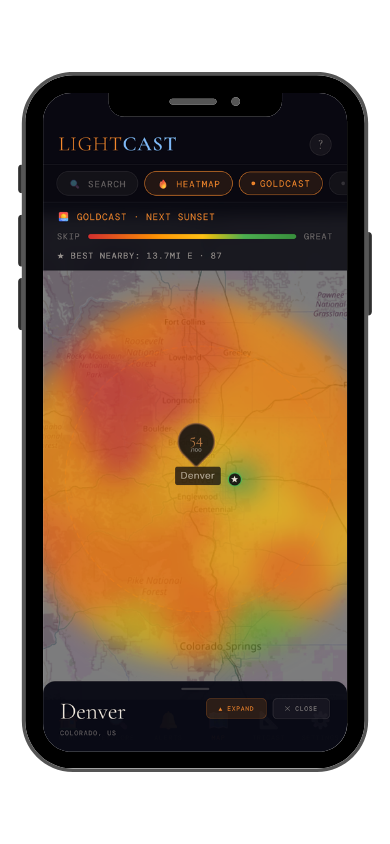
GoldCast golden hour forecast GoldCast conditions heatmap

GoldCast: golden hour score (left) · conditions heatmap (right)
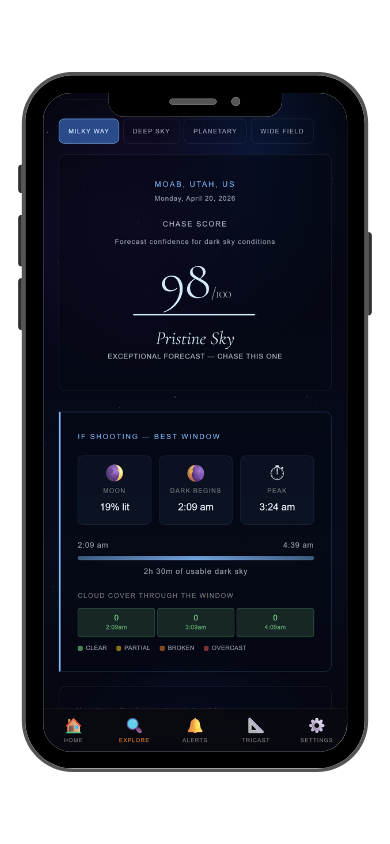
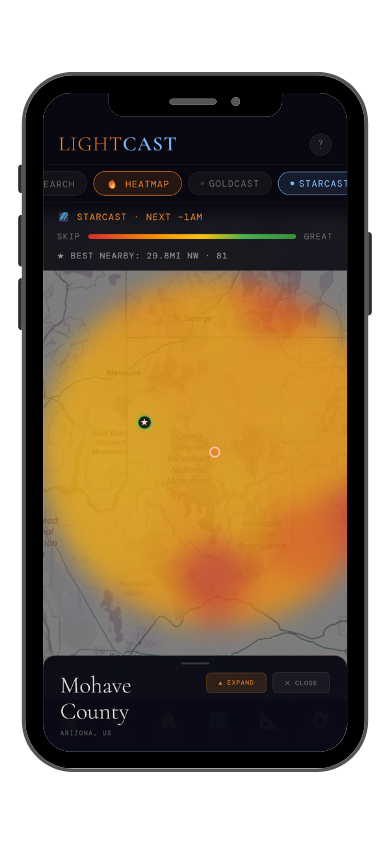
StarCast night sky forecast StarCast heatmap

StarCast: night sky score (left) · conditions heatmap (right)
LightCast Get custom forecasts on iPhone


Frequently asked
What is the best time of day to photograph the Grand Canyon?
Golden hour. The canyon walls catch the warm low-angled light at sunset and go a deep red-orange. Mather Point and Yavapai Observation Station are the most accessible South Rim spots; Point Imperial on the North Rim is exceptional for sunrise. Check GoldCast for cloud cover before committing to the drive to an overlook.
Can you see the Milky Way at the Grand Canyon?
Yes — the Grand Canyon is a certified Dark Sky Park. The South Rim sits at Bortle 3–4; the North Rim and inner canyon are darker. Desert View on the eastern South Rim has the least internal light pollution. The galactic core is visible late February through October. Check StarCast for moon phase and transparency before your visit.
Are drones allowed at the Grand Canyon?
No — drone use is prohibited within Grand Canyon National Park, including both rims and the canyon itself. Special Use Permits are required and almost never granted recreationally. Check FAA TFRs if you plan to fly anywhere near the park boundary.
What is the best season to photograph the Grand Canyon?
Spring (March–May) and fall (September–November) give the most reliably clear skies and comfortable temperatures. Summer brings monsoon thunderstorms in July–August — dramatic but unpredictable. Winter closes the North Rim but the South Rim with snow is genuinely spectacular and far less crowded.
What is LightCast?
LightCast is a suite of photography weather tools. GoldCast handles golden hour timing with cloud and fog forecasts. StarCast scores night sky conditions. Dronecast covers wind and visibility for drone pilots. All three are free on web; full features including 7-day forecasts and push alerts are in the LightCast iOS app — $2.99/month after a 7-day free trial.
LightCast
Check conditions before you make the drive.

Golden hour · Night sky · Wind & flight · Cloud & fog

Get LightCast on iPhone
or
Learn More →

$2.99/mo after 7-day free trial
