LightCast · Joshua Tree National Park, CA

Joshua Tree National Park Photography Guide

Reading today's conditions…

Photography viewpoints · Joshua Tree

Where to Shoot

Joshua Tree sits at the intersection of two deserts — the Mojave at higher elevation with its namesake trees, and the Colorado Desert in the low eastern section, bare and stark. The park's signature element is the boulder formations: enormous monzogranite piles sculpted by weathering into balanced stacks, arches, and domes that catch sunset light in extraordinary ways. The combination of alien-looking Joshua trees, chaotic boulders, and surprisingly dark skies make this one of the most distinctive night sky destinations in California.

🌅
Skull Rock and Jumbo Rocks Pinto Basin Road · Sunrise
Skull Rock is the most recognizable boulder formation in the park — two eye-like cavities weathered into a massive granite dome that genuinely resembles a skull. Sunrise light from the east catches the texture of the worn granite surface and the Joshua trees surrounding the formation. Jumbo Rocks campground nearby gives a vast field of stacked boulders for exploration at golden hour. A wide lens (16–24mm) works best to capture the scale of the formations against the sky.
🌄
Keys View Little San Bernardino Mountains · Sunset
Keys View at 5,185 feet gives the widest panorama in the park — the Coachella Valley, Salton Sea, and on clear days the mountains of Baja California extending to the horizon. At sunset the valley below fills with a layer of haze that turns pink and orange, while the San Jacinto peak above Palm Springs catches the last alpenglow. The paved road makes it accessible in any vehicle; arrive 30 minutes before sunset to find a railing position.
🌌
Cap Rock and Hidden Valley Bortle 3-4 · Night Sky
Cap Rock Nature Trail circles a massive granite formation that makes extraordinary Milky Way foreground — the flat top silhouetted against a nearly dark sky with Joshua trees around the base. Hidden Valley, a natural rock enclosure used by cattle rustlers in the 1880s, gives boulder foreground with open sky visible above the ring of granite. The galactic core rises to the south from May through August. Keep lights red-filtered — Joshua Tree has an active astronomy community that night.
🌸
Cholla Cactus Garden and Cottonwood Spring Eastern Park · Desert Wildflowers
The Cholla Cactus Garden is a dense stand of teddy bear cholla in the low Colorado Desert section of the park. Backlit at golden hour, the fine spines glow against a dark background in a halo effect that's difficult to capture at any other time of day. Cottonwood Spring to the east is an oasis with palm trees and desert willows — wildflowers in the surrounding wash bloom as early as February in good rain years, and the contrast of green against ochre desert is striking.

Inside LightCast Suite
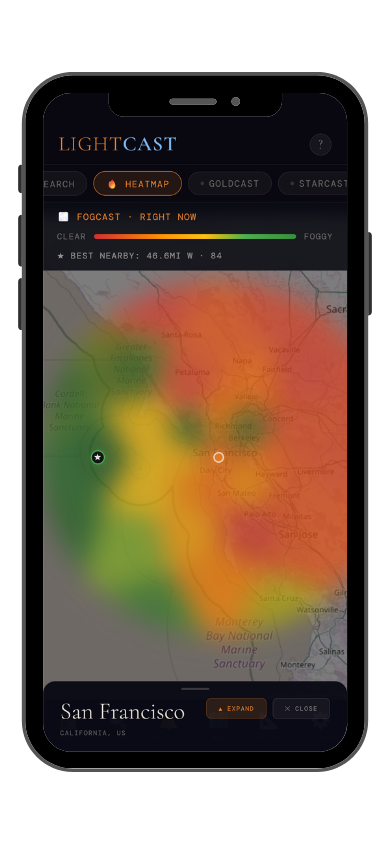
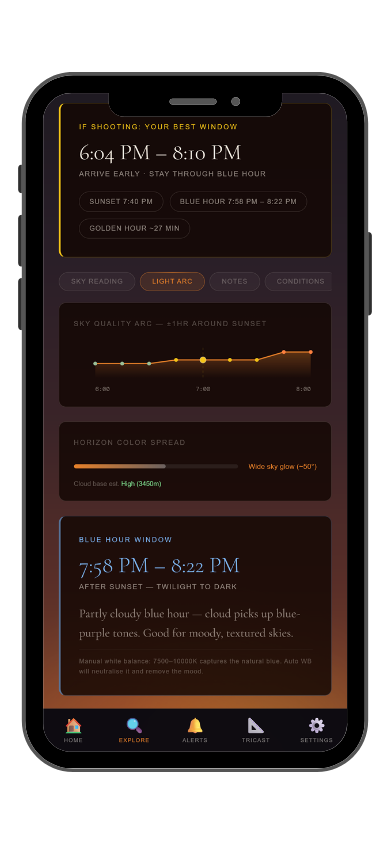
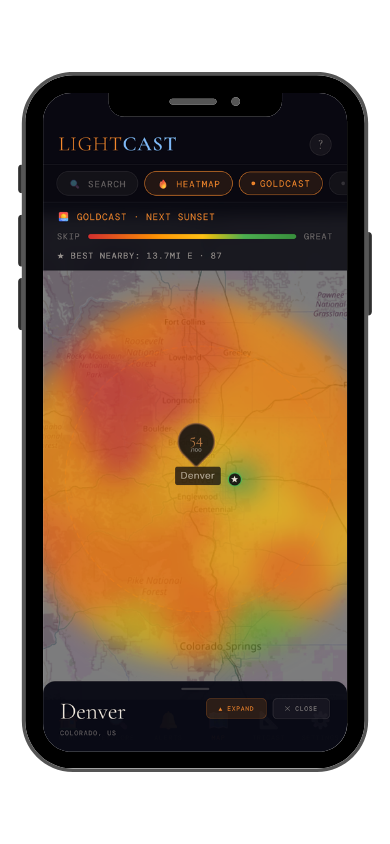
GoldCast golden hour forecast GoldCast conditions heatmap

GoldCast: golden hour score (left) · conditions heatmap (right)

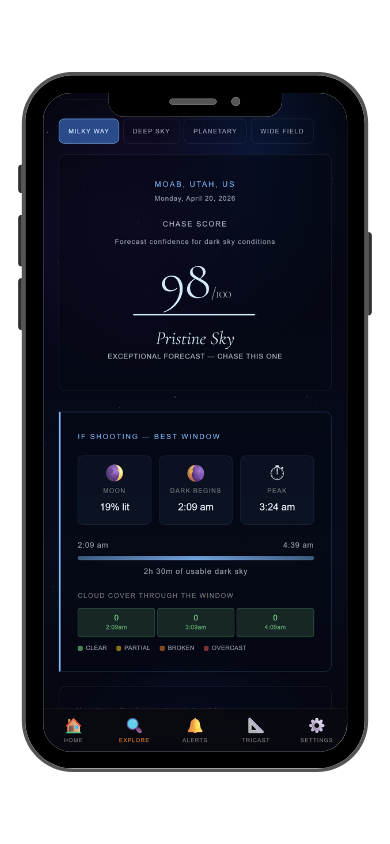
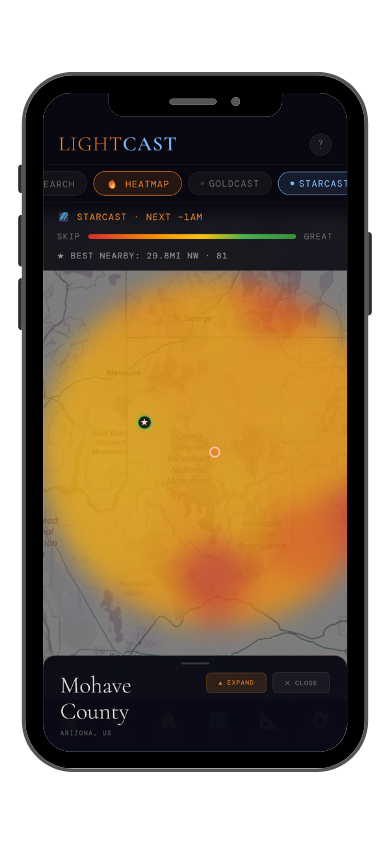
StarCast night sky forecast StarCast heatmap

StarCast: night sky score (left) · conditions heatmap (right)

LightCast Get a live forecast for your favorite spot


Frequently asked
What is the best time to photograph Joshua Tree National Park?
October through May — summer heat makes the park dangerous and photography impractical. Spring wildflower blooms in good rain years (February–April) are exceptional. Check GoldCast the night before for cloud cover; Joshua Tree sunsets with clear air can be spectacular from Keys View.
Can you see the Milky Way at Joshua Tree?
Yes — Joshua Tree is an International Dark Sky Park with Bortle 3-4 skies, and the Joshua trees are among the most distinctive Milky Way foreground subjects in the country. The galactic core is visible from late April through September. Check StarCast for moon phase and sky conditions before heading out.
Are drones allowed at Joshua Tree?
Drones are prohibited without a Special Use Permit. Check current NPS rules and FAA TFRs before any flight near the park.
When do Joshua Tree wildflowers bloom?
Wildflower timing depends entirely on fall and winter rainfall. In good rain years, the low Colorado Desert section blooms as early as February; the higher Mojave section peaks in March–April. The bloom is not guaranteed — check current conditions before making the trip specifically for wildflowers.
What is LightCast?
LightCast is a suite of photography weather tools. GoldCast handles golden hour timing with cloud and fog forecasts. StarCast scores night sky conditions. DroneCast covers wind and visibility for drone pilots. All three are free on web; full features including 7-day forecasts and push alerts are in the LightCast iOS app — $2.99/month after a 7-day free trial.
LightCast
Plan your next shoot.

Search any city, park, or location worldwide

Get LightCast on iPhone
or
Learn More →

$2.99/mo after 7-day free trial