LightCast · White Sands National Park, NM

White Sands National Park Photography Guide

Reading today's conditions…

Photography viewpoints · White Sands

Where to Shoot

White Sands is the largest gypsum dune field on earth — 275 square miles of blinding white sand in the Tularosa Basin of southern New Mexico. Unlike silica sand, gypsum doesn't absorb heat, so the dunes stay cool even in summer. The white surface reflects light in unusual ways: at golden hour it turns from pure white to warm cream to deep gold to pink at dusk, and at full moon it glows bright enough to cast shadows. The absence of color makes White Sands one of the most compositionally challenging and compositionally rewarding parks in the system.

🌅
Heart of the Dunes and Sunset Stroll Area Dune Drive · Sunset
The Dune Life Nature Trail and Interdune Boardwalk at the end of Dune Drive put you in the thickest part of the dune field for sunset. The white gypsum surface begins turning warm cream about 45 minutes before sunset and progresses through gold to deep amber to pink in the minutes after the sun drops below the San Andres Mountains to the west. Yucca plants emerging from the dune faces make natural foreground elements that break the pure geometry. Walk past the first two ridges to escape other visitors' footprints from the day.
🌑
Full Moon Nights Special Events · Moonlight
White Sands holds special Full Moon nights 2–3 times per year, extending park hours until midnight so visitors can experience the dunes by moonlight. The full moon illuminates the white gypsum surface brightly enough to see clearly without artificial light, and the soft shadowless illumination at a direction perpendicular to the sun creates an entirely different photographic environment than golden hour. These nights sell out well in advance — check the park's event calendar months ahead and purchase tickets immediately when they open.
🌌
Backcountry Camping Loop Bortle 2-3 · Night Sky
The Backcountry Camping Loop at the far end of Dune Drive has 10 primitive campsites in the heart of the dune field, accessible after the park closes to day visitors. Spending the night gives access to both sunset, full darkness, and sunrise from within the dunes — the most complete photography experience the park offers. The gypsum surface reflects ambient starlight naturally, giving the dune faces soft luminance without additional lighting. The galactic core rises to the south from May through August and reflects faintly on the dune slopes.
🌵
Alkali Flat Trail North Dune Field · Remote
The Alkali Flat Trail (4.6 miles round trip) crosses the dune field to a dry lakebed at the northern edge — the flattest and most open section of the park, with dune ridges on three sides and open sky above. The trail is marked with orange posts and should not be attempted in summer heat or without a full water supply. In fall and winter the clear air and low sun angle make the walk one of the most photogenic in the park. The lack of footprints beyond the first half mile makes compositions cleaner than the heavily trafficked Dune Life Trail.

Inside LightCast Suite
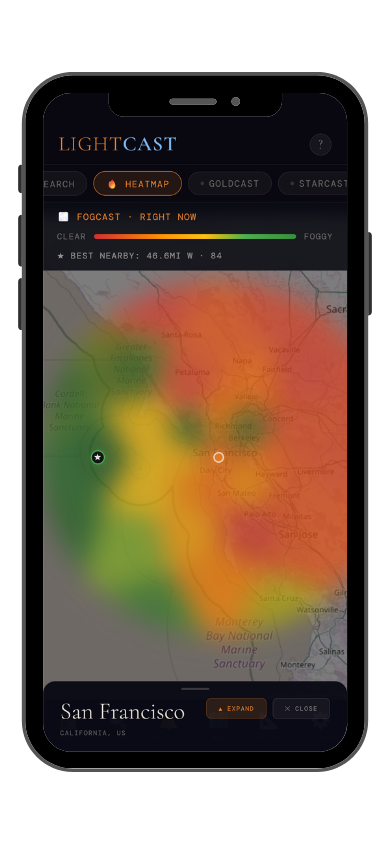
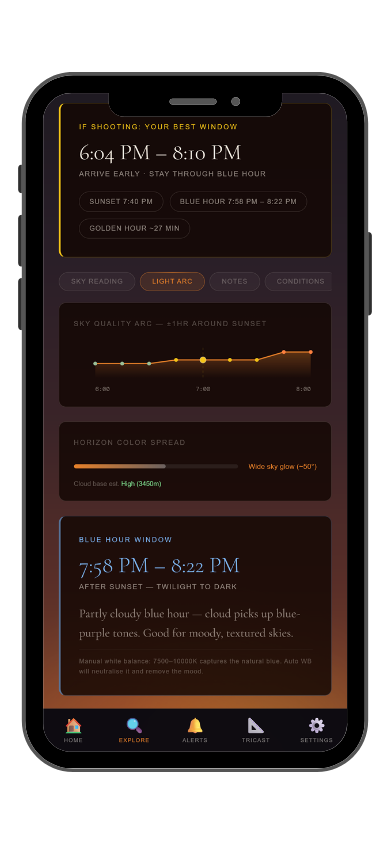
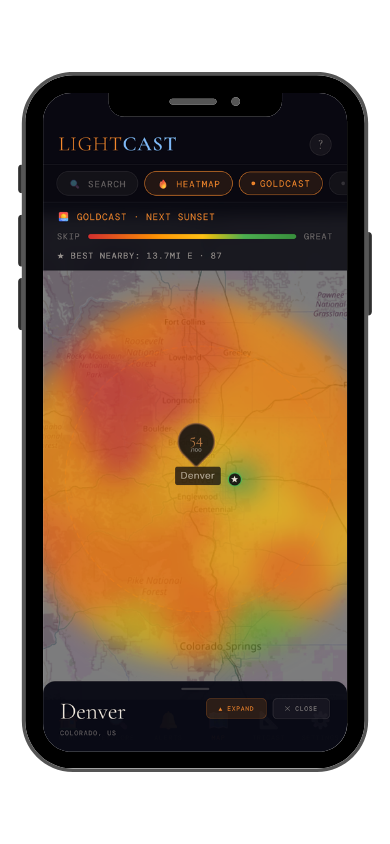
GoldCast golden hour forecast GoldCast conditions heatmap

GoldCast: golden hour score (left) · conditions heatmap (right)

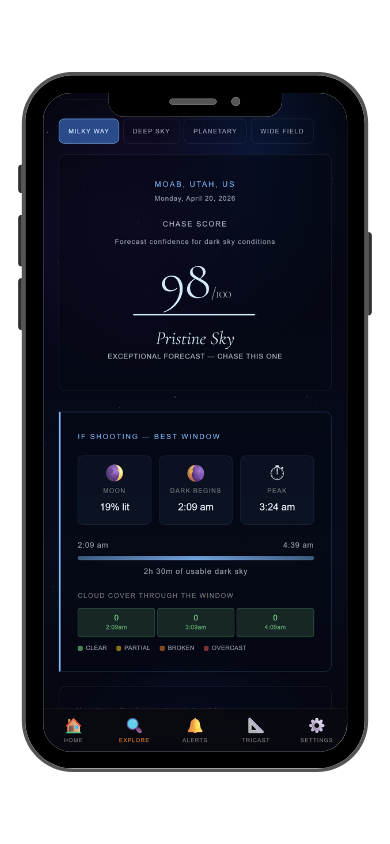
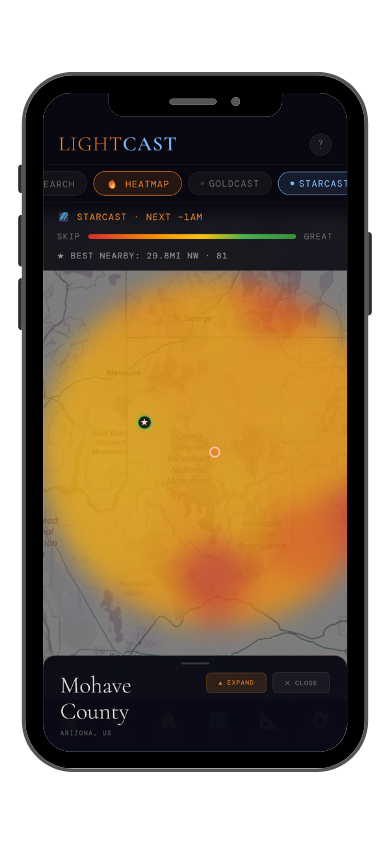
StarCast night sky forecast StarCast heatmap

StarCast: night sky score (left) · conditions heatmap (right)

LightCast Get a live forecast for your favorite spot


Frequently asked
What is the best time to photograph White Sands National Park?
October through April for comfortable temperatures, and sunset is the primary target — the white gypsum turns from cream to gold to pink in the last 45 minutes of light. Check GoldCast the night before for cloud cover and exact sunset timing; the color sequence is very sensitive to thin cloud on the western horizon.
Can you see the Milky Way at White Sands?
Yes — White Sands has Bortle 2-3 skies and the white gypsum surface reflects ambient starlight naturally. The galactic core is visible from late April through September. The backcountry camping sites give the best after-dark access. Check StarCast for moon phase — the full moon nights are a separate experience worth planning around.
Are drones allowed at White Sands?
Drones are prohibited within the park, and the surrounding White Sands Missile Range creates some of the most restricted airspace in the country. Do not fly anywhere near this area without thoroughly checking current NPS rules and FAA TFRs.
How do I photograph the dunes without footprints?
Walk past the first two dune ridges from any trailhead — the heavily visited near-dunes are footprint-covered by midday. Wind overnight resets the surface, so arrive early morning for the cleanest conditions. The Alkali Flat Trail beyond the first mile has significantly less traffic than the Dune Life Nature Trail area.
What is LightCast?
LightCast is a suite of photography weather tools. GoldCast handles golden hour timing with cloud and fog forecasts. StarCast scores night sky conditions. DroneCast covers wind and visibility for drone pilots. All three are free on web; full features including 7-day forecasts and push alerts are in the LightCast iOS app — $2.99/month after a 7-day free trial.
LightCast
Plan your next shoot.

Search any city, park, or location worldwide

Get LightCast on iPhone
or
Learn More →

$2.99/mo after 7-day free trial