LightCast · Zion National Park, UT

Zion National Park Photography Guide

Reading today's conditions…

Photography viewpoints · Zion

Where to Shoot

Zion Canyon cuts 2,000 feet deep through Navajo sandstone in southwestern Utah, creating a slot canyon environment where the light is defined by reflection and shadow. The walls themselves become the light source — bouncing warm orange and red tones into the canyon floor hours before and after direct sun. The best photography here requires understanding how the canyon funnels and blocks light, and positioning for the narrow windows when the sun angle aligns with your composition.

🌅
Angels Landing and Canyon Overlook Trail Zion Canyon · Sunrise/Sunset
Canyon Overlook Trail (1.8 miles round trip) reaches a promontory above the canyon mouth with views east toward the Great Arch — excellent for sunrise when the rising sun catches the canyon walls before the valley is lit. Angels Landing, requiring a permit via lottery, gives the highest accessible viewpoint directly over the canyon with 360-degree views of the Zion Narrows and the canyon bends. Both face east-southeast, making them sunrise positions; sunset lights the west-facing canyon walls below.
💧
The Narrows — Virgin River Zion Canyon Narrows · Midday
The Narrows is a slot canyon section of the Virgin River where walls close to 20 feet apart and rise 1,000 feet above the water. Unlike most landscape photography, the Narrows shoots best at midday when the sun is high enough to send light down between the walls. The filtered blue-green reflected light and flowing water require a wide angle, a slow shutter, and waterproof wading gear. The best entry is from the Temple of Sinawava shuttle stop; check flash flood alerts before entering.
🌌
Canyon Junction Bridge Bortle 3-4 · Night Sky
Canyon Junction Bridge over the Virgin River is the most accessible night sky location in the park — the river reflection doubles the star field and the canyon walls frame the Milky Way core as it rises in the south and east. Zion sits at Bortle 3-4 with Springdale producing modest light pollution to the south; positioning facing north or east gives the darkest sky. The galactic core is visible from late April through September. Check StarCast before making the drive.
🍂
Virgin River Cottonwood Walk Canyon Floor · Fall Color
The canyon floor along the Virgin River between Zion Lodge and the Grotto is lined with Fremont cottonwoods that turn brilliant yellow and gold in late October and early November — one of the most accessible fall color displays in the Southwest. The canyon walls glow red and orange above the yellow canopy in late afternoon light. The Pa'rus Trail (paved, 3.5 miles) runs the length of the prime cottonwood zone and is accessible without the shuttle during off-season.

Inside LightCast Suite
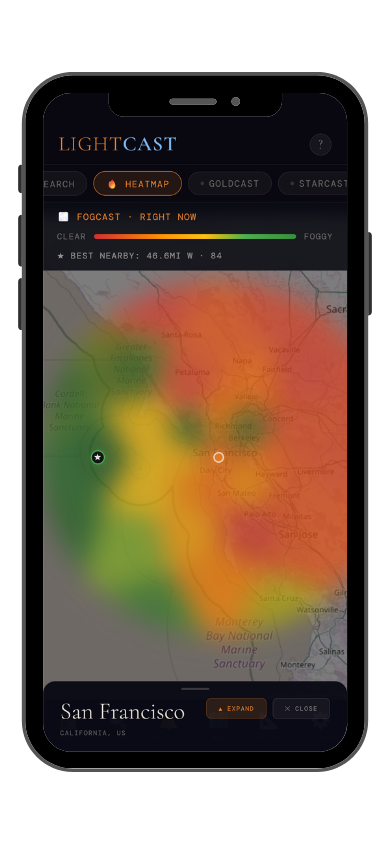
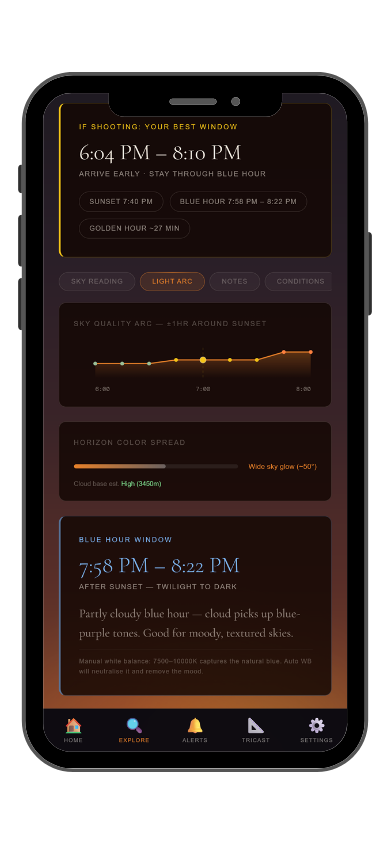
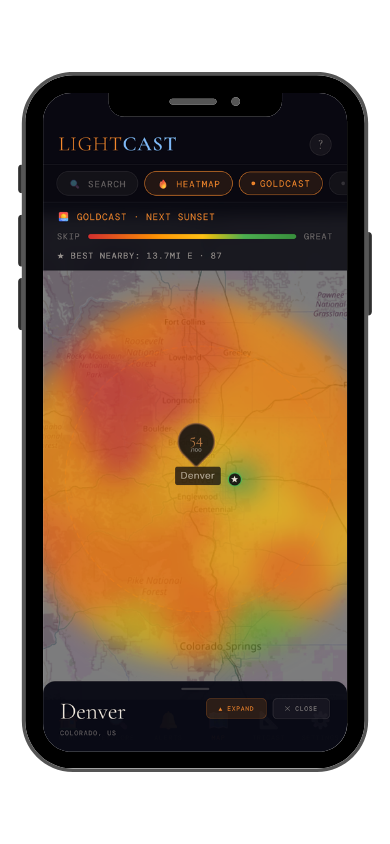
GoldCast golden hour forecast GoldCast conditions heatmap

GoldCast: golden hour score (left) · conditions heatmap (right)

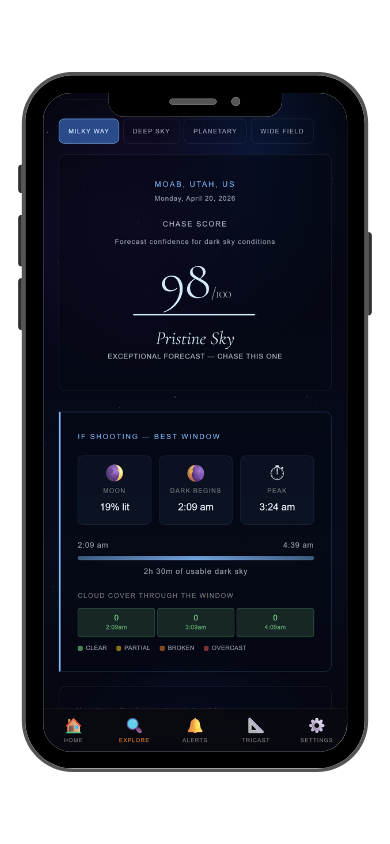
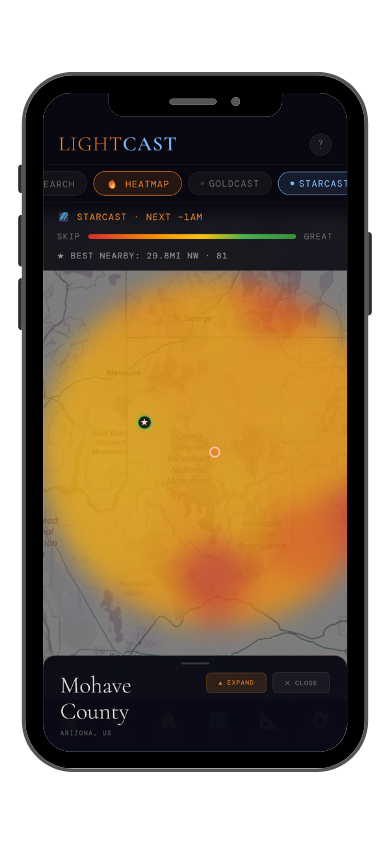
StarCast night sky forecast StarCast heatmap

StarCast: night sky score (left) · conditions heatmap (right)

LightCast Get a live forecast for your favorite spot


Frequently asked
What is the best time to photograph Zion National Park?
Spring (March–May) and fall (October–November) are the strongest seasons. Spring brings waterfalls and Narrows wading conditions before summer heat; fall turns the cottonwoods gold and the canyon walls glow warm in lower-angle light. Avoid July–August when afternoon monsoon storms and flash flood risk close the Narrows. Check GoldCast for cloud cover the night before.
Can you see the Milky Way at Zion?
Yes. Zion sits at Bortle 3-4 — the canyon walls create dramatic foreground and the Virgin River reflects the star field well. Canyon Junction Bridge is the most accessible night sky position. The galactic core is visible from late April through September on new moon nights. Check StarCast for moon phase and cloud cover before heading out after dark.
Are drones allowed at Zion?
Drones are prohibited throughout Zion National Park. No recreational Special Use Permits are issued. The canyon airspace and wilderness designation make authorization extremely unlikely. Check current NPS rules and FAA TFRs before any flight near the park boundary.
When is the best time to photograph The Narrows at Zion?
Midday, unlike almost everywhere else — the Narrows needs the sun high enough to send direct light down between walls that are sometimes only 20 feet apart. Spring and early fall give the best water levels for wading. Always check flash flood alerts from the park before entering; the canyon can flood with no warning from storms miles away upstream.
What is LightCast?
LightCast is a suite of photography weather tools. GoldCast handles golden hour timing with cloud and fog forecasts. StarCast scores night sky conditions. Dronecast covers wind and visibility for drone pilots. All three are free on web; full features including 7-day forecasts and push alerts are in the LightCast iOS app — $2.99/month after a 7-day free trial.
LightCast
Plan your next shoot.

Search any city, park, or location worldwide

Get LightCast on iPhone
or
Learn More →

$2.99/mo after 7-day free trial