StarCast · Bortle Class Lookup

LightCast

What Bortle Class Am I In?

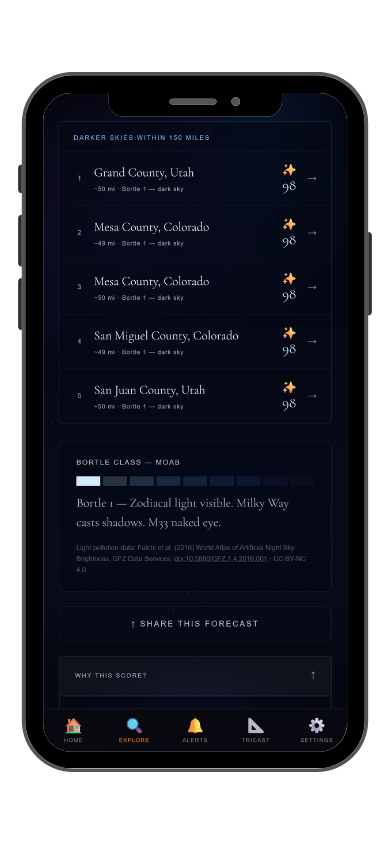
Your Bortle class is the light pollution rating of your sky — from 1 (truly dark) to 9 (city centre). StarCast shows the exact Bortle class for any location alongside tonight's moon phase, cloud cover, and live night sky score.

Find Your Bortle Class Check on web →

iOS app: $2.99/mo · 7-day free trial

What each class means for you

Bortle 1 to 9: What You Can Expect at Your Location

Most people in the US live under Bortle 5–8 skies. The question isn't just what class you're in — it's how far you need to drive to reach something better. Here's what each class actually means when you're standing under it with a camera.

Bortle 1–2: True Dark Sky
Zodiacal light is bright enough to cast faint shadows. Airglow is visible to the naked eye. The Milky Way shows full structure — dust lanes, outer arms, colour gradients — without processing effort. Almost exclusively found in remote western wilderness. Natural Bridges, Death Valley, Big Bend, and Cherry Springs (PA) are certified Bortle 1–2 locations. Find Bortle 1–2 parks near you →
🔵
Bortle 3: Rural Dark Sky
The galactic core is vivid and bright. Light domes are visible on the horizon from distant towns but the sky overhead is genuinely dark. This is the sweet spot for most serious astrophotographers — achievable within a 2–3 hour drive of most mid-size US cities if you know where to look. Many state parks and national forest areas fall here.
🟢
Bortle 4: Rural/Suburban Edge
The Milky Way core is clearly visible and the outer structure is detectable. Viable for quality results on a new moon night. Multiple horizon directions show city glow but the zenith remains dark. Typically 1–1.5 hours outside most major metro areas, depending on terrain and city size.
🟡
Bortle 5–6: Suburban
The Milky Way is visible overhead on a clear new moon night but washed out. City glow dominates multiple horizons. Wide-field Milky Way shots are frustrating here — the core lacks contrast even in long exposures. Useful for bright nebulae with narrowband filters, moon, and planet photography.
🔴
Bortle 7–9: Urban
Only the moon, planets, and brightest stars visible. The Milky Way is not detectable visually and barely shows in long exposures. Galactic photography is not viable here. Most major US metros fall in Bortle 7–9. Drive times to Bortle 3 from NYC, Chicago, and LA are 2–4+ hours.
LightCast StarCast LightCast StarCast
Your Bortle class is fixed — your score isn't

Bortle Class Is Only Part of Tonight's Equation

Bortle class describes the permanent light pollution at a location. What changes every night is moon illumination, cloud cover, and atmospheric transparency. A new moon at Bortle 4 often outperforms a full moon at Bortle 2. StarCast combines all of these into a single 0–100 score so you know whether tonight is worth the drive — not just whether the location is dark enough in theory.

🔔
StarCast Push Alerts
Save your nearest dark sky location and set a score threshold once. StarCast checks conditions nightly and sends a push alert when moon phase, cloud cover, and transparency combine for a high-scoring night at your saved spot. Exclusive to the iOS app.
Common Questions
What Bortle class am I in?
Search your location in StarCast to see the exact Bortle class instantly — no map reading required. Most US cities are Bortle 6–8. Suburbs are typically 5–6. An hour outside a mid-size city is often Bortle 4. Bortle 2–3 generally requires a dedicated drive to rural or wilderness land.
How do I find the closest Bortle 2 to me?
In StarCast, search locations progressively further from your home until you find one showing Bortle 2. In the eastern US, Cherry Springs State Park (PA) is the most accessible Bortle 2. In the west — Utah, Nevada, eastern Oregon, New Mexico — Bortle 2 is reachable within a few hours from most cities. The best dark sky parks guide lists certified Bortle 1–2 locations by region.
Is Bortle 3 near me good enough for Milky Way photography?
Yes — Bortle 3 is a very capable sky for serious astrophotography. The galactic core is vivid, outer structure is visible, and post-processing is productive rather than futile. The main variable becomes timing: new moon window, atmospheric transparency, and cloud cover. StarCast scores all of these together for any Bortle 3 location you search.
Does Bortle class change over time?
Slowly, unfortunately — and typically in the wrong direction. As urban and suburban areas expand, Bortle classes creep upward over years and decades. A location that was Bortle 3 in 2010 may be Bortle 4 today due to development. StarCast uses current light pollution data to keep Bortle readings accurate.
What is LightCast StarCast?
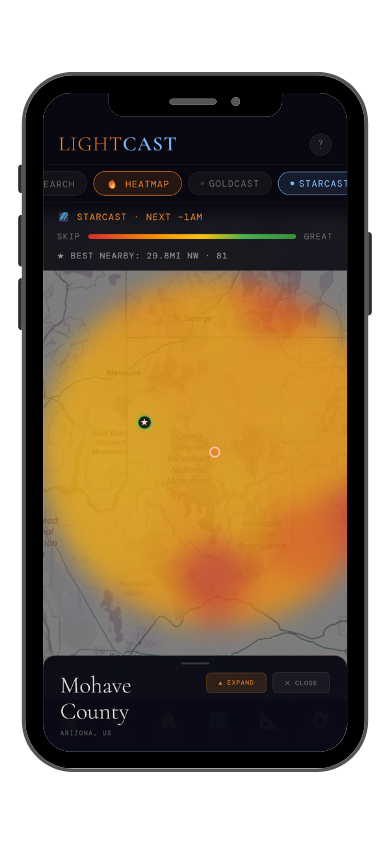
StarCast shows the Bortle class for any location and scores night sky conditions from 0 to 100 using Bortle class, moon phase, moon position, cloud cover, and atmospheric transparency. Push alerts notify you when a high-scoring night is forecast at your saved dark sky locations. Free on web at lightcastsuite.com/starcast, with push notifications in the LightCast iOS app. $2.99/month after a 7-day free trial.
LightCast
Find your Bortle class and tonight's sky score.

Bortle class · Moon phase & position · Cloud cover · Transparency

Download LightCast for iOS
or
Learn More →

$2.99/mo after 7-day free trial