GoldCast · Sunset Science

LightCast

What Causes a Red Sunset?

Rayleigh scattering removes blue from the beam. But the conditions that produce a vivid red versus a washed-out orange are specific — and forecastable. GoldCast scores them for your location.

Get Sunset Alerts — iOS App Learn More →

iOS app: $2.99/mo · 7-day free trial · Cancel anytime
The physics

Why the Sky Turns Red at Sunset

Sunlight contains all wavelengths of visible light. When it travels through the atmosphere at a low angle, it passes through a much thicker slice of air than at midday. Rayleigh scattering preferentially removes short wavelengths — blue and violet scatter away from the direct beam, leaving the longer red and orange wavelengths to reach your eyes and camera. The lower the sun, the more atmosphere the light crosses, and the more blue is removed.

🌫️
Dust and Particles Intensify Red
Extra particles in the atmosphere add more scattering material, removing more blue and deepening the red. Dust storms, wildfire smoke, volcanic ash, and desert aerosols all enhance red tones. Some of the most vivid red sunsets in the western US coincide with wildfire smoke present at altitude — the colour is real, not a camera artifact.
💧
Humidity Softens and Diffuses
High humidity adds water vapour that diffuses light broadly across the sky rather than concentrating red tones. Low humidity after a cold front tends to produce crisper, more saturated oranges and reds. Coastal locations often have softer, more pastel golden hour tones for this reason.
☁️
Cloud Is the Canvas
A cloudless sunset produces warm tones at the horizon but limited sky drama. Broken mid-level cloud catches direct warm light from below the horizon after the sun sets, reflecting vivid reds and oranges across the full sky. The most dramatic red sunsets almost always involve cloud as a reflecting surface, not just a clear sky.
🌅
The Best Colour Comes After Sunset
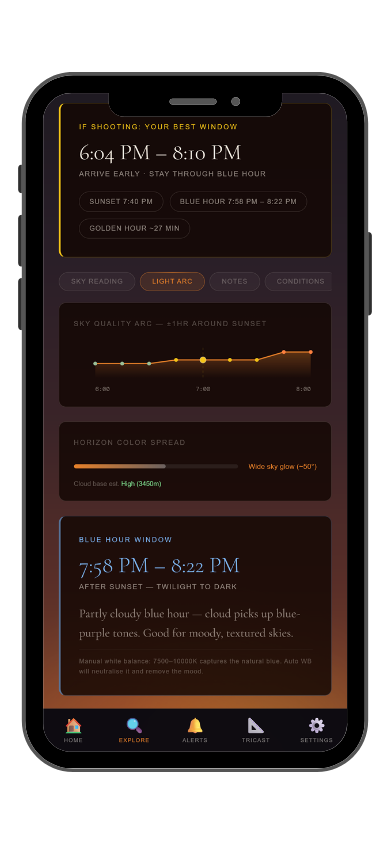
Many photographers pack up at the moment of sunset. The most vivid red and pink tones often appear 5 to 20 minutes after the sun drops below the horizon, when low-angle light is still illuminating cloud from beneath. GoldCast marks both the golden hour window and the post-sunset peak timing for your location.
LightCast GoldCast
Forecasting sunset quality

Not Every Sunset Is Worth Shooting

The sun sets every day. A photogenic red sunset requires the right combination of cloud altitude, humidity, and atmospheric clarity at the same time. GoldCast scores these variables together into a single forecast quality score — so you know whether tonight is likely to be a 30 or an 85 before you drive to your location.

🔔
GoldCast Push Alerts
Get notified when tonight's forecast looks exceptional. GoldCast scores cloud cover, humidity, and atmospheric clarity for your location and sends an alert when the conditions for a vivid sunset align — so you're not checking the sky every afternoon.
Common Questions
What causes a red sunset?
Rayleigh scattering: sunlight traveling through a thick slice of atmosphere near the horizon loses its blue wavelengths, leaving red and orange. Dust, smoke, and particles intensify the effect. LightCast GoldCast scores tonight's sunset quality — free on the web or in the iOS app.
Why are some sunsets more red than others?
More particles in the atmosphere mean more scattering and deeper reds. Smoke, dust, and volcanic aerosols all enhance colour. Low humidity and broken mid-level cloud also contribute to the most vivid sunsets.
Does smoke make sunsets redder?
Yes. Wildfire smoke at altitude can produce some of the most vivid red sunsets in affected regions. The tradeoff: heavy low-altitude smoke reduces visibility and worsens astrophotography conditions on the same nights.
When is the best colour during sunset?
Often 5 to 20 minutes after the sun sets, not at the moment of sunset. Low-angle light continues illuminating cloud from below the horizon after the sun disappears. Most photographers who leave at sunset miss the peak colour window.
What is LightCast GoldCast?
GoldCast scores sunset and golden hour quality using cloud cover, atmospheric clarity, and humidity for any location. It sends push alerts when conditions look strong. Free on web at lightcastsuite.com/goldcast, with push notifications in the LightCast iOS app. $2.99/month after a 7-day free trial.
LightCast
Know tonight's sunset before it happens.

Sunset quality score · Cloud cover · Humidity & clarity
Push notifications · Exact timing · Saved locations

Download LightCast for iOS
or
Check tonight's sunset free on web →

$2.99/mo after 7-day free trial · Cancel anytime in App Store