GoldCast ยท Sunset Science
LightCast

What Causes a Colorful Sunset?

Clear skies produce warm light. Dramatic color needs the right cloud, the right horizon, and the right air. LightCast GoldCast scores all three before you head out.

Check Tonight's Golden Hour Score โ€” iOS App Check Free on Web โ†’

iOS app: $2.99/mo ยท 7-day free trial ยท Cancel anytime

The physics, briefly

Why Sunsets Turn Red and Orange

At sunset, sunlight travels through a far longer path of atmosphere than at midday โ€” up to 40 times longer near the horizon. Shorter wavelengths like blue and violet scatter away before they reach you. What's left is the long-wavelength red, orange, and yellow light that defines golden hour. But scattering alone doesn't produce the most dramatic sunsets. For intense color, you need the right atmospheric setup on top of the physics.

โ˜๏ธ
Mid to High Cloud: The Color Canvas
The most dramatic sunsets happen when mid to high-level cloud sits above a clear horizon band. After the sun drops below the horizon, direct light continues to illuminate cloud bases from below, turning altocumulus and altostratus into vivid reflectors of orange and pink. Full overcast blocks this entirely. Zero cloud produces warm tones but no sky drama.
๐ŸŒ…
Clear Horizon Band: The Light Entry Point
A clear gap between the horizon and the base of the cloud layer allows direct sunlight to enter the scene at the most dramatic angle. Low stratus or fog along the horizon blocks this entry point and prevents the intense color from developing, even when conditions higher up look favorable.
๐Ÿ’ง
Post-Rain Atmosphere
Rain washes aerosols from the atmosphere and leaves behind clean, slightly moist air. The increased moisture after a rain event enhances color saturation at sunset while the clean air keeps the light from becoming muddy. The classic "rain clears just before sunset" setup is one of the most reliable golden hour scenarios.
๐Ÿ”ฅ
Smoke and Aerosols: Double-Edged
High-altitude smoke from distant wildfires can intensify deep red tones at sunset by adding extra scattering particles to the atmosphere. Too much smoke at low altitude blocks light entirely. A thin layer of high smoke often produces the most vivid, saturated reds that clear-air sunsets can't match.
LightCast GoldCast
Why you can't tell from a weather app

GoldCast Reads the Setup, Not Just the Forecast

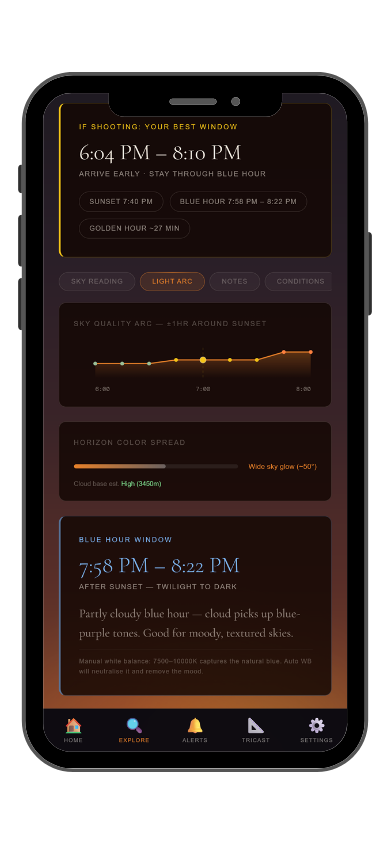
A standard forecast showing 40% cloud cover doesn't tell you whether that cloud is at 2,000 feet blocking all light or at 20,000 feet acting as a perfect color canvas. It doesn't distinguish a clear horizon band from low stratus right at the water. GoldCast evaluates cloud cover by layer, horizon clarity, atmospheric haze, and humidity together and scores the golden hour setup from 0 to 100 so you know whether the evening is worth heading out for.

๐Ÿ””
GoldCast Push Alerts
GoldCast sends push alerts when a high-scoring golden hour is forecast at your saved locations โ€” so you don't miss the exceptional evenings. Set your threshold once and let the app tell you when to go.
Common Questions
What causes a colorful sunset?
Rayleigh scattering removes blue light as sunlight travels through a long atmosphere path at low angles, leaving red and orange wavelengths. Dramatic color requires mid to high cloud above a clear horizon band to catch and reflect that light. GoldCast scores this setup for any location โ€” available in the LightCast iOS app and at lightcastsuite.com/goldcast.
Does a clear sky mean a better sunset?
Not for dramatic color. A clear sky produces warm golden tones but no sky drama. The most photogenic sunsets happen with 30 to 70% mid to high-level cloud above a clear horizon band, where cloud catches direct light from below the horizon after sunset.
Why are sunsets after rain often the best?
Rain washes aerosols from the atmosphere and leaves clean, slightly moist air. The moisture enhances color saturation while clean air keeps light from becoming hazy. Clearing skies after afternoon rain with broken cloud remaining above is one of the most reliable golden hour setups.
Can smoke improve sunset color?
High-altitude smoke adds scattering particles that can intensify deep red tones beyond what clear air produces. Low-altitude smoke blocks light and produces dull, muted sunsets. GoldCast factors atmospheric haze into its golden hour score.
What is LightCast GoldCast?
GoldCast scores golden hour quality from 0 to 100 using cloud cover by layer, horizon clarity, atmospheric haze, and humidity for any location. Push alerts notify you when a high-scoring evening is forecast. Free at lightcastsuite.com/goldcast, with push notifications in the LightCast iOS app. $2.99/month after a 7-day free trial.
LightCast
Know if tonight's setup will actually produce color.

Cloud cover by layer ยท Horizon clarity ยท Haze ยท Humidity
0โ€“100 golden hour score ยท Push notifications ยท Saved locations

Download LightCast for iOS
or
Check tonight's golden hour score free on web โ†’

$2.99/mo after 7-day free trial ยท Cancel anytime in App Store