StarCast ยท Cloud Cover for Stargazing
LightCast

What Cloud Cover Is Too Much for Stargazing?

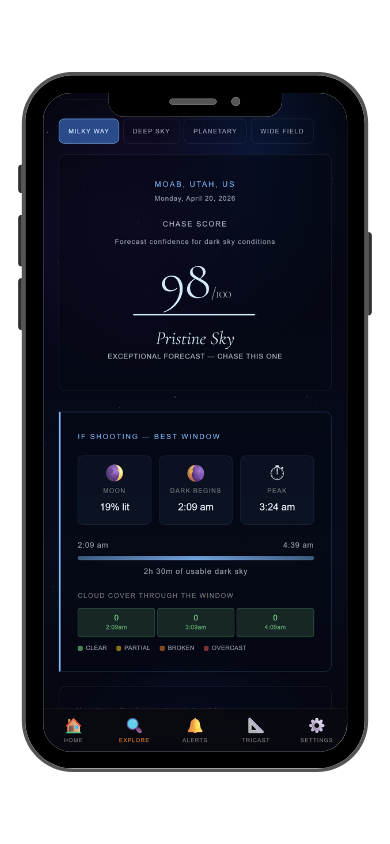
The cutoff depends on what you're trying to do โ€” and on the type of cloud, not just the percentage. LightCast StarCast scores cloud coverage across all atmospheric layers so you know whether the sky is actually usable tonight.

Download LightCast โ€” iOS Check cloud cover free โ†’

iOS app: $2.99/mo ยท 7-day free trial ยท Cancel anytime

Cloud cover thresholds for stargazing and astrophotography

How Much Cloud Cover Is Actually Too Much?

A single cloud cover percentage doesn't tell you what you need to know. 30% broken cumulus is a very different sky than 30% thin cirrus โ€” one gives you clear gaps to shoot through, the other softens and scatters light across the entire frame. What really matters is cloud type, cloud layer, and how coverage evolves through the night. LightCast StarCast evaluates all of it and gives you a single, honest sky quality score.

โœ…
Under 20%: Go. This Is What You're Waiting For.
Sub-20% cloud coverage with clear skies at all atmospheric layers is the target for astrophotography and serious stargazing. You'll have consistent, uninterrupted views with minimal risk of clouds drifting through long exposures. Pair this with low moon illumination and high transparency and you have an exceptional night. StarCast scores the full combination, not cloud cover in isolation.
๐ŸŸก
20โ€“40%: Workable, With Caveats
Partly cloudy skies in this range can still produce good stargazing and even usable astrophotography sessions โ€” especially if the coverage is patchy and high rather than low stratus. You'll need to work around gaps and watch how the coverage moves. Cloud type matters more than the number here. StarCast shows how cloud coverage is distributed across atmospheric layers so you can judge whether the gaps are real.
๐Ÿ”ด
Above 40%: Consistently Problematic for Imaging
Above 40% coverage, long-exposure astrophotography becomes hit-or-miss. Clouds drifting through 30-second exposures leave streaks and gradients that can't be corrected in post. Casual visual stargazing can still work through gaps, but plan on interruptions. For Milky Way photography specifically, 40%+ cloud cover combined with any significant moon illumination is a no-go.
โ˜๏ธ
Cloud Type Changes Everything
Low stratus and fog block the sky entirely and don't clear without frontal passage. High cirrus can look like a clear sky visually but scatters moonlight and reduces image contrast. Broken cumulus may leave clear windows but moves unpredictably. StarCast scores cloud coverage across low, mid, and high atmospheric layers โ€” not just a single blended percentage โ€” so you can see what kind of sky you're actually dealing with.
LightCast StarCast
๐Ÿ””
LightCast Alerts You When Cloud Cover Drops Below Your Threshold
Set your clear sky threshold in LightCast StarCast and save your shooting locations. When cloud cover drops and conditions score above your bar, you get a push alert before dark. No more checking the forecast every evening. Exclusive to the iOS app.
Common Questions
What percentage of cloud cover is too much for stargazing?
For astrophotography, above 40% coverage makes imaging inconsistent. For casual stargazing, up to 50% broken cloud can still be enjoyable through gaps. Cloud type matters as much as the number โ€” thin high cirrus at 20% affects images differently than 20% broken low cumulus. LightCast StarCast scores all layers together. Free on web, push alerts on iOS.
Can you stargaze through thin clouds?
Sometimes. Thin high cirrus allows visual stargazing for bright objects โ€” planets, the moon, and first-magnitude stars remain visible. For faint deep-sky objects or Milky Way photography, even thin cirrus degrades contrast and reduces the number of visible stars significantly. StarCast accounts for this in its score.
Is 30% cloud cover okay for astrophotography?
It depends on cloud type and movement. Thirty percent patchy high cloud moving slowly may leave enough clear gaps for usable sessions. Thirty percent scattered low cumulus moving quickly will interrupt long exposures unpredictably. Check how coverage breaks down by atmospheric layer โ€” StarCast shows this so you can make a real judgment, not just react to a single percentage.
Does cloud cover forecast accuracy change throughout the day?
Yes. Cloud cover forecasts become significantly more reliable within 12โ€“24 hours. At 48โ€“72 hours, treat them as trend indicators. For a go/no-go decision on astrophotography, check StarCast within a few hours of dark for the most current picture. StarCast pulls from Open-Meteo, which updates hourly at high resolution.
What is LightCast StarCast?
StarCast scores night sky conditions using moon phase, Bortle class, atmospheric transparency, and cloud cover into a single 0โ€“100 score. Free on web at lightcastsuite.com/starcast, push notifications in the LightCast iOS app. $2.99/month after a 7-day free trial.
LightCast
LightCast scores cloud cover by layer โ€” so you know whether tonight is actually clear, not just forecast clear.

Cloud cover ยท Transparency ยท Moon phase ยท Bortle class
Push alerts ยท Saved locations ยท 3-day outlook

Download LightCast for iOS
or
Check cloud cover free on web โ†’

$2.99/mo after 7-day free trial ยท Cancel anytime in App Store