StarCast ยท Astrophotography Guide
LightCast

What Is Atmospheric Transparency?

A sky can look clear and still produce poor astrophotography results. Transparency is why โ€” and StarCast factors it into every night sky score.

Check Tonight's Sky Score โ€” iOS App Learn More โ†’

iOS app: $2.99/mo ยท 7-day free trial ยท Cancel anytime

What it is and why it matters

Clear Sky โ‰  Good Transparency

Transparency measures how much starlight actually makes it through the atmosphere to your sensor. High transparency means minimal scattering: stars are bright, faint objects are visible, and the Milky Way shows structure and colour. Low transparency means haze, humidity, smoke, or aerosols are diffusing light across the sky โ€” reducing contrast and washing out faint detail even when you can't see a single cloud.

๐Ÿ’ง
Humidity and Dewpoint
High relative humidity increases water vapour in the atmosphere, which scatters and absorbs light. Below 40% humidity is ideal for astrophotography. Above 70%, even a visually clear sky can produce noticeably reduced star brightness and Milky Way contrast.
๐Ÿ”ฅ
Smoke and Wildfire Particulates
Smoke at altitude is one of the worst transparency killers because it can be invisible at ground level while significantly degrading the sky overhead. Western US astrophotographers routinely lose entire summer windows to wildfire smoke that doesn't show up in a standard cloud cover forecast.
๐ŸŒฌ๏ธ
Post-Front Conditions
The night after a cold front passes is typically the best transparency of the month. The front scours the atmosphere of aerosols and moisture. The first clear night after rain or a front often produces dramatically better results than a clear night that's been sitting in a high-pressure system for a week.
๐Ÿ”๏ธ
Altitude and Dry Air
Higher elevation means less atmosphere above you, which directly improves transparency. Locations above 5,000 feet in dry climates โ€” the Colorado Plateau, Arizona high desert, New Mexico โ€” have consistently better transparency than coastal or low-elevation sites at the same latitude.
LightCast StarCast
Transparency vs. seeing

Two Different Things That Both Matter

Transparency and seeing are often confused. Transparency is about how much light gets through. Seeing is about atmospheric turbulence โ€” whether the air is stable enough that stars appear as sharp points rather than blurry blobs. You can have excellent transparency with poor seeing (crisp, bright, but blurry stars) or good seeing with poor transparency (sharp but dim stars). The best nights have both.

๐Ÿ””
StarCast Push Alerts
StarCast factors transparency into every score. When humidity, particulates, and cloud cover all align for a genuinely good night, the app notifies you โ€” so you're not manually cross-referencing forecasts the night before every potential shoot.
Common Questions
What is atmospheric transparency in astrophotography?
How clearly light from stars passes through the atmosphere to reach your sensor. High transparency = less haze, humidity, and particulates. A sky can look clear and still have poor transparency. LightCast StarCast factors transparency into its score for any location โ€” available in the iOS app and on the web.
What causes poor transparency?
High humidity, smoke, dust, pollen, and atmospheric aerosols. Wildfire smoke at altitude is particularly hard to detect from the ground and can ruin Western US night sky conditions across entire regions without any visible cloud cover.
When is transparency best?
The night immediately after a cold front passes, in dry high-altitude locations, and in winter months when humidity is lower. The first clear night after rain is often the best transparency of the month in most US regions.
What's the difference between transparency and seeing?
Transparency is about light passing through the atmosphere. Seeing is about atmospheric stability. Both matter for astrophotography and are independent of each other. Good seeing produces sharp stars; good transparency produces bright ones. Ideal nights have both.
What is LightCast StarCast?
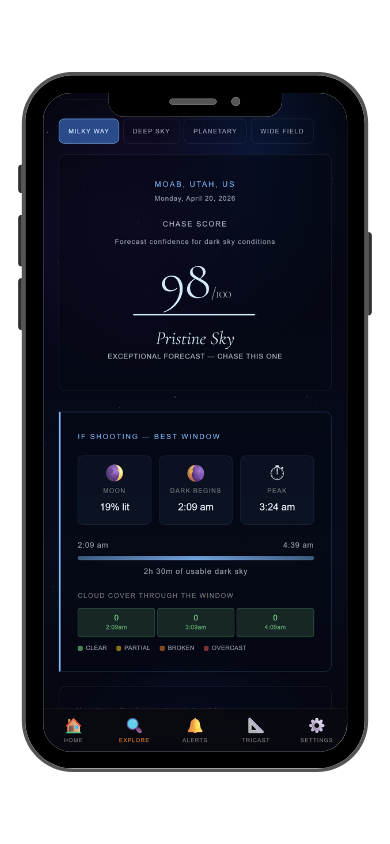
StarCast scores night sky conditions from 0 to 100 using Bortle class, moon phase, moon position, cloud cover, and atmospheric transparency for any location. Push alerts notify you when conditions are worth the trip. Free on web at lightcastsuite.com/starcast, with push notifications in the LightCast iOS app. $2.99/month after a 7-day free trial.
LightCast
Stop guessing whether the sky is actually good.

Transparency score ยท Humidity & dewpoint ยท Bortle class
Moon phase ยท Cloud cover ยท Push notifications

Download LightCast for iOS
or
Check tonight's conditions free on web โ†’

$2.99/mo after 7-day free trial ยท Cancel anytime in App Store