StarCast · Night Sky Planning

LightCast

What Is a Bortle Map?

A color-coded map of light pollution levels used to find dark sky locations. LightCast StarCast shows the Bortle class for any location and factors it directly into your night sky score.

Check Your Location's Bortle Class — iOS App Check Free on Web →

iOS app: $2.99/mo · 7-day free trial · Cancel anytime
Reading the colors

What Each Bortle Class Means for Photography

Bortle maps color-code light pollution from darkest to brightest. Most maps use a gradient from black through blue, green, yellow, orange, and red to white. Black and dark grey are where Milky Way photography is most rewarding. Red and white are where it's essentially impossible. Here's what each zone actually looks like in the field.

Bortle 1–2: Exceptional Dark Sky
The Milky Way casts faint shadows. Zodiacal light and airglow are visible. Full galactic structure, dust lanes, and color gradients are photogenic without post-processing heroics. Most national parks and wilderness areas in the western US fall here. The gold standard for astrophotography.
🔵
Bortle 3–4: Rural Sky
The galactic core is clearly visible and bright. Outer arm structure is detectable. Good results with moderate exposure and processing. Some horizon glow from distant towns but the sky overhead is still dark. The minimum for quality Milky Way photography for most photographers.
🟡
Bortle 5–6: Suburban Transition
The Milky Way is visible overhead but washed out near the horizon. The core is detectable but lacks contrast in typical exposures. Significant effort in post-processing required to recover what's there. City glow dominates multiple horizon directions.
🔴
Bortle 7–9: Urban Sky
Only bright stars and planets visible. The Milky Way is not visible to the naked eye and barely detectable in long exposures. Useful for bright object photography — moon, planets, conjunctions — but not for galactic subjects. Most major metro areas fall in this range.
LightCast StarCast
Bortle is permanent, weather isn't

How StarCast Factors Bortle Into Your Score

Cloud cover and moon phase change night to night. Bortle class is a permanent characteristic of a location determined by the surrounding light pollution infrastructure. StarCast combines both in a single score: a Bortle 2 location on a clear new moon night scores significantly higher than a Bortle 6 location under the same sky conditions — because no amount of perfect weather makes up for baseline light pollution when shooting the Milky Way.

🔔
StarCast Push Alerts
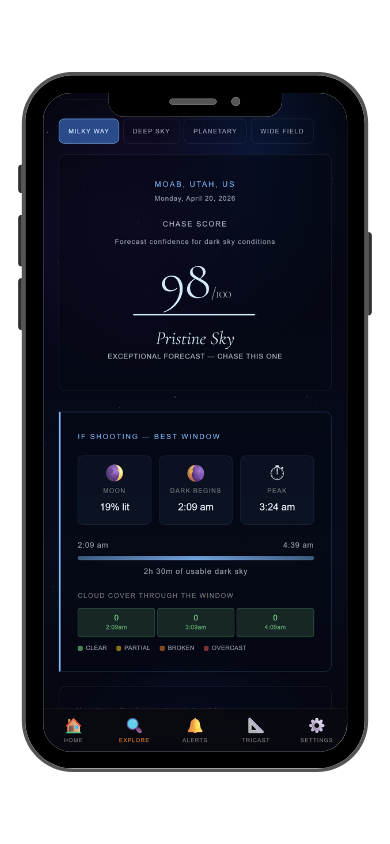
StarCast shows Bortle class for any location you search and factors it into the 0–100 night sky score alongside cloud cover, moon illumination, and atmospheric transparency. Save dark sky locations and get push alerts when a high-scoring night is forecast there.
Common Questions
What is a Bortle map?
A color-coded map showing light pollution levels using the 1–9 Bortle scale. Dark areas are Bortle 1–2: exceptional dark skies. Red and white areas are Bortle 7–9: urban skies. StarCast shows Bortle class for any location without needing a separate map — available in the LightCast iOS app and at lightcastsuite.com/starcast.
What Bortle class do I need for Milky Way photography?
Bortle 4 or lower for usable results. Bortle 3 and below for the full arch, dust lanes, and color gradients that make Milky Way images dramatic. Most national parks and wilderness areas in the western US are Bortle 2–3.
Can I improve results at a high Bortle location?
Somewhat. Shooting at higher elevations, pointing away from city glow, and using narrowband filters for specific objects can help. But light pollution is a permanent physical constraint — at Bortle 6 and above, the Milky Way core simply doesn't have the contrast to photograph well regardless of exposure or technique.
Does StarCast show Bortle class?
Yes. StarCast shows the Bortle class for any location you search and factors it into the 0–100 night sky score. A Bortle 8 location scores lower than a Bortle 2 location under the same weather conditions, because light pollution affects results regardless of the forecast.
What is LightCast StarCast?
StarCast scores night sky conditions from 0 to 100 using Bortle class, cloud cover, moon illumination, atmospheric transparency, and seeing for any location. Push alerts notify you when conditions score high at your saved dark sky locations. Free at lightcastsuite.com/starcast, with push notifications in the LightCast iOS app. $2.99/month after a 7-day free trial.
LightCast
Know your Bortle class before you drive.

Bortle class · Cloud cover · Moon phase · Atmospheric transparency
Dark sky locations · Push notifications · 0–100 night sky score

Download LightCast for iOS
or
Check your location's Bortle class free on web →

$2.99/mo after 7-day free trial · Cancel anytime in App Store