StarCast · Dark Sky Guide
What Is the Bortle Scale?
The Bortle scale measures night sky darkness from 1 to 9. LightCast StarCast shows the Bortle class for any location alongside moon phase, cloud cover, and a live night sky score.
iOS app: $2.99/mo · 7-day free trial · Cancel anytime
The nine classes
Bortle 1 to 9: What Each Class Means
The scale runs from 1 (darkest) to 9 (brightest). Most astrophotographers target Bortle 3 or below for serious work. The jump from Bortle 4 to Bortle 2 is more dramatic in a final image than most beginners expect.
| Class | Description | Milky Way |
|---|
| 1 | Truly dark. Zodiacal light casts shadows. Airglow visible. | Stunning |
| 2 | Typical dark sky park. Faint airglow on horizon. | Excellent |
| 3 | Rural sky. Some light domes on horizon. | Very good |
| 4 | Rural/suburban transition. Core visible, detail reduced. | Good |
| 5 | Suburban. Sky glow obvious. Milky Way faint. | Marginal |
| 6–7 | Bright suburban to urban. Core barely visible or not. | Poor |
| 8–9 | City centre. Only moon, planets, brightest stars. | Not viable |
How StarCast uses it
Bortle Class Is One Input, Not the Whole Score
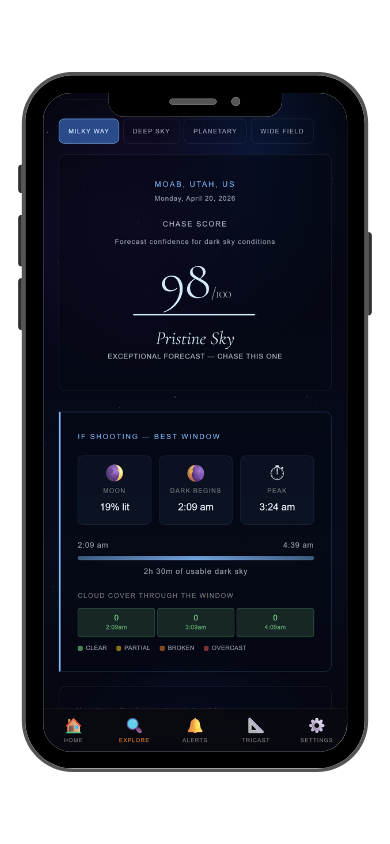
Bortle class describes the baseline light pollution at a location — it doesn't change night to night. What changes is everything on top of it: moon illumination, cloud cover, atmospheric transparency, and humidity. A Bortle 3 location under a half moon scores lower than a Bortle 4 location on a new moon night with perfect transparency. StarCast combines all of these into a single 0–100 score so you don't have to calculate the interaction yourself.
🔔
StarCast Push Alerts
Get notified when tonight looks good. Set your location and threshold once. StarCast alerts you when moon phase, cloud cover, and Bortle class combine for a high-scoring night — so you're not checking manually every evening.
Common Questions
What is the Bortle scale?
A nine-level scale measuring night sky darkness, from Class 1 (truly dark, remote wilderness) to Class 9 (inner city). Developed by John Bortle in 2001, it's the standard reference for astrophotographers.
LightCast StarCast shows the Bortle class for any location in the
iOS app and on the
web.
What Bortle class do I need for Milky Way photography?
The core is faintly visible from Bortle 4 and below. For detailed, high-quality images, Bortle 3 or better is the target. Most designated Dark Sky Parks in the US are Bortle 2. Bortle 1 sites exist but require significant travel to truly remote areas.
Is Bortle class the same as light pollution?
They measure the same thing from different angles. Light pollution maps show sky brightness in measurable units (mag/arcsec²). Bortle class is a qualitative description of what's actually visible to the naked eye at that brightness level. Both are useful; Bortle is more intuitive for planning.
Can you improve Bortle class conditions?
No — Bortle class is fixed by the light pollution at your location. What you can control is timing: new moon nights, low humidity, and high atmospheric transparency all improve the effective viewing conditions on top of whatever Bortle class your location has. StarCast scores all of these together.
What is LightCast StarCast?
StarCast scores night sky conditions from 0 to 100 using Bortle class, moon phase, moon position, cloud cover, and atmospheric transparency for any location. It sends push alerts when conditions hit your threshold. Free on web at
lightcastsuite.com/starcast, with push notifications in the
LightCast iOS app. $2.99/month after a 7-day free trial.