StarCast ยท Milky Way Planning
LightCast

What Is the Galactic Center and When Is It Visible?

The brightest, most dramatic part of the Milky Way. LightCast StarCast tracks galactic core rise, transit, and set for your exact location so you know when to be on site.

Check Galactic Core Timing โ€” iOS App Check Free on Web โ†’

iOS app: $2.99/mo ยท 7-day free trial ยท Cancel anytime

What you're actually photographing

The Core Bulge of the Milky Way

When photographers say "galactic center" they mean the dense, bright bulge at the center of the Milky Way galaxy: the visually richest region of the night sky, packed with stars, dust lanes, and nebulae. It's located in the direction of Sagittarius and rises in the southeastern sky from late winter through fall in the northern hemisphere. This is the part of the Milky Way that looks like a glowing arch in wide-field astrophotography โ€” not the faint band visible on either side of it.

๐Ÿ“…
Season: March Through October
The galactic center is above the horizon during nighttime hours from roughly late February through October in the northern hemisphere. In winter, it's below the horizon when it's dark โ€” you can photograph Milky Way star fields in winter, but the bright core is not visible. Peak season is May through August when the core transits high and the nights are dark.
๐ŸŒ…
Rise Time Shifts Two Hours Earlier Each Month
In late February the core rises around 4am โ€” barely before twilight at mid-latitudes. By May it rises around midnight. By July it's rising at dusk and already high by midnight. StarCast shows the exact rise, transit, and set times for your location so you can see when the core will be above the horizon during your dark window.
๐Ÿงญ
Direction: Southeast to South
The galactic center rises in the southeast and transits due south. Your shooting position needs a clear, dark southern horizon to capture the core rising or to frame it against foreground. Obstructions, trees, or light pollution to the south are the most limiting factor for galactic core photography at most locations.
๐ŸŒ
Latitude Affects Maximum Height
From southern US latitudes (25โ€“35ยฐN), the core rises to a useful height above the horizon. From northern states above 45ยฐN, the core barely clears the southern horizon and foreground compositions become trickier. Southern hemisphere photographers see the core directly overhead.
LightCast StarCast
The window within the window

Core Timing + Dark Sky + Moon Phase Together

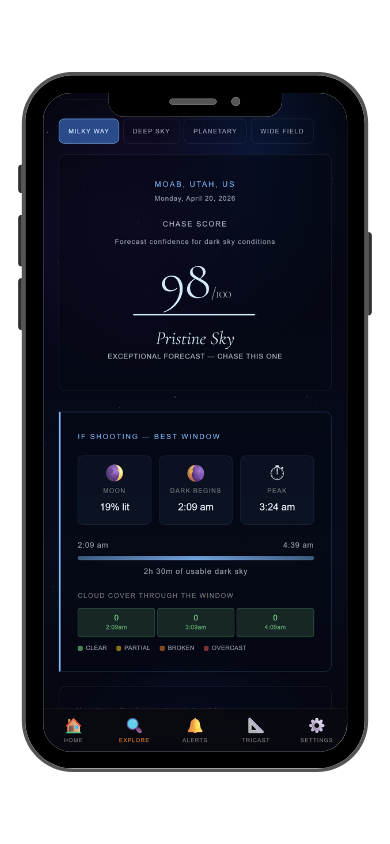
A usable galactic core shot requires three things to overlap: the core above the horizon, the sky astronomically dark, and the moon below the horizon or at low illumination. StarCast combines all three into a single 0โ€“100 night sky score for your location each night, with a breakdown of each factor so you can see exactly what's limiting a given night.

๐Ÿ””
StarCast Push Alerts
StarCast sends push alerts when high-scoring nights are forecast โ€” nights where cloud cover, moon phase, and atmospheric conditions align during the galactic core visibility window for your saved location. Set your threshold and let the app find the nights worth driving for.
Common Questions
What is the galactic center?
The rotational center of the Milky Way galaxy, and the brightest, densest region of the Milky Way as seen from Earth. For photographers, it's the glowing core bulge that rises in the southeast from late winter through fall. StarCast tracks its timing for any location โ€” available in the LightCast iOS app and at lightcastsuite.com/starcast.
When is the galactic center visible?
From roughly late February through October in the northern hemisphere. Peak visibility is May through August, when the core is highest in the southern sky and the dark window is long enough for extended sessions. In winter, the core is below the horizon during nighttime hours.
What time does the galactic center rise?
Rise time shifts earlier by about two hours each month. Late February: around 4am. May: around midnight. July: at dusk. StarCast shows exact rise, transit, and set times for your location every night.
Which direction does the galactic center rise?
Southeast, transiting to due south at its highest point. A dark, unobstructed southern horizon is the most important positioning factor for galactic core photography. Light pollution or terrain to the south limits your shooting window even when the core is technically above the horizon.
What is LightCast StarCast?
StarCast scores night sky conditions from 0 to 100 and tracks galactic core timing, moon phase, moonrise and moonset, and atmospheric conditions for any location. Push alerts notify you when conditions score high during the core visibility window. Free at lightcastsuite.com/starcast, with push notifications in the LightCast iOS app. $2.99/month after a 7-day free trial.
LightCast
Know exactly when the core is up and the sky is dark.

Galactic core timing ยท Moon phase & rise/set ยท Dark window
Cloud cover ยท Bortle class ยท Push notifications

Download LightCast for iOS
or
Check galactic core timing free on web โ†’

$2.99/mo after 7-day free trial ยท Cancel anytime in App Store