TriCast ยท Camera Calculators
LightCast

What Is Hyperfocal Distance?

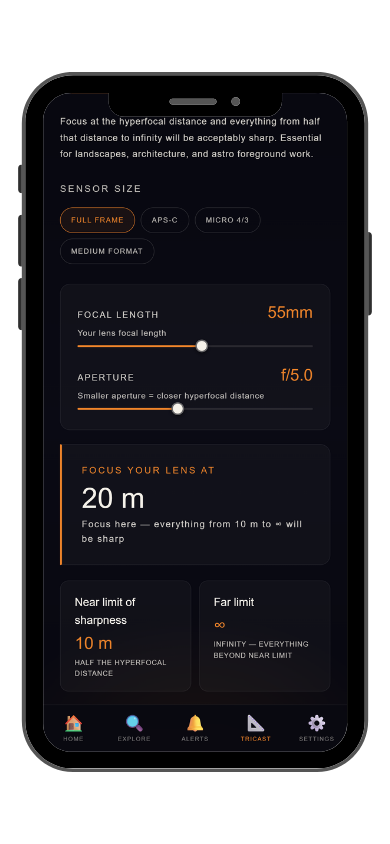
The focus point that keeps everything from half that distance to infinity acceptably sharp. LightCast TriCast calculates it instantly for your lens, aperture, and sensor.

Calculate Hyperfocal Distance โ€” iOS App Learn More โ†’

iOS app: $2.99/mo ยท 7-day free trial ยท Cancel anytime

The core idea

Maximum Depth of Field From a Single Focus Point

Depth of field always extends further behind your focus point than in front of it. Hyperfocal distance takes this to its practical limit: focus at the hyperfocal distance and sharpness extends from half that distance all the way to infinity. For landscape photographers, it's the focus point that keeps the rock in the foreground and the mountain on the horizon both acceptably sharp in the same frame.

๐Ÿ“
How Focal Length Affects It
Longer focal lengths have a longer hyperfocal distance. A 200mm lens at f/8 has a hyperfocal distance measured in hundreds of feet. Wide-angle lenses at moderate apertures have short hyperfocal distances, which is why 16โ€“24mm lenses are preferred for landscape photography where deep foreground-to-infinity sharpness is the goal.
๐Ÿ”ข
How Aperture Affects It
Smaller apertures (higher f-numbers) shorten the hyperfocal distance. At f/11, you can focus significantly closer and still keep infinity sharp than you can at f/4. For most landscape work, f/8 to f/11 gives the best balance between a manageable hyperfocal distance and optical sharpness before diffraction softens the image.
๐Ÿ“ท
Sensor Size Changes the Number
Hyperfocal distance is calculated using the circle of confusion for your sensor size. Full frame, APS-C, and Micro Four Thirds sensors produce different hyperfocal distances for the same focal length and aperture. TriCast accounts for sensor size so the number it gives you is accurate for your specific camera body.
๐ŸŒ…
When to Use It
Hyperfocal focusing is most useful for wide-angle landscape shots with foreground interest, astrophotography where infinity focus is required but foreground sharpness is also wanted, and any scene where you need the deepest possible depth of field from a single exposure. It's less useful for portraits, macro, or compositions with no strong foreground.
LightCast TriCast
Skip the formula

TriCast Calculates It in the Field

The hyperfocal distance formula requires focal length, f-stop, and circle of confusion โ€” the last of which varies by sensor size and isn't something most photographers have memorized. TriCast gives you the number instantly for any combination of focal length, aperture, and camera body, alongside depth of field range and near/far limits, so you can focus accurately in the field without pulling up a spreadsheet.

๐Ÿ“
App Exclusive
TriCast is in the iOS app, alongside FogCast, CloudCast, StarCast, GoldCast, and DroneCast. GoldCast and StarCast send push alerts when conditions are worth the drive โ€” so you arrive already knowing your hyperfocal distance for the lens you're bringing.
Common Questions
What is hyperfocal distance?
The closest focus distance at which objects at infinity are still acceptably sharp. Focusing at this point gives you the maximum depth of field for your lens and aperture, extending from half the hyperfocal distance to infinity. TriCast calculates it for any combination in the LightCast iOS app.
How do you focus at hyperfocal distance?
Calculate the distance for your focal length, aperture, and sensor. Then manually focus your lens to that distance โ€” either using the lens distance scale or by measuring the distance to a subject at that point and focusing on it. TriCast gives you the number; the rest is execution.
Should you always use hyperfocal distance for landscapes?
Not always. It maximizes the range of acceptable sharpness, but the point of maximum sharpness is still at infinity when you focus there. If you have a strong foreground subject that needs to be critically sharp, focusing closer or focus stacking may serve the image better.
Does sensor size affect hyperfocal distance?
Yes. The calculation uses the circle of confusion for your sensor size, which differs between full frame, APS-C, and Micro Four Thirds. TriCast accounts for sensor size so the result is accurate for your specific camera body, not a generic estimate.
What is LightCast TriCast?
TriCast is a set of camera calculators covering hyperfocal distance, depth of field, the 500 Rule, NPF Rule, exposure value, and more. Exclusive to the LightCast iOS app. $2.99/month after a 7-day free trial.
LightCast
Get the number for your lens before you arrive.

Hyperfocal distance ยท Depth of field ยท 500 Rule ยท NPF Rule
Sensor-aware ยท All calculators in one app

Download LightCast for iOS
or
Learn More โ†’

$2.99/mo after 7-day free trial ยท Cancel anytime in App Store