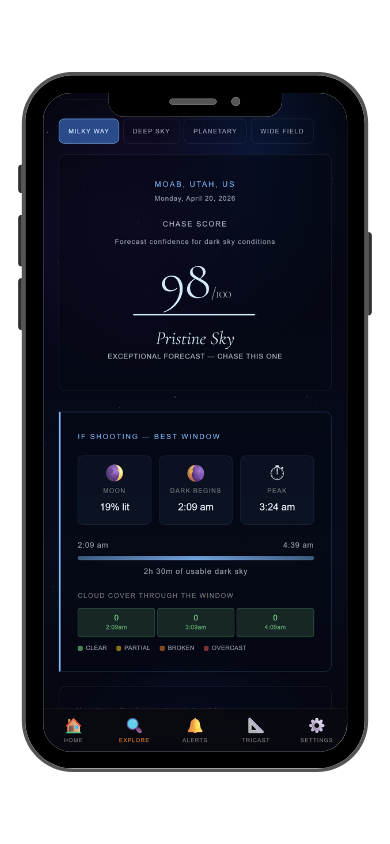
A cloudless night isn't always a sharp night. Atmospheric seeing determines how steady the air is above you. LightCast StarCast factors seeing into its night sky score for your location.
iOS app: $2.99/mo ยท 7-day free trial ยท Cancel anytime
Cloud cover is the obvious obstacle for astrophotography. Seeing is the less obvious one. Atmospheric turbulence bends and distorts light as it passes through layers of air with different temperatures, producing the twinkling effect visible to the naked eye and blur in long exposures. You can have perfectly clear skies and still get soft, smeared stars if the atmosphere is unstable above you.
Seeing and transparency are often confused. Seeing is atmospheric steadiness: it determines sharpness and star size in your images. Transparency is atmospheric clarity: it determines how faint an object you can detect. Both matter, and they don't always move together. A night after a cold front passes often has excellent transparency with poor seeing as the unsettled air stabilizes. StarCast scores both as part of its 0โ100 night sky rating.
Atmospheric seeing ยท Transparency ยท Cloud cover ยท Moon illumination
Bortle class ยท Push notifications ยท 0โ100 night sky score
$2.99/mo after 7-day free trial ยท Cancel anytime in App Store