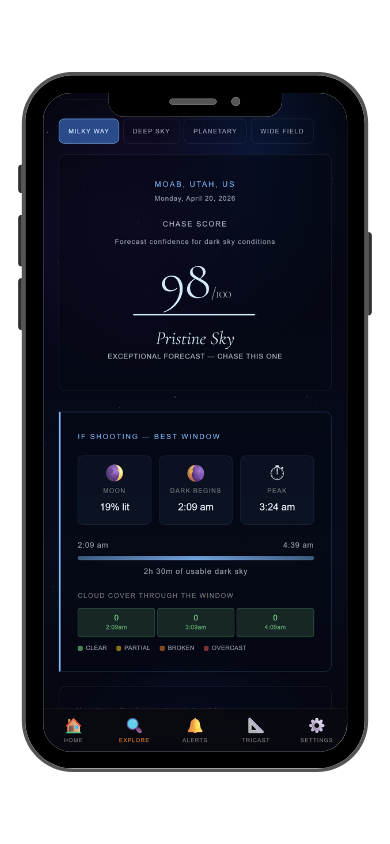
StarCast ยท Night Sky Conditions
LightCast

What Is Sky Transparency for Astrophotography?

A cloudless sky isn't always a clear sky. Transparency determines how much light the atmosphere actually lets through. LightCast StarCast factors it into your night sky score.

Check Tonight's Sky Score โ€” iOS App Check Free on Web โ†’

iOS app: $2.99/mo ยท 7-day free trial ยท Cancel anytime

More than just cloud cover

Why Cloudless Doesn't Always Mean Clear

Cloud cover is the obvious obstacle for astrophotography, but it's not the only one. Humidity, smoke, haze, and high-altitude aerosols all absorb and scatter incoming starlight before it reaches your sensor. A night with zero clouds and high humidity can produce noticeably softer, lower-contrast images than a dry night with a few scattered clouds at high altitude. Transparency is the number that captures this.

๐Ÿ’ง
Humidity and Water Vapor
Water vapor in the atmosphere absorbs and scatters light. High humidity nights reduce contrast on faint objects like nebulae and the outer arms of the Milky Way even when the sky appears completely clear. The lower the dew point, the better the transparency baseline.
๐Ÿ”ฅ
Wildfire Smoke and Aerosols
Smoke from distant wildfires can travel hundreds of miles and dramatically reduce transparency without producing visible cloud cover. A smoke-affected night may look clear to the naked eye but shows significant extinction in long exposures, washing out faint targets and reducing star count.
โ˜๏ธ
Thin High Cirrus
Cirrus cloud at 20,000โ€“40,000 feet is often invisible to the eye at night but absorbs a significant fraction of incoming starlight. Even thin cirrus reduces Milky Way contrast noticeably in 20-second exposures. CloudCast's high-layer cloud data feeds directly into StarCast's transparency component.
๐ŸŒฌ๏ธ
After a Cold Front: Best Transparency
The 12 to 48 hours following a cold front passage typically deliver the best transparency of any weather pattern. Dry air replaces humid air, precipitation washes aerosols from the atmosphere, and the clear post-frontal sky produces maximum star contrast and limiting magnitude.
LightCast StarCast
Transparency vs. seeing

Two Different Variables, Both in Your Score

Transparency affects how faint an object you can detect. Seeing affects how sharp and steady the stars appear. Both are included in StarCast's 0โ€“100 night sky score, alongside cloud cover, moon illumination, Bortle class, and humidity. A high score means all five variables are working in your favor.

๐Ÿ””
StarCast Push Alerts
StarCast notifies you when a high-scoring night is forecast โ€” including nights where transparency improves after a front clears through. Push alerts in the iOS app mean you don't have to check manually every evening.
Common Questions
What is sky transparency in astrophotography?
How clearly the atmosphere transmits light from stars to your camera. High transparency means dry, clean air with minimal aerosols or haze. Low transparency reduces contrast and limits the faintest objects you can capture, even on cloudless nights. StarCast scores it for any location โ€” available in the LightCast iOS app and at lightcastsuite.com/starcast.
What reduces sky transparency?
High humidity, wildfire smoke, thin cirrus cloud, dust, and industrial haze. Even a perfectly cloudless night can have poor transparency if the air holds significant moisture or particulates. The best transparency follows cold front passage when dry air moves in.
Does transparency matter for Milky Way photography?
Yes. Low transparency reduces Milky Way contrast in wide-field shots and washes out the fainter outer arm detail. High humidity nights in summer are the most common cause of soft, hazy Milky Way images even when cloud cover is zero.
What is the difference between transparency and seeing?
Transparency: how much light the atmosphere transmits, affecting faint object detection. Seeing: how steady the atmosphere is, affecting sharpness and resolution. Both are scored by StarCast as part of its 0โ€“100 night sky rating.
What is LightCast StarCast?
StarCast scores night sky conditions from 0 to 100 using cloud cover, moon illumination, Bortle class, humidity, atmospheric transparency, and seeing for any location. Push alerts notify you when conditions are worth the drive. Free at lightcastsuite.com/starcast, with push notifications in the LightCast iOS app. $2.99/month after a 7-day free trial.
LightCast
Know if tonight's air is actually clear.

Atmospheric transparency ยท Seeing ยท Cloud cover ยท Moon illumination
Bortle class ยท Push notifications ยท 0โ€“100 night sky score

Download LightCast for iOS
or
Check tonight's sky score free on web โ†’

$2.99/mo after 7-day free trial ยท Cancel anytime in App Store