StarCast ยท Astrophotography Guide
LightCast

What Is Star Trailing and How to Avoid It?

Star trailing happens when the shutter stays open long enough for Earth's rotation to move stars across the frame. Here's how to calculate your maximum shutter speed and when trailing is the effect you want.

Try LightCast Free โ€” iOS App Check tonight's conditions free on web โ†’

iOS app: $2.99/mo ยท 7-day free trial ยท Cancel anytime

Photography forecast

Star Points vs Star Trails: Two Different Intents

Star trailing is either a problem to solve or an effect to pursue โ€” depending on what you're making. For Milky Way photography you want star points. For long-exposure star trail art, you want the trailing. The technique diverges completely.

โญ
Why Stars Trail: Earth's Rotation
The Earth rotates once every 24 hours โ€” meaning stars appear to move across the sky at about 15 arcseconds per second. At long shutter speeds, this motion registers as a streak rather than a point. The longer the exposure and the longer the focal length, the more visible the trail.
๐Ÿ”ข
The 500 Rule: Quick Calculation
Divide 500 by your focal length in mm: 500 รท 24mm = ~20 seconds maximum. This is a rough guide. High-megapixel sensors show trailing at shorter times โ€” a 45-megapixel camera needs a stricter limit than a 24-megapixel camera at the same focal length.
๐Ÿ“
The NPF Rule: More Precise
NPF accounts for sensor resolution and star declination: (35 ร— aperture + 30 ร— pixel pitch) รท focal length. More complex but more accurate for modern high-resolution sensors. Useful when you're printing large or pixel-peeping. NPF calculators are available online.
๐ŸŒ€
When You Want Trails
For intentional star trail photography, expose for 30โ€“60 minutes in a single shot or stack multiple shorter exposures. New moon, Bortle 2 sky, and north-facing compositions showing circular trails around Polaris are the classic target. StarCast scores the conditions for this too.
LightCast
๐Ÿ””
StarCast Push Alerts
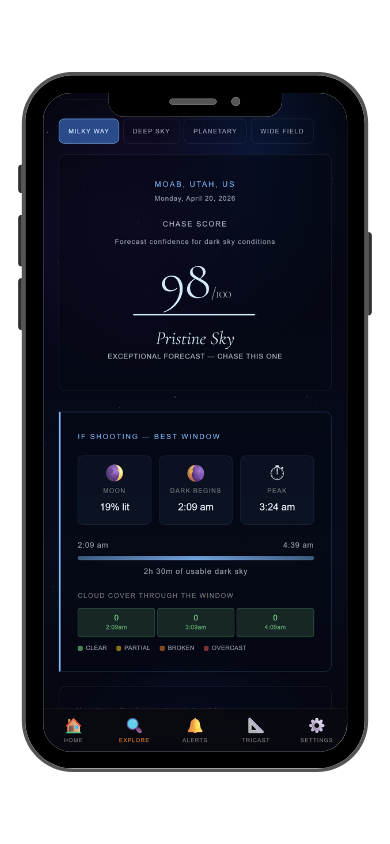
Whether you're chasing star points or star trails, conditions determine the result. StarCast scores moon phase, transparency, and cloud cover nightly โ€” push alert when a high-scoring night is forecast at your location. Exclusive to the iOS app.
Common Questions
What is star trailing in photography?
Stars moving across the frame during long exposures due to Earth's rotation, producing streaks instead of points. Use the 500 Rule to calculate maximum shutter speed for your focal length. Check StarCast for conditions โ€” free on web.
How do I avoid star trails?
Keep shutter speed under the 500 Rule limit for your focal length. Use a wider lens (allows longer exposures), higher ISO (shorter shutter), and faster aperture (shorter shutter). For precise limits, use the NPF Rule.
What is the 500 Rule for avoiding star trails?
500 รท focal length in mm = maximum shutter seconds before stars show trailing. At 24mm: ~20 seconds. At 14mm: ~35 seconds. At 50mm: ~10 seconds. Reduce by 1.5x for high-resolution sensors (above 30 megapixels).
How do I make intentional star trail photos?
Expose 30โ€“60 minutes single shot or stack multiple 2โ€“4 minute exposures. Shoot on a new moon night in Bortle 2 sky, face north for circular trails around Polaris. StarCast scores dark sky conditions for trail photography the same as for Milky Way.
What is LightCast StarCast?
StarCast scores night sky conditions using moon phase, Bortle class, transparency, and cloud cover. Push alerts notify you when a high-scoring night is forecast. Free on web at lightcastsuite.com/starcast, push notifications in the LightCast iOS app. $2.99/month after a 7-day free trial.
LightCast
Check conditions before your star photography session.

Moon phase ยท Bortle class ยท Transparency ยท Cloud cover
Push alerts ยท Saved locations ยท 3-day outlook

Download LightCast for iOS
or
Check tonight's conditions free on web โ†’

$2.99/mo after 7-day free trial ยท Cancel anytime in App Store