StarCast ยท Astrophotography Forecast
LightCast

What Makes a Good Astrophotography Forecast?

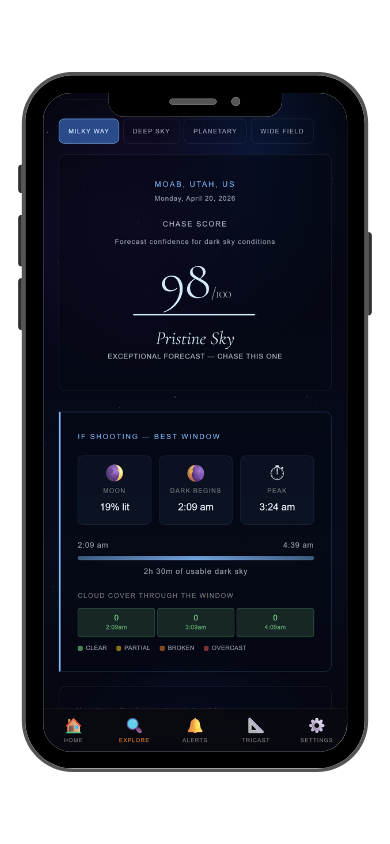
A real astrophotography forecast isn't just cloud cover โ€” it's cloud cover, atmospheric transparency, moon phase, and Bortle class all scored together. LightCast StarCast combines all four into one honest number for any location you save.

Download LightCast โ€” iOS Check your forecast free โ†’

iOS app: $2.99/mo ยท 7-day free trial ยท Cancel anytime

Why standard weather forecasts miss the mark for astrophotography

The Four Variables That Make an Astrophotography Forecast Accurate

Standard weather apps are designed to answer "will I need an umbrella?" โ€” not "will my 30-second exposures of the Andromeda Galaxy come out clean?" Astrophotography demands a forecast that measures the actual quality of the sky above you. That means four variables, not one. LightCast StarCast is built around all four.

โ˜๏ธ
Cloud Cover: Necessary but Not Sufficient
Low or zero cloud cover is the minimum requirement for astrophotography. But cloud cover percentages from standard forecasts often mask what's happening at different atmospheric layers โ€” thin high cirrus is very different from a solid stratus deck at 3,000 feet. StarCast scores cloud coverage across all atmospheric layers and reflects whether that cloud cover actually blocks the sky or merely reduces contrast.
๐ŸŒซ๏ธ
Atmospheric Transparency: The Difference Between Sharp and Soft
Transparency is the most underrated variable in astrophotography forecasting. High humidity, wildfire smoke, sea salt, and fine aerosols all reduce transparency โ€” creating a technically cloudless sky that still produces dim, low-contrast images. Post-frontal air after a cold front is the gold standard: the atmosphere cleans out, stars snap sharp, and dynamic range in your exposures visibly improves. StarCast scores transparency for every forecast.
๐ŸŒ™
Moon Phase: The Sky's Natural Light Pollution
A full moon adds roughly as much light to the night sky as significant urban light pollution. For wide-field Milky Way work, anything above 40โ€“50% illumination is effectively a wasted night. Even for deep-sky imaging on a telescope, bright moon raises your noise floor and limits exposure time. StarCast shows moon illumination, rise time, and set time for every location so you can calculate your true dark window with precision.
๐Ÿ™๏ธ
Bortle Class: What Your Location Is Capable of
Even a perfect forecast can't overcome severe light pollution. At Bortle 7 or above, wide-field deep-sky work is marginal regardless of conditions. At Bortle 3 or below, even a moderate night produces stunning results. StarCast loads the Bortle class for any location you save โ€” so the score you see reflects what's actually achievable there, not just what the atmosphere is doing above it.
LightCast StarCast
๐Ÿ””
LightCast Alerts You When All Four Variables Align
When cloud cover, transparency, moon phase, and your Bortle class all line up for a strong astrophotography night, LightCast StarCast pushes an alert to your phone. Set your score threshold once. Your saved locations are monitored automatically. Exclusive to the iOS app.
Common Questions
What makes a good astrophotography forecast?
Four things: low cloud cover, high atmospheric transparency, minimal moon illumination (or a moon that sets early), and a dark-sky location (Bortle 4 or below for wide-field work). LightCast StarCast scores all four together into a single 0โ€“100 number. Free on web, push alerts on iOS. $2.99/month after a 7-day free trial.
Is atmospheric transparency important for astrophotography?
Yes โ€” arguably as important as cloud cover for image quality. High humidity and aerosols reduce the sharpness and contrast of stars even on a cloudless night. The best astrophotography nights follow cold fronts, when the atmosphere clears of moisture and particulates. StarCast scores this for every forecast.
What moon phase is best for astrophotography?
New moon, or within 4โ€“5 days on either side. At 30% illumination the sky brightens noticeably; at 50%+, wide-field deep-sky work is largely compromised. StarCast shows moon illumination and set time for your location so you can calculate exactly how much dark sky you have each night.
How far ahead should I plan astrophotography shoots?
Use StarCast's 3-day outlook for trip planning and location comparison. Confirm conditions within 6โ€“12 hours of your shoot for the most accurate cloud cover and transparency data. Open-Meteo, the model StarCast draws from, updates hourly at high resolution.
What is LightCast StarCast?
StarCast scores night sky conditions using moon phase, Bortle class, atmospheric transparency, and cloud cover into a single 0โ€“100 score. Free on web at lightcastsuite.com/starcast, push notifications in the LightCast iOS app. $2.99/month after a 7-day free trial.
LightCast
LightCast gives you the complete astrophotography forecast โ€” not just a cloud percentage.

Cloud cover ยท Transparency ยท Moon phase ยท Bortle class
Push alerts ยท Saved locations ยท 3-day outlook

Download LightCast for iOS
or
Check your forecast free on web โ†’

$2.99/mo after 7-day free trial ยท Cancel anytime in App Store