StarCast ยท Astrophotography Conditions
LightCast

What Weather Ruins Astrophotography?

Clouds are the obvious answer โ€” but high humidity, atmospheric haze, wildfire smoke, and a bright moon all ruin images on nights the forecast calls "clear." LightCast StarCast scores the conditions that actually matter for astrophotography.

Download LightCast โ€” iOS Check conditions free โ†’

iOS app: $2.99/mo ยท 7-day free trial ยท Cancel anytime

The conditions that kill astrophotography โ€” even on "clear" nights

What Actually Ruins an Astrophotography Night

Most astrophotographers learn quickly that cloud cover is just the starting point. A night the weather app calls clear can still produce dim, soft, or washed-out images. The culprits are predictable once you know what to look for โ€” and each one is trackable in advance. LightCast StarCast flags all of them before you head out.

โ˜๏ธ
Cloud Cover: The Obvious One
Heavy cloud cover blocks the sky entirely. But even partial cloud cover above 30โ€“40% causes problems for long-exposure astrophotography โ€” clouds drifting through during an exposure leave streaks, gradients, and ruined frames. Thin high cirrus, often invisible to the naked eye, scatters moonlight and degrades contrast across the entire frame. StarCast evaluates all cloud layers, not just total coverage as a single percentage.
๐Ÿ’ง
High Humidity and Summer Haze
High relative humidity โ€” even without any clouds โ€” fills the atmosphere with water vapor that scatters and absorbs light. The result is a sky that looks clear to the eye but photographs as milky and low-contrast. Summer nights are the worst offenders. The best nights for transparency are typically after a cold front passes, when dry continental air replaces the humid air mass. StarCast's transparency score tracks this directly.
๐Ÿ”ฅ
Wildfire Smoke and Aerosols
Smoke from distant wildfires can degrade atmospheric transparency hundreds of miles from the fire itself โ€” often without any visible color tint until you examine your exposures. Fine aerosols in the 0.1โ€“1 micron range are particularly effective at scattering starlight and producing a foggy, low-detail sky. StarCast's transparency score accounts for aerosol loading in the atmosphere above your saved locations.
๐ŸŒ•
Moonlight: The Most Predictable Ruiner
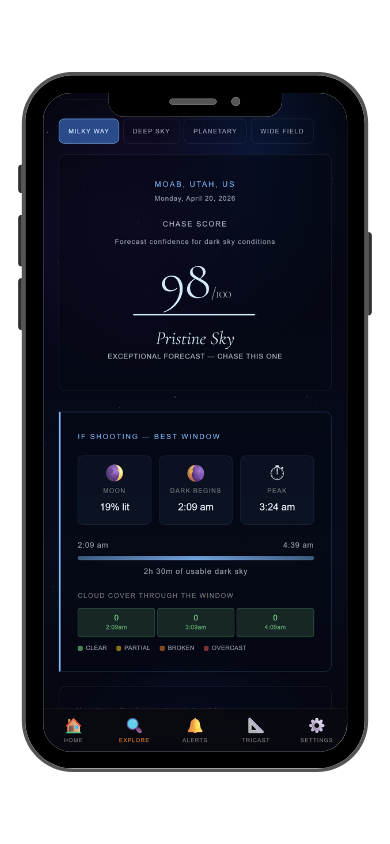
A bright moon is the single most consistent source of ruined astrophotography nights. At 50% illumination, the sky background in your images brightens dramatically, burying faint nebulae in noise. Near full moon, wide-field deep-sky work is essentially impossible. StarCast shows moon illumination percentage, rise time, and set time for every location so you can see exactly how much โ€” or how little โ€” dark sky you have to work with.
LightCast StarCast
๐Ÿ””
LightCast Alerts You When Conditions Are Actually Clean
When cloud cover is low, transparency is high, and the moon is out of the way, LightCast StarCast sends a push alert to your phone before dark. Save your shooting locations, set your threshold, and let LightCast do the monitoring. Exclusive to the iOS app.
Common Questions
What weather conditions ruin astrophotography?
Cloud cover above 30โ€“40%, poor atmospheric transparency from humidity or smoke, and significant moon illumination (above 40โ€“50%) are the main culprits. Any one of them can ruin an otherwise promising night. LightCast StarCast scores all three together โ€” free on web, push alerts on iOS.
Can high humidity ruin astrophotography even without clouds?
Yes. High humidity scatters and absorbs starlight, producing a milky, low-contrast sky that photographs poorly even when it looks clear. Humidity-driven transparency loss is one of the most common reasons astrophotographers get home and find disappointing results despite clear skies. StarCast's transparency score tracks this directly.
Does wind affect astrophotography?
Strong wind causes camera shake and vibration, especially on longer focal length setups. But atmospheric seeing โ€” the turbulence in the air column above you โ€” is the more common wind-related issue for planetary and high-magnification work. For wide-field Milky Way photography, wind is less critical than transparency and moon phase.
When is the best weather for astrophotography?
The night after a cold front passes is often the best of the week: clear skies, low humidity, excellent transparency, and stable air. Pair that with a new moon window and a dark-sky location and you have the ideal combination. StarCast shows all these variables together so you can spot those nights in advance.
What is LightCast StarCast?
StarCast scores night sky conditions using moon phase, Bortle class, atmospheric transparency, and cloud cover into a single 0โ€“100 score. Free on web at lightcastsuite.com/starcast, push notifications in the LightCast iOS app. $2.99/month after a 7-day free trial.
LightCast
LightCast scores what actually ruins astrophotography โ€” before you drive out to find out.

Cloud cover ยท Transparency ยท Moon phase ยท Bortle class
Push alerts ยท Saved locations ยท 3-day outlook

Download LightCast for iOS
or
Check conditions free on web โ†’

$2.99/mo after 7-day free trial ยท Cancel anytime in App Store