StarCast ยท Night Sky Conditions
LightCast

Why Are Stars Brighter in the Desert?

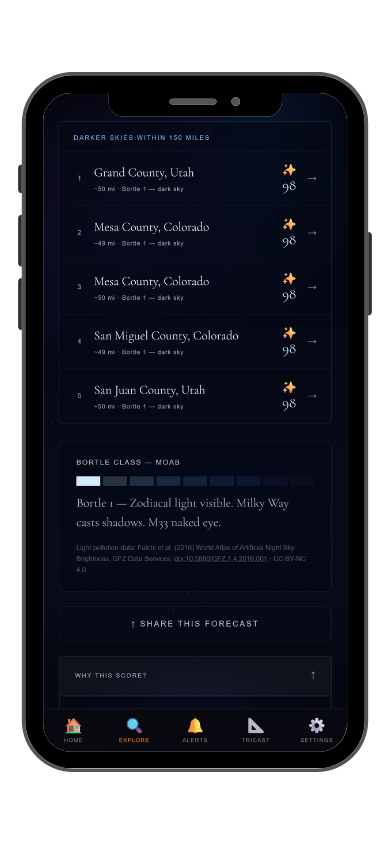
Three things compound: less light pollution, less humidity, and higher elevation. LightCast StarCast scores all three as part of its night sky rating for any location.

Check Tonight's Sky Score โ€” iOS App Check Free on Web โ†’

iOS app: $2.99/mo ยท 7-day free trial ยท Cancel anytime

Three compounding factors

Why the Desert Sky Is Different

The difference between a desert sky and a humid coastal sky isn't subtle. On a clear night in the Mojave or the Colorado Plateau, the Milky Way casts a faint shadow. The zodiacal light is visible as a band across the sky. Stars near the horizon twinkle far less. Three factors combine to produce this, and understanding them helps you find similar quality closer to home when you can't travel.

๐ŸŒƒ
Low Light Pollution
Desert regions in the US Southwest are predominantly Bortle 1 to 3. The sparse population and low development density mean almost no artificial sky glow in any horizon direction. Light pollution is the most permanent and impactful factor: no weather improvement can compensate for a Bortle 7 or 8 location the way clear skies can compensate for temporary cloud cover.
๐Ÿ’ง
Extreme Low Humidity
Water vapor absorbs and scatters starlight. Desert air with dew points regularly below 20โ€“30ยฐF is dramatically more transparent than humid air at the same temperature. The Milky Way appears visibly brighter and more detailed on a dry desert night than on a technically clear but humid summer night at the same Bortle class location.
๐Ÿ”๏ธ
Elevation Reduces Atmosphere Overhead
Most desert photography destinations in the American West sit at 3,000 to 7,000 feet. Higher elevation means less total atmosphere between you and space, reducing both absorption and the turbulence that causes stars to shimmer. Each 1,000 feet of elevation eliminates a measurable fraction of the air column that light passes through on the way to your sensor.
๐ŸŒฌ๏ธ
Stable, Aerosol-Free Air
Deserts have low particulate matter year-round: no agricultural dust, minimal industrial emissions, low pollen, and no sea salt aerosols. Clean air transmits more light per unit of distance than air loaded with particulates. After a weather front clears desert air, transparency levels can exceed what most other environments ever achieve.
LightCast StarCast
Getting desert-quality skies closer to home

Transparency After a Cold Front

You don't have to be in the desert to get desert-quality transparency. The 12 to 48 hours after a cold front sweeps through brings dry air, washed-out aerosols, and suppressed humidity โ€” temporarily approaching desert-level transparency even at lower elevations. StarCast scores atmospheric transparency alongside Bortle class so you can see when your local sky is having an unusually clear night, not just whether it's cloudless.

๐Ÿ””
StarCast Push Alerts
StarCast notifies you when a high-scoring night is forecast at your saved locations โ€” including nights when transparency spikes after a front clears through. Push alerts in the iOS app mean you catch the good nights without checking every evening.
Common Questions
Why are stars brighter in the desert?
Less light pollution, lower humidity, and higher elevation combine to produce darker, more transparent skies. Desert air is drier and cleaner than almost anywhere else, transmitting more starlight per unit of atmosphere. StarCast scores these factors for any location โ€” available in the LightCast iOS app and at lightcastsuite.com/starcast.
Does humidity really affect star brightness?
Yes, noticeably. Water vapor absorbs and scatters starlight before it reaches your camera. Desert air with dew points below 30ยฐF is dramatically more transparent than humid summer air, producing visible differences in Milky Way brightness and contrast even at the same Bortle class location.
What Bortle class are US deserts?
The major southwestern deserts are predominantly Bortle 1 to 3. Death Valley, Big Bend, Great Basin, and the Bears Ears region regularly hit Bortle 1 to 2, among the darkest accessible locations in the contiguous US. StarCast shows Bortle class for any location you search.
Can I get desert-quality skies without traveling to the desert?
Temporarily, yes. The 12 to 48 hours after a cold front brings dry, clean air that temporarily approaches desert-level transparency even at lower elevations. StarCast scores atmospheric transparency so you can see when your local sky is having an unusually clear night.
What is LightCast StarCast?
StarCast scores night sky conditions from 0 to 100 using Bortle class, cloud cover, moon illumination, atmospheric transparency, humidity, and seeing for any location. Push alerts notify you when conditions are worth the drive. Free at lightcastsuite.com/starcast, with push notifications in the LightCast iOS app. $2.99/month after a 7-day free trial.
LightCast
Know when your sky is at its clearest.

Atmospheric transparency ยท Bortle class ยท Humidity ยท Seeing
Cloud cover ยท Moon phase ยท Push notifications

Download LightCast for iOS
or
Check tonight's sky score free on web โ†’

$2.99/mo after 7-day free trial ยท Cancel anytime in App Store