StarCast · Maine · Bortle 2–3
LightCast

Astrophotography in Acadia National Park

Acadia is the darkest national park in the eastern US east of the Mississippi — Bortle 2–3 on the outer portions of Mount Desert Island, with the Atlantic Ocean providing a perfectly dark southern and eastern horizon.

Check Tonight's Sky — iOS App Check Acadia National Park conditions free →

iOS app: $2.99/mo · 7-day free trial · Cancel anytime
Planning guide · Bortle 2–3 · May–October

Where and When to Shoot in Acadia National Park

The Park Loop Road stays open after dark. The granite coastline is slippery at night — bring sturdy footwear. October through November often has the best transparency as maritime humidity drops. The southern-facing coast gives a clear horizon for galactic core framing.

🌊
Sand Beach and Great Head
The granite headland south of Sand Beach gives an open Atlantic ocean horizon facing south — ideal for galactic core framing. The beach itself gives reflective wet sand compositions at low tide.
🏔️
Cadillac Mountain Summit
The highest point on the US Atlantic coast gives panoramic dark sky in every direction. The timed entry vehicle reservation is required in peak season — check the current system before planning an after-dark shoot.
🌿
Otter Cliff
The 110-foot granite sea cliff gives an elevated Atlantic horizon composition. The cliff face and ocean directly below provide dramatic foreground. One of the strongest astrophotography positions in the park.
🦭
Bass Harbor Head Lighthouse Area
The lighthouse grounds (check access after dark) give the lighthouse structure as foreground against the Atlantic sky. The rocky ledge below the lighthouse catches wave energy for long-exposure water foreground.
Season and gear

Best Season and What to Bring

Season: May–October · October–November best transparency · New moon essential

Gear notes: Sturdy footwear for granite coastline, warm layers, check vehicle reservation requirements for Cadillac Mountain

LightCast StarCast
🔔
StarCast Push Alerts
Save Acadia National Park as a location in StarCast. Get a push alert when moon phase, cloud cover, and transparency align for a high-scoring night — before you make the drive. Exclusive to the iOS app.
Common Questions
Is Acadia National Park good for astrophotography?
Acadia is the darkest national park in the eastern US east of the Mississippi — Bortle 2–3 on the outer portions of Mount Desert Island, with the Atlantic Ocean providing a perfectly dark southern and eastern horizon. Check tonight's conditions on StarCast before making the drive — free on web, push alerts in the iOS app.
What Bortle class is Acadia National Park?
Acadia National Park is Bortle 2–3 — strong dark sky for serious astrophotography. StarCast shows Bortle class alongside moon phase and transparency for any location.
When is the best time for astrophotography in Acadia National Park?
May–October · October–November best transparency · New moon essential. Target new moon windows — within 5 days of new moon for a full dark window. StarCast shows moon phase for any date so you can plan trips months in advance.
How do I check conditions before driving to Acadia National Park?
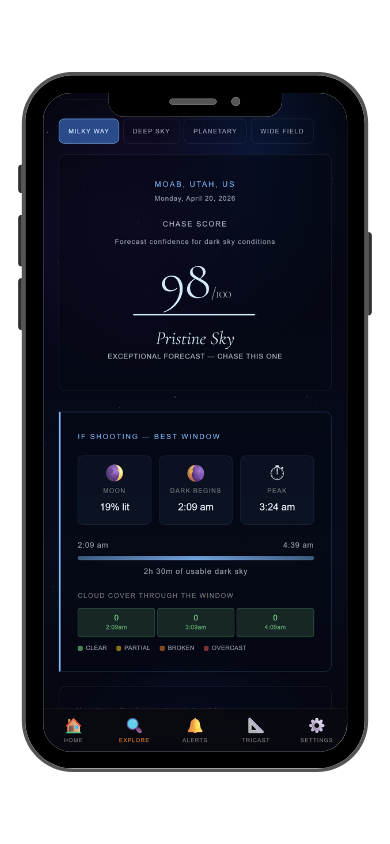
Check StarCast for Acadia National Park — moon phase, Bortle class, transparency, and cloud cover scored together into a single 0–100 night sky score. Check 3–5 days out for planning, confirm 24–48 hours before when transparency and cloud timing are most accurate.
What is LightCast StarCast?
StarCast scores night sky conditions using moon phase, Bortle class, atmospheric transparency, and cloud cover. Push alerts notify you when a high-scoring night is forecast. Free on web at lightcastsuite.com/starcast, push notifications in the LightCast iOS app. $2.99/month after a 7-day free trial.
LightCast
Check tonight's conditions before you make the drive.

Moon phase · Bortle 2–3 · Transparency · Cloud cover
Push alerts · Saved locations · 3-day outlook

Download LightCast for iOS
or
Check Acadia National Park free on web →

$2.99/mo after 7-day free trial · Cancel anytime in App Store