CloudCast ยท Cloud Photography Guide
LightCast

Best Conditions for Cloud Photography

The best clouds depend on what you're shooting. LightCast CloudCast scores conditions by altitude layer and by subject so you know what today's sky is actually good for.

Check Cloud Conditions โ€” iOS App Check today's clouds free on web โ†’

iOS app: $2.99/mo ยท 7-day free trial ยท Cancel anytime

Cloud types by photography use case

The Right Cloud Depends on the Shoot

Photographers chase completely different clouds for different subjects. A storm chaser and a portrait photographer are both interested in clouds โ€” but their ideal conditions are essentially opposite. Knowing which cloud type serves your subject is the first step to using the forecast productively.

๐ŸŒฉ๏ธ
Cumulonimbus: Dramatic Sky and Storm Photography
Towering storm clouds with anvil tops, defined edges, and complex internal shadow structure. Best photographed in afternoon light from the side or front, never from directly underneath. Post-frontal clearing with isolated cells building over flat terrain produces the classic storm photography setup. Late afternoon light catches the vertical structure dramatically.
โ˜๏ธ
Altocumulus: Golden Hour and Landscape
The golden hour cloud. Broken mid-level altocumulus with a clear horizon band catches and reflects warm light from below the horizon after sunset. 30โ€“70% altocumulus coverage is the target range for vivid sunset photography. Too little cloud and you get warm tones but no sky drama. Too much and it's a grey blanket.
๐ŸŒซ๏ธ
Stratus: Portraits, Macro, and Waterfall
Full overcast stratus turns the sky into a giant softbox. Eliminates harsh shadows and creates even, directionless light ideal for outdoor portraits, macro, and waterfall photography where you want consistent exposure without blown highlights or deep shadow. Completely unsuitable for golden hour or sky drama.
๐ŸŒค๏ธ
Cumulus: Bright Day Landscapes
Classic fair-weather cumulus โ€” puffy white clouds on a blue sky โ€” creates the alternating sun and shadow that produces dramatic landscape photography on clear days. Patches of light moving across terrain reveal texture and create natural gradients across a scene. Timing the light patch over your subject is the game.
๐ŸŒ€
Lenticular: Mountain and Landscape
Lens-shaped orographic clouds that form over mountains and ridges in strong wind. Rare, distinctive, and highly sought by landscape photographers near mountain ranges. Form when moist air flows over elevated terrain and cools at altitude. Best photographed at golden hour when low light catches their smooth, sculpted forms.
LightCast CloudCast
Reading today's sky

What Today's Forecast Actually Means

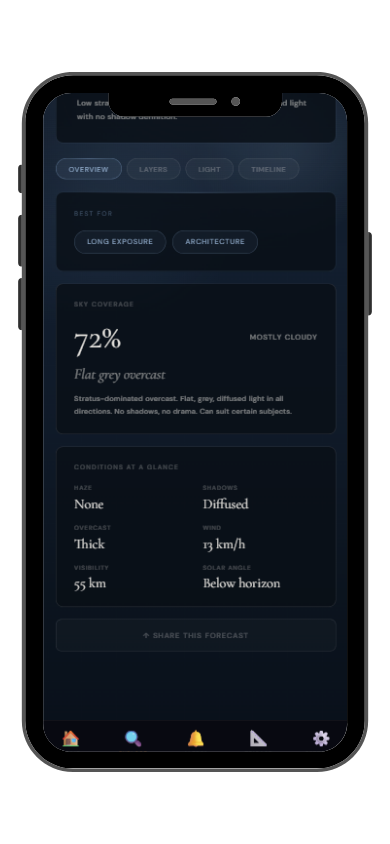
A cloud cover percentage from a standard weather app tells you almost nothing useful for photography. CloudCast separates coverage into low, mid, and high layers and factors in light penetration and atmospheric haze โ€” then scores conditions for your specific shooting target so you know whether today's sky is worth the trip.

๐Ÿ“
App Exclusive
CloudCast is only in the iOS app. It scores cloud conditions by layer for your shooting target. GoldCast and StarCast send push alerts when golden hour or night sky conditions look strong โ€” all six tools in one place.
Common Questions
What are the best conditions for cloud photography?
It depends on your subject. Broken altocumulus for golden hour. Stratus for portraits and macro. Cumulonimbus for dramatic skies. Cumulus for light-and-shadow landscape. LightCast CloudCast scores today's conditions by shooting target โ€” app exclusive, free to try in the iOS app.
What cloud type is most photogenic?
Depends on the shoot. Cumulonimbus for dramatic skies, altocumulus for golden hour colour, lenticular for mountain landscapes, stratus for even diffused light. Each cloud type serves a different photographic purpose.
What time of day is best for cloud photography?
Golden hour and the 2โ€“3 hours before sunset for most landscape and sky subjects. Low-angle light creates shadow and texture in cloud formations that flat midday light cannot. Storm photography often peaks in late afternoon when convective activity is highest.
Is overcast good for cloud photography?
For dramatic sky subjects: no. For portraits, macro, and waterfall: full overcast is often ideal โ€” it creates even, diffused light. CloudCast scores the same sky differently based on your specific shooting target.
What is LightCast CloudCast?
CloudCast separates cloud cover into low, mid, and high layers, factors in light penetration and haze, and scores conditions for your shooting target. Exclusive to the LightCast iOS app. $2.99/month after a 7-day free trial.
LightCast
Know what today's sky is actually good for.

Cloud cover by layer ยท Light penetration ยท Score by subject
Saved locations ยท 7-day outlook ยท All tools in one app

Download LightCast for iOS
or
Check today's cloud conditions free on web โ†’

$2.99/mo after 7-day free trial ยท Cancel anytime in App Store