
iOS App Exclusive
LightCast

CloudCast

Cloud Cover Scoring for Photographers

A 60% cloud cover forecast tells you almost nothing useful. CloudCast breaks cloud down by altitude layer, factors in light penetration and haze, and scores the sky for your specific shooting target

Try CloudCast Free — iOS App

7-day free trial · then $2.99/mo · Cancel anytime in App Store
Why cloud percentage alone is useless

The Same Sky Is Great for One Shoot and Terrible for Another

60% cloud cover could mean broken mid-level altocumulus — ideal for golden hour. Or it could mean a solid sheet of low stratus — which kills golden hour entirely but is perfect for portraits. A weather app's cloud percentage conflates these completely different situations into one number. CloudCast doesn't.

Cloud layers

Three Altitude Bands, Read Separately

High
20,000+ ft
Cirrus
High Cloud — Drama Without Blocking
Wispy cirrus and cirrostratus spread light across the sky without significantly blocking it. Excellent for golden hour — adds sweeping colour while keeping the horizon clear. Scores high for most shooting targets.
Mid
6,500–20k ft
Altocumulus
Mid Cloud — The Golden Hour Sweet Spot
Altocumulus and altostratus at mid altitude create textured, dramatic skies. 30–70% mid cloud with a clear horizon is the ideal golden hour setup — the cloud acts as a canvas lit from below. Also softens light beautifully for portraits without blocking it entirely.
Low
Under 6,500 ft
Stratus
Low Cloud — Mostly a Penalty
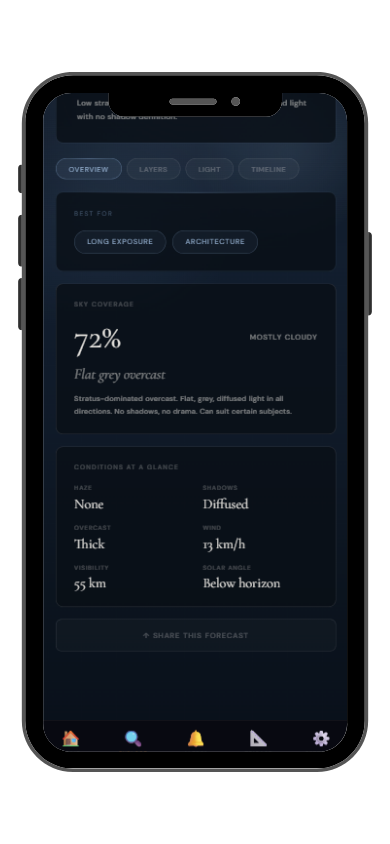
Low stratus and fog block direct sunlight and kill golden hour contrast. Thick low cloud = flat grey sky. The exception: thin low overcast (20–45%) creates the even, shadowless light that portrait and waterfall photographers prefer. CloudCast weights low cloud as a penalty for most targets except portraits.
LightCast CloudCast showing cloud layer breakdown and score by shooting target
What CloudCast measures

Beyond the Layer Breakdown

Light Penetration
Derived from total cloud cover, low cloud weighting, visibility, and humidity. How much usable light is reaching the ground — and through the clouds as texture.
Shadow Strength
Calculated from solar elevation and cloud cover. Hard shadows define structure for architecture and landscapes. Soft or absent shadows are better for portraits and wildlife.
Haze Level
Derived from visibility, humidity, and dew point. High humidity creates atmospheric haze — soft shadows, diffused light, reduced contrast. Can be beautiful for certain subjects, frustrating for others.
Cloud Texture
Wispy cirrus adds drama without blocking. Mid puffs create beautiful diffused light. Low stratus creates flat grey sky. CloudCast identifies the texture type driving the current score.
Six shooting targets

Select Your Target, Get the Right Score

CloudCast adjusts the score based on what you're planning to shoot. The same 60% mid cloud that scores 80 for golden hour might score 45 for astrophotography. Select your target in the app and the score recalculates instantly.

🧍
Portraits
Best: thin to moderate overcast — even, shadow-free light.
Worst: direct overhead sun.
🌄
Landscapes
Best: dramatic texture, high cloud, some directional light.
Worst: flat full overcast.
🦌
Wildlife
Best: bright overcast or thin cloud — even light, no blown highlights.
Worst: harsh midday direct sun.
🌅
Golden Hour
Best: 30–70% mid cloud, clear horizon.
Worst: solid low stratus or totally clear.
💧
Long Exposure
Best: moving cloud, neutral light levels.
Worst: bright direct sun (too much light to expose long).
🏛️
Architecture
Best: partial cloud with directional light — shadow defines form.
Worst: flat overcast.
Part of LightCast Suite

Every Condition Photographers Chase, in One App

CloudCast is one of five tools in LightCast. The same app that scores your cloud cover for portraits can also predict tomorrow morning's fog, score tonight's Milky Way visibility, and tell you if it's too windy to fly your drone.

🌅 GoldCast 🌌 StarCast 🚁 DroneCast 🌫️ FogCast 📐 TriCast
Common Questions
What cloud cover is best for photography?
It depends on your subject. For golden hour: 30–70% broken mid cloud with a clear horizon. For portraits and waterfalls: thin to moderate overcast. For landscapes: dramatic texture with high cloud. For astrophotography: zero cloud at any layer. CloudCast scores the same sky differently for each — available in the LightCast iOS app.
Is overcast good or bad for photography?
For portraits, waterfalls, and forest photography: overcast is excellent. It acts as a giant natural softbox, eliminating harsh shadows and high contrast. For golden hour and landscape photography, it kills sky drama. For astrophotography, it's a hard no. CloudCast tells you what a given sky is actually good for rather than a single verdict.
What is the difference between low, mid, and high cloud for photography?
Low cloud (stratus) blocks direct sunlight and creates flat grey skies — bad for golden hour, acceptable for portraits. Mid cloud (altocumulus) is the golden hour sweet spot — textured, dramatic, lit from below during sunrise and sunset. High cloud (cirrus) adds sweeping drama without blocking light. CloudCast reads all three separately rather than combining them into a single percentage.
How do I know if the clouds will be good for sunset tonight?
You need broken mid-level cloud above a clear western horizon, with 30–70% total coverage. CloudCast scores this specifically for golden hour in the iOS app. GoldCast — which includes cloud as part of the full sunset quality score — is free on web at lightcastsuite.com/goldcast.
Is CloudCast free?
CloudCast is exclusive to the LightCast iOS app. The app includes a 7-day free trial, then $2.99/month. GoldCast, StarCast, and DroneCast are free on web at lightcastsuite.com — GoldCast includes cloud scoring as part of the full sunset quality forecast.
LightCast
Know what the sky is actually good for.

Cloud by layer · Light penetration · Shadow strength · Haze
Six shooting targets · Push notifications · Saved locations

Try CloudCast Free — iOS App

7-day free trial · $2.99/mo · Cancel anytime in App Store


Cloud scoring is also part of GoldCast — free on web →