FogCast Β· Fog Season Guide
LightCast

Best Time of Year for Fog Photography

Fog photography has seasons. Fall is peak for most of the US, but the window varies by region and terrain. LightCast FogCast scores formation probability and burn-off timing year-round for your location.

Check Fog Probability β€” iOS App Learn More β†’

iOS app: $2.99/mo Β· 7-day free trial Β· Cancel anytime

Season by season

When Radiation Fog Is Most Likely to Form

Radiation fog needs a specific setup: warm, moist surface air cooling rapidly overnight to the dew point. The seasons that produce this most reliably are the ones where surface temperatures are still warm from recent heat while overnight air temperatures are falling fast. That transition window is what fog photographers should be targeting.

πŸ‚
Fall: Peak Season (September–November)
The most reliable fog season across most of the US interior. Nights cool rapidly while soil retains summer warmth, creating strong radiative cooling setups. Increasing precipitation raises surface moisture, lowering the bar for dew point convergence. Morning sun angle is strong enough to produce dramatic burn-off rather than all-day grey.
❄️
Winter: Persistent Valley Fog
Dense, persistent valley fog is more common in winter, particularly in California's Central Valley, the Willamette Valley, and enclosed mountain basins. Tule fog in California can persist for days under strong inversions. Burn-off is slower in winter due to low sun angle, which means the photogenic thinning window can last longer but also extends later into the morning.
🌸
Spring: Secondary Season
Less reliable than fall in most regions because cold soil from winter reduces the surface warmth needed for strong radiative setups. Best in areas with significant snowmelt moisture: mountain valleys, the upper Midwest, and river corridors where saturated ground raises near-surface humidity through May and June.
β˜€οΈ
Summer: Coastal and Marine Fog
Interior radiation fog is least common in summer β€” nights don't cool enough for most inland locations. The exception is coastal regions, particularly the California coast, Pacific Northwest, and New England, where cold ocean upwelling creates marine layer fog that rolls in overnight and burns off through the morning most days from June through August.
LightCast FogCast
Beyond season

The 48-Hour Setup Matters More Than the Calendar

Season sets the baseline probability, but the specific 48-hour weather pattern determines whether fog actually forms on a given morning. Rain 24 to 48 hours prior, followed by clearing skies and calm overnight wind, is the classic setup that produces the most photogenic fog regardless of month. FogCast monitors the exact variables β€” dew point depression, overnight wind, sky coverage, recent precipitation, and terrain β€” and scores each morning independently so you know which days are worth the alarm.

πŸ“
App Exclusive
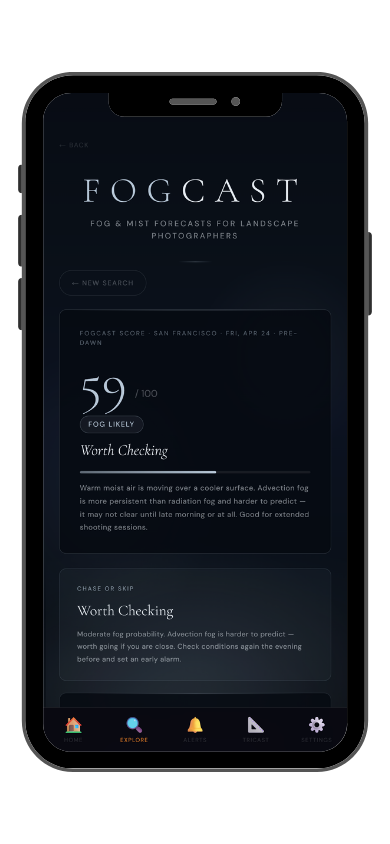
FogCast is only available in the iOS app. It includes a 7-day fog outlook, saved locations, and formation and burn-off timing updated daily. GoldCast and StarCast send push alerts when golden hour or night sky conditions hit your threshold β€” one app covers every type of shoot.
Common Questions
What is the best time of year for fog photography?
Fall, specifically September through November across most of the US interior. Rapidly cooling nights combined with warm residual soil moisture produce the most frequent and photogenic radiation fog setups. FogCast tracks probability daily regardless of season β€” available in the LightCast iOS app.
Is spring or fall better for fog?
Fall is more reliable for most of the US. Spring soil is still cold from winter, which reduces the surface warmth needed for strong radiation fog setups. The exception is mountain valleys and snowmelt regions where saturated ground raises spring humidity significantly.
Where is summer fog most common?
Coastal regions: the California coast, Pacific Northwest, and New England. Cold ocean upwelling creates marine layer fog that rolls in overnight and burns off through the morning from June through August. Interior locations rarely see radiation fog in summer because nights don't cool enough.
What weather pattern produces the best fog for photography?
Rain 24 to 48 hours prior, followed by clearing skies and calm overnight wind. The precipitation raises surface moisture, the clear sky allows radiative cooling, and the calm wind lets fog build density rather than mix away. FogCast identifies this setup automatically and scores the morning probability.
What is LightCast FogCast?
FogCast scores fog formation probability using dew point depression, overnight wind, humidity, sky coverage, terrain, and recent precipitation for any location. Includes formation and burn-off timing. Exclusive to the LightCast iOS app. $2.99/month after a 7-day free trial.
LightCast
Know when fog season peaks at your location.

Daily fog probability Β· Formation & burn-off timing Β· 7-day outlook
Terrain-aware Β· Saved locations Β· All tools in one app

Download LightCast for iOS
or
Learn More β†’

$2.99/mo after 7-day free trial Β· Cancel anytime in App Store