FogCast · Fog Location Guide

LightCast

How to Find Fog for Photography

Fog forms in predictable terrain under predictable conditions. Here's how to read both so you're positioned in the right place before the light arrives. LightCast FogCast scores probability for any location.

Check Fog Conditions — iOS App Check fog probability free on web →

iOS app: $2.99/mo · 7-day free trial · Cancel anytime
Where fog forms

Cold Air Drains Downhill

Fog doesn't form randomly. Cold air is denser than warm air and drains into the lowest points of the landscape overnight. Wherever cold air pools, fog concentrates. Understanding this one principle is enough to identify likely fog terrain without any forecast tools.

🏔️
Valleys and River Corridors
The classic fog trap. Cold air from surrounding slopes drains into the valley floor overnight. River corridors add moisture from evaporation which raises baseline humidity. The combination of cold air pooling and elevated moisture makes river valleys the most reliable fog locations in most regions. Think: Yosemite Valley, the Palouse, the Smokies, any agricultural river bottom.
🌊
Lakes and Reservoirs
Water bodies release moisture as the surface cools overnight. Morning mist rising off a still lake is one of the most reliable fog photography setups available. The mist is often lower and more patchy than valley radiation fog — excellent for minimalist compositions with water and mist at the frame edge.
🌾
Farmland and Agricultural Basins
Irrigated farmland has high soil moisture, which increases overnight evaporation and raises baseline humidity. Agricultural valleys are among the most fog-prone terrain in the US — California's Central Valley, the Willamette Valley in Oregon, and the Appalachian valleys in Virginia and Tennessee all produce dense radiation fog consistently through autumn and winter.
🏙️
Ridges Above the Fog
If you know a valley is likely to fog, position yourself on the ridge above it. A 200–500 foot elevation gain can put you above the fog ceiling, looking down at a sea of cloud with peaks and structures emerging. This is a completely different composition from being inside the fog — often more dramatic and easier to photograph cleanly.
LightCast FogCast
When fog will form tonight

Reading the Forecast Setup

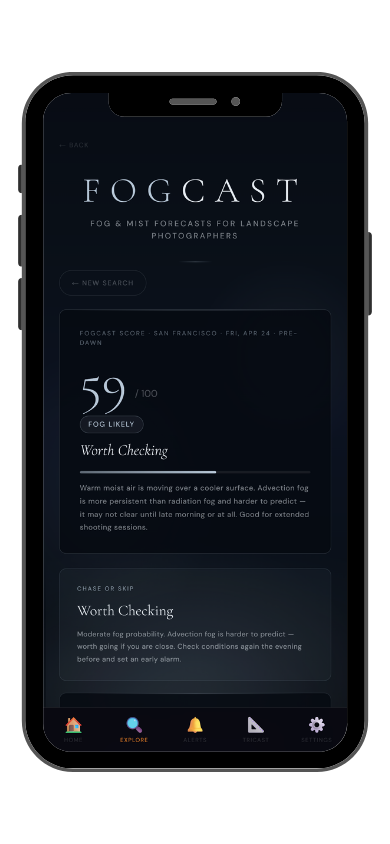
Once you know the terrain that produces fog near you, the next step is identifying which nights will actually deliver. FogCast checks dew point depression, overnight humidity, wind speed, and sky coverage — the four variables that determine whether fog forms — and scores probability for your specific location.

📍
App Exclusive
FogCast is only in the iOS app. It scores fog formation probability and estimates burn-off timing so you know whether to set the alarm. GoldCast and StarCast also send push alerts when their respective conditions look strong — one app for the full forecast workflow.
Common Questions
How do you find fog for photography?
Look for low-lying terrain near water: river valleys, lake shores, agricultural basins. Then check FogCast for probability — it scores dew point depression, humidity, wind, and sky coverage together. LightCast FogCast is exclusive to the iOS app.
What terrain produces the most fog?
Valleys and river corridors where cold air pools overnight. Areas near water add moisture that raises baseline humidity. Ridges 200–500 feet above fog-prone valleys give above-the-fog compositions when conditions are right.
Can you predict fog the night before?
Yes, with reasonable accuracy. Dew point, overnight humidity, wind speed, and sky coverage can be assessed the evening before. FogCast scores all four variables and gives a probability score so you can make a go/no-go decision without cross-referencing multiple forecasts.
What time should I arrive for fog photography?
Before sunrise. Be on location at first light — fog is densest in the pre-dawn hour and the burn-off window (30–90 minutes after sunrise) is the most photogenic phase. Arriving after sunrise means you've already missed setup and may be chasing the end of the window.
What is LightCast FogCast?
FogCast scores fog formation probability using dew point depression, humidity, overnight wind, and sky coverage for any location. Includes formation window and burn-off timing estimates. Exclusive to the LightCast iOS app. $2.99/month after a 7-day free trial.
LightCast
Know which mornings are worth the alarm.

Fog probability · Formation window · Burn-off timing
Dew point · Humidity · All tools in one app

Download LightCast for iOS
or
Check fog probability free on web →

$2.99/mo after 7-day free trial · Cancel anytime in App Store