LightCast ยท Photography Forecast Guide
LightCast

How to Read a Weather Forecast for Photography

Temperature and precipitation are almost irrelevant. Cloud altitude, humidity, and transparency are what actually matter. Here's how photographers read a forecast differently.

Get Photography-Specific Forecasts โ€” iOS App Explore all LightCast tools free on web โ†’

iOS app: $2.99/mo ยท 7-day free trial ยท Cancel anytime

What to ignore and what to focus on

Reading a Forecast as a Photographer

Most weather apps are designed for people deciding whether to wear a coat. The variables they emphasise โ€” temperature, rain chance, UV index โ€” are largely irrelevant for photography decisions. The variables that matter are almost always buried or absent entirely.

โ˜๏ธ
Cloud Cover: Look for Altitude, Not Just Percentage
A cloud cover percentage is almost useless without altitude. 40% low stratus is a washed-out sky. 40% mid altocumulus with a clear horizon is a great sunset setup. When reading any forecast, try to find cloud base height or cloud type โ€” if the app doesn't show it, the percentage alone should be treated with skepticism.
๐Ÿ’ง
Humidity and Dew Point: Critical for Multiple Tools
Low humidity means better transparency for night sky, crisper colour saturation for sunset, and less risk of lens fogging during overnight shoots. When air temperature approaches dew point (small dew point depression), fog forms and lenses fog over. High humidity is a red flag for astrophotography and a green flag for fog photography.
๐ŸŒฌ๏ธ
Wind: Sustained vs Gusts Matter Differently
For drone pilots, gusts matter more than sustained wind. For long exposure photographers, any wind above about 15 mph can cause camera shake even on a heavy tripod. For fog formation, wind above 5 mph prevents fog entirely. Check gust data specifically, not just sustained speed.
๐Ÿ”†
Pressure Trends: The Shortcut Signal
Rising pressure after a frontal passage almost always means improving transparency, clearing cloud, and calming wind. A rising barometer the day before a shoot is one of the best single indicators of good conditions โ€” for golden hour, night sky, and drone photography alike. Falling pressure signals the opposite.
By photography type

What to Check for Each Kind of Shoot

Sunset / Golden Hour
Cloud altitude and horizon clarity. Humidity under 60%. Rising pressure. GoldCast โ†’
Night Sky
Moon phase and position. Cloud cover overnight. Transparency. Bortle class. StarCast โ†’
Drone
Wind speed and gusts separately. Precipitation. Visibility. Temperature. DroneCast โ†’
Fog
Dew point depression overnight. Wind under 5 mph. Clear sky for radiative cooling. FogCast โ†’
LightCast
๐Ÿ“
LightCast Does the Reading For You
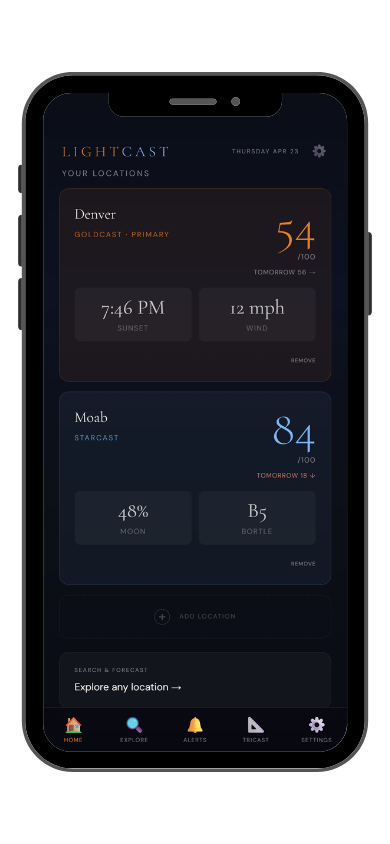
Each LightCast tool translates the relevant forecast variables into a single photography-specific score. GoldCast and StarCast send push alerts when conditions hit your threshold โ€” so you don't have to manually interpret a forecast every day.
Common Questions
How do you read a weather forecast for photography?
Focus on cloud altitude and coverage by layer, humidity and dew point, wind speed and gusts, and pressure trends. Ignore temperature, UV index, and daily high/low โ€” they're irrelevant for most photography decisions. LightCast translates these into tool-specific scores โ€” free on the web or in the iOS app.
What does cloud cover percentage actually mean?
Very little without altitude. 40% low stratus blocks all direct light. 40% mid-level altocumulus with a clear horizon is the ideal sunset setup. Always try to find cloud type or base height alongside the percentage. LightCast CloudCast separates coverage by layer.
What is a good humidity level for photography?
For night sky: below 50% for best transparency. For sunset colour: below 60%. For fog photography: above 90% overnight. Dew point depression โ€” the gap between air temperature and dew point โ€” is more useful than relative humidity alone for predicting fog formation and lens fogging risk.
What does rising pressure mean for photography?
Rising pressure after a frontal passage almost always means improving transparency, clearing cloud, and calming wind โ€” good conditions for golden hour, night sky, and drone photography. A rising barometer the day before a shoot is one of the best single forecast signals available.
What is LightCast?
LightCast is a suite of six photography weather tools: GoldCast (sunset and golden hour), StarCast (night sky), DroneCast (drone flight), CloudCast (cloud conditions), FogCast (fog prediction), and TriCast (camera calculators). Each translates the relevant forecast variables into a single score. Free on web at lightcastsuite.com, with push notifications in the iOS app. $2.99/month after a 7-day free trial.
LightCast
Stop interpreting forecasts. Start shooting.

Photography-specific scores ยท Push notifications ยท 6 tools in one app
Sunset ยท Night sky ยท Drone ยท Fog ยท Cloud ยท Camera calculators

Download LightCast for iOS
or
Explore all tools free on web โ†’

$2.99/mo after 7-day free trial ยท Cancel anytime in App Store