FogCast ยท Fog Timing Guide
LightCast

What Is Fog Burn-Off Time?

Burn-off is the most photogenic window of the morning: fog thinning, patches separating, light filtering through. LightCast FogCast estimates when that window opens for your location.

Check Fog Timing โ€” iOS App Learn More โ†’

iOS app: $2.99/mo ยท 7-day free trial ยท Cancel anytime

Why burn-off is worth waking up for

The 20-Minute Window Most Photographers Miss

Full fog before sunrise is photogenic in a moody, low-contrast way. Clear sky after burn-off is just a normal morning. The window in between โ€” when fog is thinning, patches are separating, and early sunlight starts filtering through from above โ€” is one of the most sought-after light conditions in landscape photography, and it typically lasts 20 to 45 minutes. Knowing when it opens is the whole point.

โ˜€๏ธ
Solar Angle: The Primary Driver
Burn-off begins when solar heating warms the surface enough to evaporate fog droplets. Summer sun burns fog faster than low winter sun: the higher solar angle delivers more energy per unit of surface area. Typical burn-off starts 45 to 90 minutes after sunrise but varies significantly by season.
๐ŸŒซ๏ธ
Fog Density and Depth
Thin radiation fog that formed in the last hour before dawn burns off quickly after sunrise. Dense valley fog that pooled overnight can hold until mid-morning because the thick layer resists solar heating from above and terrain keeps cold air trapped below. FogCast factors fog density into the burn-off estimate.
๐Ÿ’จ
Wind After Sunrise
Light wind developing after sunrise mixes warmer air into the fog layer and accelerates burn-off significantly. Calm conditions after sunrise let fog persist longer but also produce the most dramatic patchy layering during the burn-off phase. Both are worth shooting for different reasons.
โ˜๏ธ
Cloud Cover Above the Fog
If a cloud layer sits above the fog after sunrise, it shades the surface and reduces solar heating. Fog under an overcast layer can persist for hours past a time when it would normally burn off on a clear day. FogCast checks upper-level cloud coverage as part of its burn-off timing model.
LightCast FogCast
How to use the timing

Formation Time, Burn-Off Time, and When to Arrive

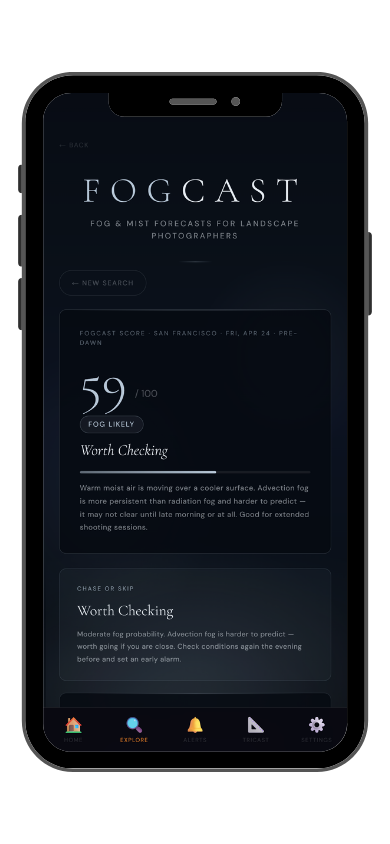
Arriving at your location after fog has already lifted means you missed the window. Arriving before fog forms means a long wait in the dark. The ideal arrival is just before the formation window closes and at least 20 minutes before estimated burn-off, so you're set up and ready when the light changes. FogCast shows both times so you can plan the drive.

๐Ÿ“
App Exclusive
FogCast is only available in the iOS app. It includes a 7-day fog outlook, saved locations, and formation and burn-off timing for each day. GoldCast and StarCast send push alerts when golden hour or night sky conditions hit your threshold โ€” so one app covers every type of shoot.
Common Questions
What time does fog burn off?
Typically 45 to 90 minutes after sunrise for radiation fog over open terrain. Dense valley fog can hold until mid-morning. FogCast estimates burn-off timing based on fog density, solar angle, post-sunrise wind, and upper cloud cover โ€” available in the LightCast iOS app.
Is fog burn-off good for photography?
Yes: it's often the best light of the morning. Thinning, patchy fog with early sunlight filtering through creates layered depth and crepuscular rays that neither full fog nor clear sky can produce. The window is short, typically 20 to 45 minutes, so being on location early is essential.
What makes fog burn off faster?
Strong solar angle (summer), light post-sunrise wind, thin fog density, and a clear sky above the fog layer. Cloud cover above the fog slows burn-off by blocking solar heating. Dense valley fog persists longer than open-terrain radiation fog regardless of conditions.
When should I arrive for fog photography?
Aim to arrive before the formation window closes and at least 20 minutes before estimated burn-off so you're set up when the light changes. FogCast shows both the formation window and the estimated burn-off time so you can calculate your alarm and drive time.
What is LightCast FogCast?
FogCast scores fog formation probability and provides estimated formation and burn-off timing for any location. Uses dew point depression, humidity, overnight wind, sky coverage, and terrain. Exclusive to the LightCast iOS app. $2.99/month after a 7-day free trial.
LightCast
Know when the fog will thin before you set the alarm.

Formation window ยท Burn-off timing ยท Fog probability score
7-day outlook ยท Saved locations ยท All tools in one app

Download LightCast for iOS
or
Learn More โ†’

$2.99/mo after 7-day free trial ยท Cancel anytime in App Store