What the app shows you
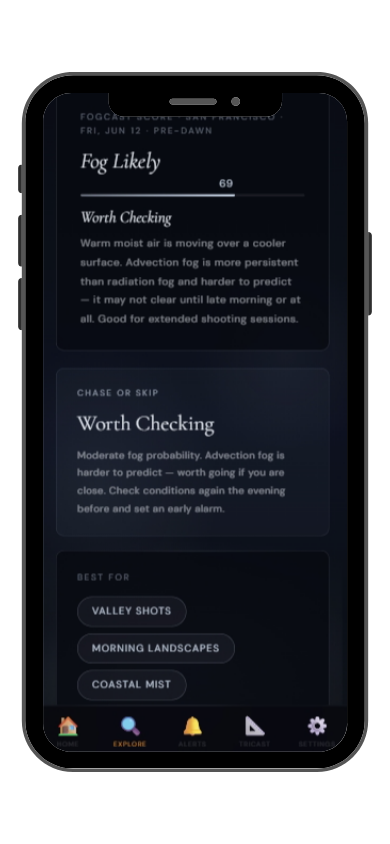

Full FogCast score, fog type, chase-or-skip verdict, and 10-day outlook — all in the app.
Get LightCast Suite on iOS
Know before you drive: FogCast checks the conditions that produce photogenic fog
Get more than a snapshot of current conditions. The LightCast app unlocks everything to plan ahead
Humidity alone isn't enough. Wind alone isn't enough. Cloud cover alone isn't enough. Photogenic valley fog requires several conditions to line up at once, and most weather apps don't read them together.
Set a FogCast threshold once. The app will alert you when conditions at your saved locations look promising, so you're not manually checking at 4am.

Don't waste a sunrise drive. Check FogCast before you leave.
Download on the App StoreArtist Point sits at 1,539 meters at the end of the Mount Baker Highway in the North Cascades, a high alpine saddle between Table Mountain and Huntoon Point with sweeping views of Mount Baker and Mount Shuksan. The location is renowned in Pacific Northwest photography, and fog elevates it to another level entirely — when clouds and mist swirl between the ice-clad peaks and the glaciated ridges disappear and reappear through breaking fog, the resulting light is extraordinary.
Mount Shuksan from Artist Point is the iconic composition, and partial fog between the photographer and the summit adds layers of depth and mystery that clear weather cannot replicate. Table Mountain trail above Artist Point gives elevated views over the fog when the inversion sits at or just above the road level. The late September to mid-October window after first snowfall but before the road closes for winter is the single best period — fresh snow on the peaks, autumn color in the heather, and frequent morning fog events produce conditions that landscape photographers travel from across the world to photograph.
Artist Point fog arrives as upslope mist when moist Pacific air encounters the Cascades and is forced upward, condensing into cloud at the ridge level. It is different from valley radiation fog — it moves, shifts, and breaks constantly rather than sitting stationary. Watch for southwest winds of 15–25 km/h with 850mb temperatures near 5°C; this produces the most dynamic, photogenic cloud-fog interactions at the ridge. Complete overcast usually means no light; broken cloud and fog is the ideal.