FogCast · Great Smoky Mountains, TN
Fog Forecast for the Great Smoky Mountains
Know before you drive: FogCast checks the conditions that produce photogenic fog
Reading current conditions…
Photography Forecasts for Any Location Worldwide
Fog photography at Great Smoky Mountains
The Great Smoky Mountains get their name from the blue-grey mist that rises from the dense forests and fills the valleys year-round. The park is one of the most biodiverse in North America and its heavy tree cover releases moisture continuously, producing the orographic fog and low cloud that gives the mountains their characteristic hazy appearance.
Clingmans Dome is the highest point in the Smokies and on foggy mornings the observation tower rises above a sea of cloud, with ridgelines emerging from the mist in layers. Cades Cove is the most photographed valley, with open meadows and historic structures surrounded by fog-draped treelines at sunrise. The Morton Overlook and Foothills Parkway pullouts offer classic layered ridge compositions.
Fall is the best season, combining peak foliage color with the most reliable morning fog from October through November. Spring also produces consistent fog. The pre-dawn to 9am window is the most productive, before valley fog burns off as temperatures rise.
Other fog photography locations
Why fog is hard to predict
Humidity alone isn't enough. Wind alone isn't enough. Cloud cover alone isn't enough. Photogenic valley fog requires several conditions to line up at once, and most weather apps don't read them together.
Dew Point Depression
When air temperature and dew point converge below 2°C, the air is near saturation. This is the single strongest fog predictor and the first thing FogCast checks.
Wind Speed
Fog needs calm air. Below 5 km/h is ideal. Above 15 km/h, fog disperses before it can pool in the valley. A standard weather app won't flag this combination.
Overnight Sky Clarity
Clear overnight skies let the ground cool rapidly, pushing surface temperatures toward the dew point. Counterintuitively, clouds overnight suppress radiation fog.
Temperature Trend
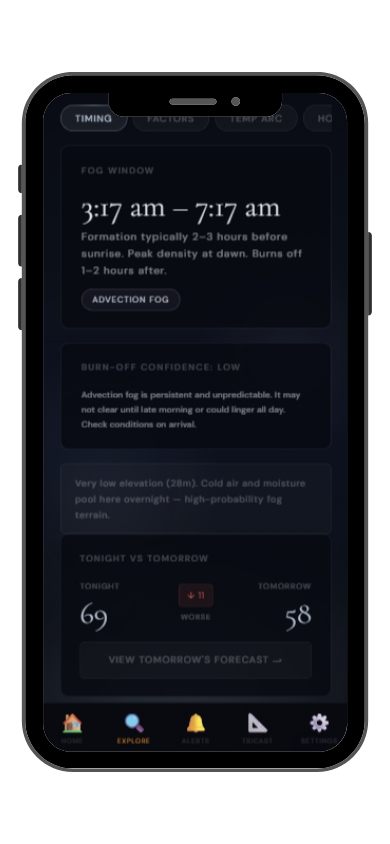
FogCast reads the overnight temperature arc. If temps are converging toward the dew point hour by hour, fog probability increases significantly by pre-dawn.
Check today's FogCast
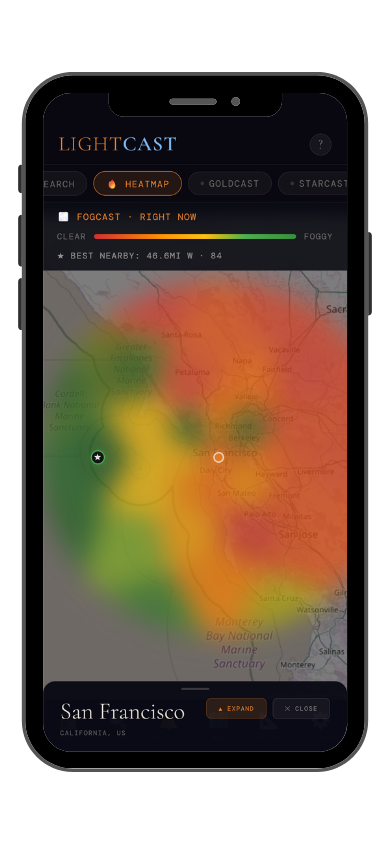
What the app shows you
Set a threshold and get a notifications when fog will form. Never check manually again.
Get LightCast Suite on iOS
Frequently asked
Can I check FogCast on the website?
This page shows a preview of current conditions, including humidity, wind, temperature, and dew point. The full FogCast score, 7-day outlook, push notifications, and best shooting windows are available exclusively in the LightCast app for iOS.
Is FogCast free?
The current conditions preview on this page is free, no account needed. The full FogCast tool is in the LightCast Suite iOS app, which includes a 7-day free trial. After the trial it's $2.99/month, cancel anytime in the App Store.
Why use FogCast instead of checking humidity?
Humidity alone doesn't tell you whether photogenic fog is likely. High humidity with strong wind produces no fog at all. FogCast combines dew point depression, wind speed, overnight sky clarity, temperature trend, and visibility into a single score built specifically for fog photography planning.
What is FogCast's scoring scale?
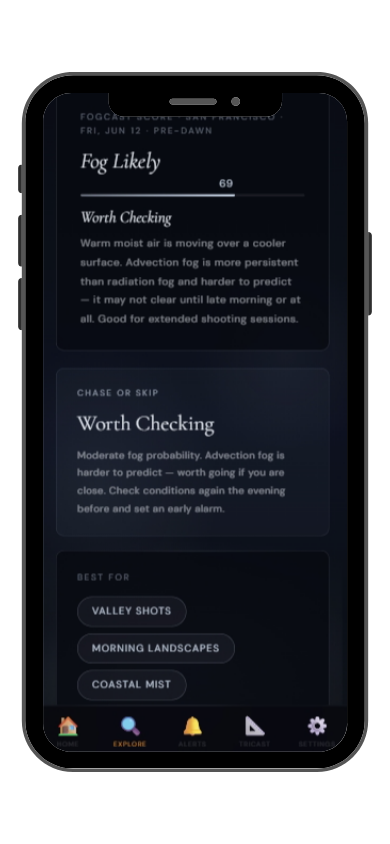
FogCast scores fog conditions from 0 to 100. A score of 75 or above indicates dense fog is expected. 55 to 74 means fog is likely and worth chasing. 35 to 54 suggests patchy mist is possible. Below 35, conditions are unlikely to produce photogenic fog. The full score is available in the LightCast app.