What the app shows you
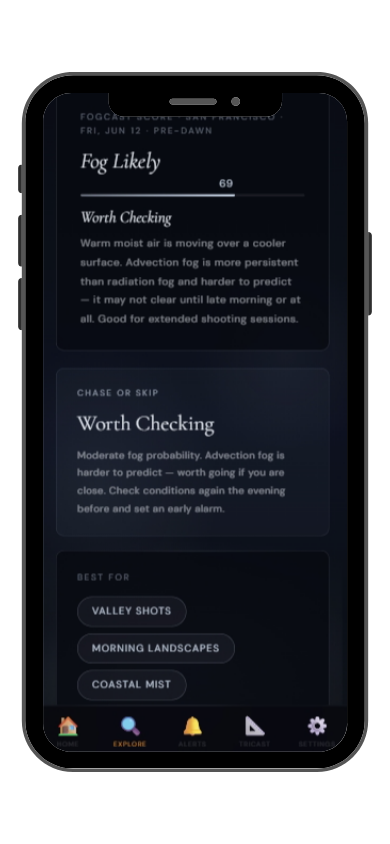
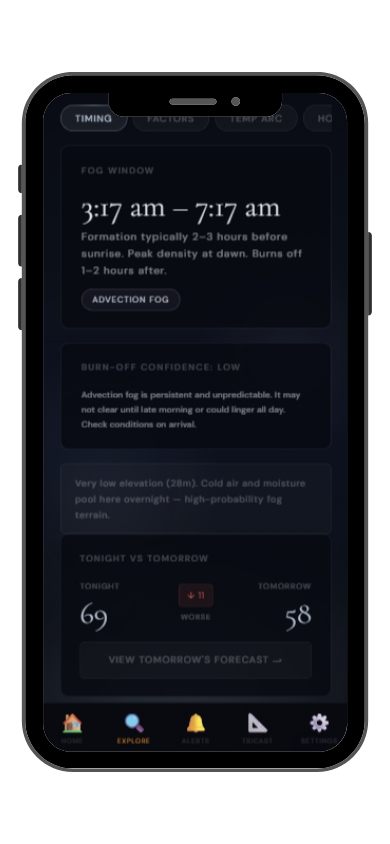
Full FogCast score, fog type, chase-or-skip verdict, and 10-day outlook — all in the app.
Get LightCast Suite on iOS
Know before you drive: FogCast checks the conditions that produce photogenic fog
Get more than a snapshot of current conditions. The LightCast app unlocks everything to plan ahead
Humidity alone isn't enough. Wind alone isn't enough. Cloud cover alone isn't enough. Photogenic valley fog requires several conditions to line up at once, and most weather apps don't read them together.
Set a FogCast threshold once. The app will alert you when conditions at your saved locations look promising, so you're not manually checking at 4am.

Don't waste a sunrise drive. Check FogCast before you leave.
Download on the App StoreDead Horse Point is a mesa-top state park in Utah's canyon country, where a narrow neck of land extends to a point 600 meters above the Colorado River and the Canyonlands basin. The view from the rim takes in one of the deepest and widest canyon perspectives in the American Southwest — the river making an almost complete loop below while the La Sal Mountains rise above the red rock horizon. When fog or low cloud forms in the canyon depths while the mesa rim is clear, the effect is one of the most dramatic inversion photography scenes in the western US.
The main overlook and the east and west rim trails give multiple angles on the canyon below. Canyon fog at Dead Horse Point is a rare but exceptional event — it forms most often in late autumn and winter when cold air drains into the Colorado River canyon overnight and cloud forms at the canyon bottom while the mesa rim at 1,800 meters is above the inversion layer. The fog or cloud glows at sunrise before the sun reaches the canyon floor, and the La Sal Mountains above provide a three-layer composition of snow, mesa, and fog.
Canyon fog in the Moab area forms when cold air pools in the Colorado River valley after clear, cold nights. The canyon is deep enough (600 meters at Dead Horse) that even a shallow fog layer is completely invisible from above until the rim, creating a dramatic reveal effect when approaching the overlook in darkness. Check overnight temperatures at the Moab valley floor — if they drop below 5°C with high humidity and calm winds, dawn fog in the canyon is worth the drive.