What the app shows you
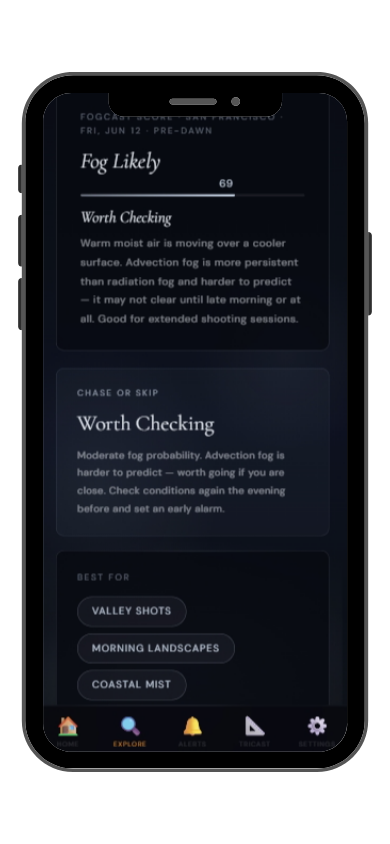

Full FogCast score, fog type, chase-or-skip verdict, and 10-day outlook — all in the app.
Get LightCast Suite on iOS
Know before you drive: FogCast checks the conditions that produce photogenic fog
Get more than a snapshot of current conditions. The LightCast app unlocks everything to plan ahead
Humidity alone isn't enough. Wind alone isn't enough. Cloud cover alone isn't enough. Photogenic valley fog requires several conditions to line up at once, and most weather apps don't read them together.
Set a FogCast threshold once. The app will alert you when conditions at your saved locations look promising, so you're not manually checking at 4am.

Don't waste a sunrise drive. Check FogCast before you leave.
Download on the App StoreMilford Sound is a glacially carved fiord on the southwestern coast of New Zealand's South Island, where vertical walls of granite and rainforest rise up to 1,200 meters directly from the water. It is one of the wettest places on Earth, receiving over 6 meters of rain annually, and this moisture means low cloud, mist, and waterfalls are present on most days. After heavy rain — which can arrive with almost no warning — hundreds of temporary waterfalls pour from every cliff and the fiord fills with mist rising from the water below the cloud base.
The classic view from the entrance to the fiord, with Mitre Peak rising 1,692 meters from the water, is most dramatic when low cloud sits at 400 to 600 meters and partially obscures the upper peak while the waterfall-streaked lower cliffs remain visible. Fog and mist at Milford are most common in the morning before the prevailing westerlies pick up by mid-afternoon. Winter (June through August) brings the heaviest cloud, but the fiord is atmospheric in mist in any season.
Milford Sound fog forecasting is different from most locations because rainfall — not clear skies — is often the trigger. The hours immediately after heavy rain, when the air is saturated and temporary waterfalls are at their peak, produce the most extraordinary conditions. A dropping barometer followed by rain and then partial clearing often delivers the best mixed cloud and mist photography.