What the app shows you
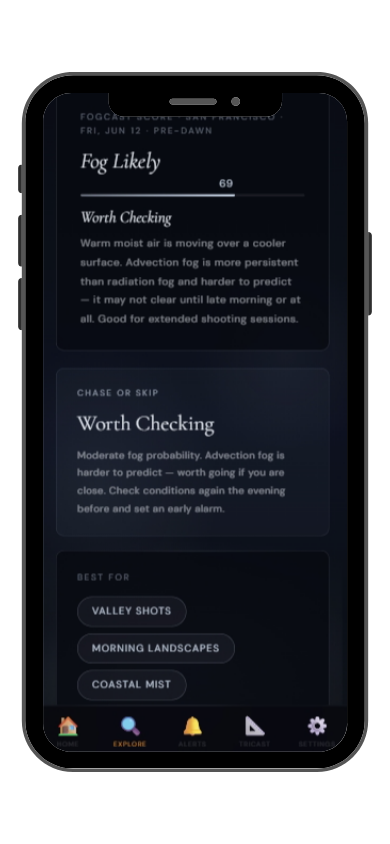
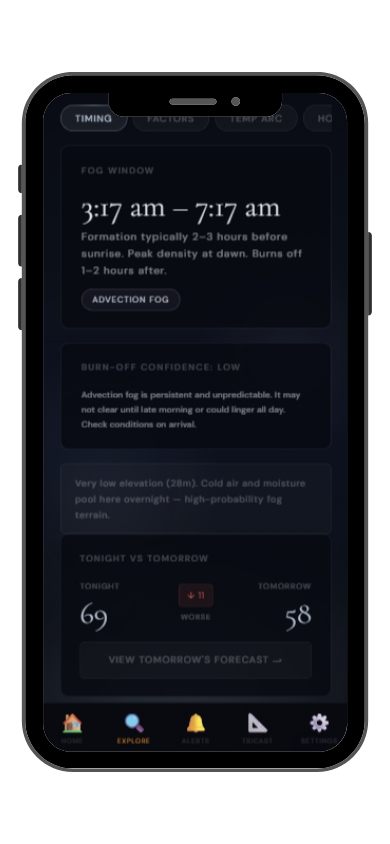
Full FogCast score, fog type, chase-or-skip verdict, and 10-day outlook — all in the app.
Get LightCast Suite on iOS
Know before you drive: FogCast checks the conditions that produce photogenic fog
Get more than a snapshot of current conditions. The LightCast app unlocks everything to plan ahead
Humidity alone isn't enough. Wind alone isn't enough. Cloud cover alone isn't enough. Photogenic valley fog requires several conditions to line up at once, and most weather apps don't read them together.
Set a FogCast threshold once. The app will alert you when conditions at your saved locations look promising, so you're not manually checking at 4am.

Don't waste a sunrise drive. Check FogCast before you leave.
Download on the App StoreMount Fuji is Japan's highest peak at 3,776 meters and one of the most photographed mountains in the world — a nearly symmetrical volcanic cone rising above the Fuji Five Lakes basin to the north and the Suruga Bay coast to the south. Morning fog over Lake Kawaguchiko, Lake Yamanakako, and Lake Motosu with Fuji rising above is an iconic Japanese landscape image. The lakes sit at roughly 830 to 980 meters, and when radiation fog forms on the still water at dawn and the mountain above is clear, the reflection of the summit in the fog-edged water is one of the most extraordinary photography compositions in Asia.
Kawaguchiko's northern shore, particularly around the Chureito Pagoda and the Kawaguchiko Music Forest area, provides classic compositions with Fuji above the fog-covered lake. Lake Motosu gives the widest views and is the location of the image on the Japanese 1,000-yen note. Autumn, October through December, is the prime fog season at the Fuji Five Lakes. The clearest Fuji views combined with lake fog occur after typhoon season ends and cold fronts begin bringing dry, transparent air from the northwest.
Fuji lake fog forms on calm, clear autumn nights when cold air drains from the surrounding highland terrain and chills the lake surfaces. Morning fog on the lakes is most reliably present between 5 and 7am before solar heating disperses it. The highest probability of both fog and a clear Fuji summit — the two don't always coincide — is during the October to November transition when overnight temperatures are dropping but daytime convection hasn't yet eliminated the fog.