What the app shows you
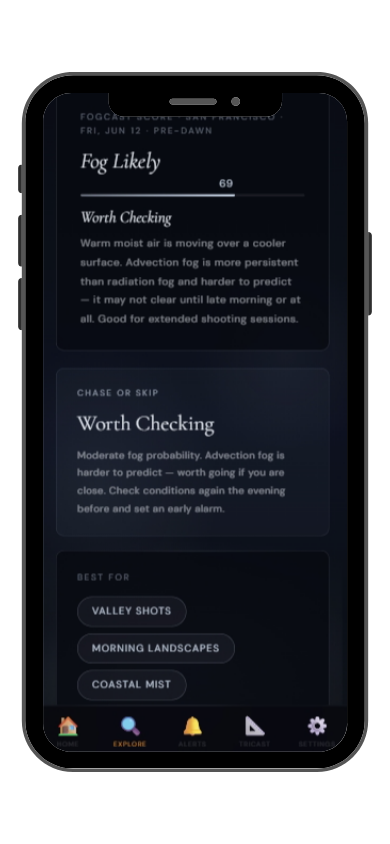

Full FogCast score, fog type, chase-or-skip verdict, and 10-day outlook — all in the app.
Get LightCast Suite on iOS
Know before you drive: FogCast checks the conditions that produce photogenic fog
Get more than a snapshot of current conditions. The LightCast app unlocks everything to plan ahead
Humidity alone isn't enough. Wind alone isn't enough. Cloud cover alone isn't enough. Photogenic valley fog requires several conditions to line up at once, and most weather apps don't read them together.
Set a FogCast threshold once. The app will alert you when conditions at your saved locations look promising, so you're not manually checking at 4am.

Don't waste a sunrise drive. Check FogCast before you leave.
Download on the App StoreMount Shasta is an isolated 4,322-meter stratovolcano in northern California that rises dramatically from the surrounding valley floor, visible for over 150 kilometers on clear days. The Shasta Valley to the north and the wide flats of the upper Sacramento River watershed to the south are both prone to radiation fog in autumn and winter, and when valley fog fills to the 1,500-meter level and only the upper cone of Shasta is visible above, the effect of the volcano emerging from a white sea is extraordinary.
The most reliable fog photography positions are on Highway 89 north of McCloud and the roads above the valley floor on the mountain's lower slopes, where elevation gives a perspective above the fog layer. When the Shasta Valley fog is at its densest, the forested lower slopes disappear and only the snowcapped upper mountain is visible. October through December is the strongest fog season as the Sacramento Valley fog machine begins operating and northern California valleys fill with tule fog.
Mount Shasta fog is primarily tule-type valley fog — the same radiation fog that blankets the Central Valley — pushing north into the Shasta Valley basin under stable high-pressure conditions. Clear, cold nights following wet periods are the best trigger. If dew point depression is under 2°C by midnight with calm winds, the valley floors around Shasta are likely to fill with dense fog by 4 to 5am.