What the app shows you
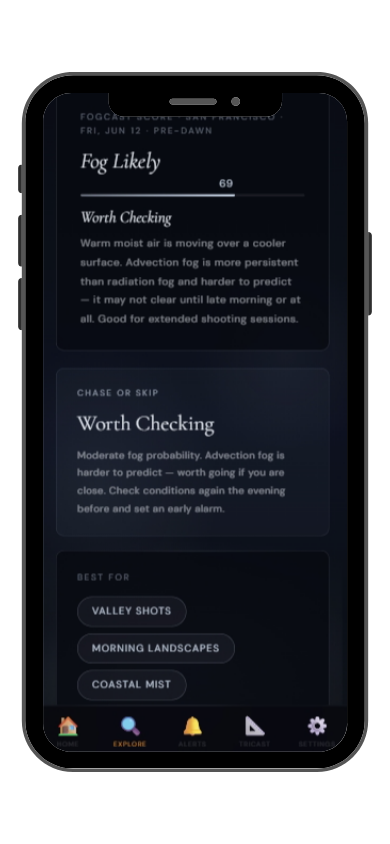

Full FogCast score, fog type, chase-or-skip verdict, and 10-day outlook — all in the app.
Get LightCast Suite on iOS
Know before you drive: FogCast checks the conditions that produce photogenic fog
Get more than a snapshot of current conditions. The LightCast app unlocks everything to plan ahead
Humidity alone isn't enough. Wind alone isn't enough. Cloud cover alone isn't enough. Photogenic valley fog requires several conditions to line up at once, and most weather apps don't read them together.
Set a FogCast threshold once. The app will alert you when conditions at your saved locations look promising, so you're not manually checking at 4am.

Don't waste a sunrise drive. Check FogCast before you leave.
Download on the App StorePigeon Point Lighthouse stands 35 meters tall on a rocky headland south of Half Moon Bay, making it one of the tallest lighthouses on the West Coast and one of the most photogenic fog subjects in California. Built in 1872, the white tower rising out of coastal fog against a gray Pacific sky is a composition that has defined coastal California photography for generations. The point juts out into the Pacific without protection, placing it squarely in the marine layer's path.
The lighthouse itself from the south bluff is the primary composition, with the rocky shore and surge channel in the foreground when fog softens the background. The fog horn building and keeper's quarters add architectural complexity to wider shots. On the thickest mornings, only the lighthouse beam is visible through the fog. The tide pools at the base of the point offer close foreground elements when fog is light and diffuse. May through August is peak season; the lighthouse was operated historically because of the fog danger to ships, and that fog is just as reliable today.
Pigeon Point fog forms when the California marine layer deepens to 200 meters or more and moves onshore overnight. The point's exposed headland position means fog arrives and clears earlier than sheltered bay locations. A westerly wind of 10–20 km/h is ideal — enough to push the marine layer onshore but not so strong it tears the fog apart. Watch for the sea breeze to shift onshore in the late evening as a signal for a foggy dawn.