What the app shows you
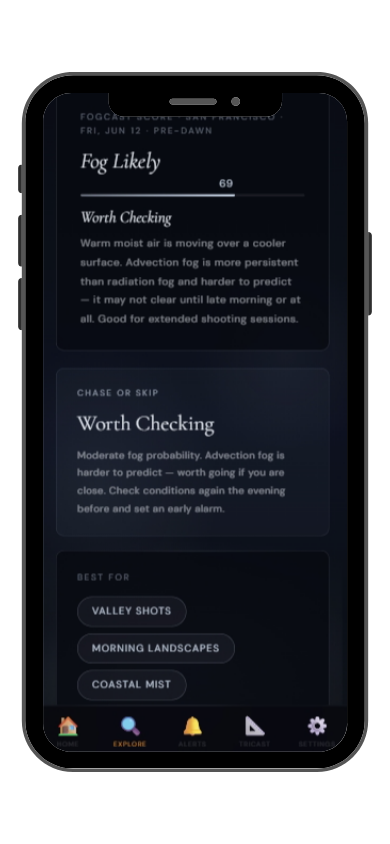
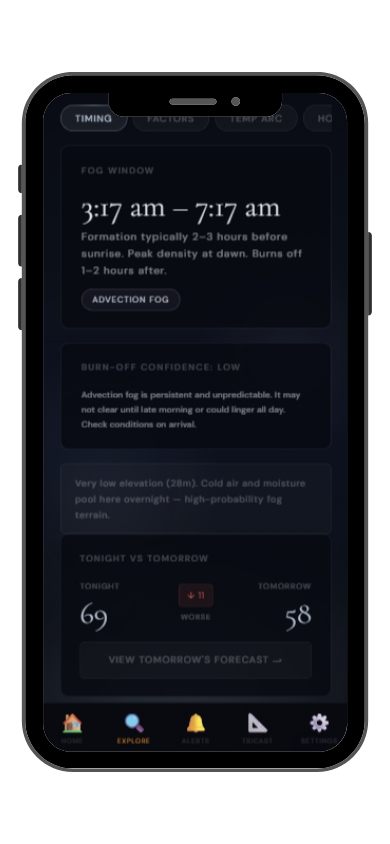
Full FogCast score, fog type, chase-or-skip verdict, and 10-day outlook — all in the app.
Get LightCast Suite on iOS
Know before you drive: FogCast checks the conditions that produce photogenic fog
Get more than a snapshot of current conditions. The LightCast app unlocks everything to plan ahead
Humidity alone isn't enough. Wind alone isn't enough. Cloud cover alone isn't enough. Photogenic valley fog requires several conditions to line up at once, and most weather apps don't read them together.
Set a FogCast threshold once. The app will alert you when conditions at your saved locations look promising, so you're not manually checking at 4am.

Don't waste a sunrise drive. Check FogCast before you leave.
Download on the App StoreRuby Beach on the Washington coast in Olympic National Park is one of the most photographed beaches in the Pacific Northwest — a wide cobble and driftwood beach studded with dramatic sea stacks and offshore seastacks that disappear into the Pacific fog with haunting regularity. The Hoh River reaches the ocean just north of Ruby Beach, and the combination of river mouth, sea stacks, massive bleached driftwood logs, and coastal fog creates a landscape of unusual visual richness.
The sea stacks and offshore rocks are the primary subjects — Destruction Island lighthouse is occasionally visible far offshore in partial fog when the marine layer is thin. The massive driftwood piles above the high tide line provide strong geometric foreground elements against foggy sea stacks. Abbey Island, directly offshore, is the largest and most photogenic sea stack, disappearing and reappearing through fog with dramatic effect. May through August is the reliable marine fog season; fall and winter bring storm light that is also exceptional though fog is less predictable then.
Ruby Beach fog is Pacific maritime marine layer moving onshore from the west and northwest. The beach's full western exposure means there are no barriers between the photographers and the open Pacific fog bank. When the marine layer is 150–300 meters deep and onshore winds are 10–20 km/h, fog is dense on the beach from pre-dawn through mid-morning. Early morning low tide combined with fog is the ideal condition — the tidal pools and kelp reflect fog-diffused sky light beautifully.