What the app shows you
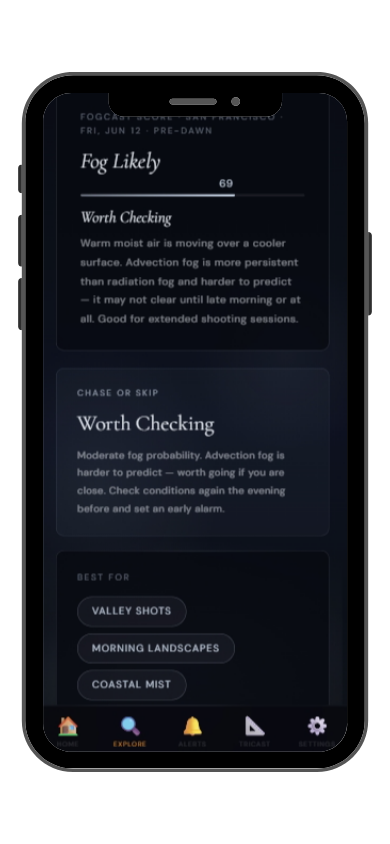

Full FogCast score, fog type, chase-or-skip verdict, and 10-day outlook — all in the app.
Get LightCast Suite on iOS
Know before you drive: FogCast checks the conditions that produce photogenic fog
Get more than a snapshot of current conditions. The LightCast app unlocks everything to plan ahead
Humidity alone isn't enough. Wind alone isn't enough. Cloud cover alone isn't enough. Photogenic valley fog requires several conditions to line up at once, and most weather apps don't read them together.
Set a FogCast threshold once. The app will alert you when conditions at your saved locations look promising, so you're not manually checking at 4am.

Don't waste a sunrise drive. Check FogCast before you leave.
Download on the App StoreSequoia National Park occupies the western slope of the Sierra Nevada between 500 and 4,400 meters, a range that places it squarely in the path of marine air masses moving inland from the San Joaquin Valley. The valley below fills with tule fog in autumn and winter, and on the right mornings that fog climbs the foothills and floods the lower elevations of the park, leaving the giant sequoias standing above a white sea while the upper ridges remain perfectly clear.
The Giant Forest area around 2,000 meters is the most photogenic fog zone — when inversion layers settle at that elevation, the massive sequoia trunks rise out of mist in ways that are nearly impossible to capture any other time of year. Moro Rock offers a commanding above-fog vantage point, and Tunnel Log is a surreal fog subject when the temperature differential produces a ground-level drift. The best fog window runs from November through February, coinciding with the deepest tule fog episodes in the Central Valley.
Sequoia fog is driven by temperature inversions from the valley floor. Cold, dense air pools below 1,500 meters while warmer air sits above. When the inversion is strong and winds are calm overnight, fog climbs through the lower park by pre-dawn. A clear overnight sky is critical — cloud cover breaks the inversion and prevents fog formation.